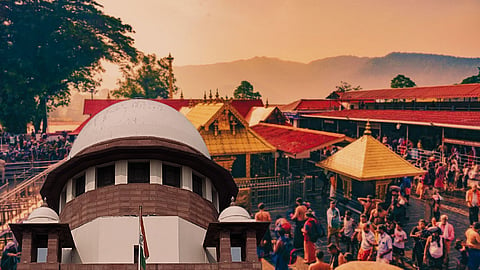

OVER TWO DAYS, April 21 and 22, the nine-judge Constitution Bench led by Chief Justice Surya Kant continued hearing arguments on the Sabarimala reference, with the Review Petitioners completing their submissions. Senior Advocates V. Giri, Gopal Sankaranarayanan, J. Sai Deepak, Aryama Sundaram, Gopal Subramanium, Rakesh Dwivedi, Mukul Rohatgi and Neeraj Kishan Kaul addressed the Court.
The hearings majorly moved across three interlocking issues: the relationship between Articles 25 and 26, the meaning of ‘religious denomination’ and the question of temple entry, and whether ‘morality’ in the two provisions can accommodate constitutional morality as an independent doctrine of judicial review.
Previously, the Review Petitioners and the Union government had argued over how Articles 25 and 26 inter-operate, with Senior Advocate Singhvi contending that constitutional morality is too vague and dangerous a standard to apply to religious rights, and Senior Advocate Dhavan urging that the Essential Religious Practices doctrine is conceptually unworkable and should not serve as a threshold test to deny constitutional protection. Read our other reports here and here.
Are Articles 25 and 26 distinct?
The central structural question, whether Article 26 is controlled by Article 25(2)(b), or whether it stands independently, produced the sharpest arguments.
Senior Advocate V. Giri argued that the right under Article 25(1) is not a free-standing guarantee of temple entry but one to be exercised in conformity with the characteristics of the deity being worshipped. A devotee who approaches a temple subjugates himself to the divine spirit, and it is not open to him to assert his right in a manner “antagonistic” to the defining features of that deity.
Justice Ahsanuddin Amanullah pressed upon this with force, and asked whether the Constitution must come to the rescue of a genuine believer who is permanently barred from touching the deity purely on account of birth, something over which he has no control. Giri accepted that a disqualification resting solely on birth would not be constitutionally valid. Justice M.M. Sundresh observed that such a situation would fall within Article 25(2)(b) as a matter of social reform, while Justice B.V. Nagarathna clarified that Agamic qualifications for ritual performance stand on a different footing from untouchability and must be understood within the framework of the practice itself.
Senior Advocate Gopal Sankaranarayanan argued that when Article 25(1) says it is subject to “other provisions of this part,” the provisions intended are those that operate horizontally by binding private actors, and not just the State. In his reading, these are Articles 15(2), 17, 23, and 24. Article 26, he explained, is not controlled by Article 25 at all. A denomination can never use Article 26 to exclude those whom Article 17 protects, but that result flows from the ‘morality’ exception within Article 26 itself and not from any subordination of 26 to 25(2)(b).
Going further, Senior Advocate J. Sai Deepak argued that Article 25(2) was designed only as a proviso on Article 25(1) and cannot be stretched to curtail Article 26. The collective denominational right was deliberately carved out of Article 25(1) precisely so that it would not be fettered by the restrictions applicable to the individual right. The conspicuous absence of “subject to other provisions of this part” in Article 26 was, he submitted, controlling.
Chief Justice Surya Kant asked who would review State action restricting a religious practice if not the courts, adding that “to say there is no power at all may also be a very difficult proposition.” Deepak clarified that State action remains reviewable, but the practices themselves cannot be evaluated directly or indirectly.
Taking a contrary position, Senior Advocate Gopal Subramanium argued that Article 26 cannot have a “sui generis existence” without walking through the gate of Article 25. A denomination is constituted through individuals, and inside an institution, members exercise Article 25(1) rights. Justice Sundresh observed that the freedom under Article 26 is therefore not entirely divorced from the rights actually exercised by members. Subramanium also submitted that the word “manage” in Article 26(b) is wide enough to include internal debates and discussions within a denomination and this need not be located in Article 19(1)(c).
In the hearings today, taking a middle ground, Senior Advocate Aryama Sundaram argued that Articles 25 and 26 must be read together, and the State’s power under Article 25 extends to denominations, but only as classes and sections. Crucially, he agreed that “classes and sections” in Article 25(2)(b) does not include gender, and only to those “similarly placed”.
Religious denomination and temple entry
On the issue of what constitutes a religious denomination, Giri argued from the theology of temple worship. Drawing on Agama shastras and the history of consecration practice, he submitted that a consecrated image is a living deity and that the rituals prescribed by the Agamas serve to preserve its sanctity from pollution or defilement. Regulation of who may enter which parts of a temple, and in what condition, is therefore part of the religious practice and cannot be dismissed as irrational by those outside the faith.
Justice Joymalya Bagchi asked whether a member of the denomination who disputes a practice arguing it has no ancient basis, would have any locus before a court. Giri answered that a person who disagrees with a practice is free to follow a different path but cannot enter a temple and simultaneously challenge the manner of worship there.
Rather than applying the three-part test from S.P. Mittal v. Union of India (1982), Sundaram argued that a denomination is nothing more than a collective of persons who see God in a particular form and wish to worship in a manner aligned with that form. The Sabarimala devotees who understand the deity as a naishtika brahmachari and organise their worship around that understanding constitute a denomination on this view, without needing to satisfy any formal test.
Subramaniam submitted that religious denomination must encompass every collective that shares a faith tradition and organises practice in aid of it, including groupings that would fail the S.P. Mittal test. He also argued that “all classes and sections of Hindus” in Article 25(2)(b) includes denominations, meaning the State’s power to throw open temples extends to ensuring access for persons of all Hindu denominations.
“I take the position that Article 26 is necessarily subject to Articles 25(2)(a) and (b). That is the only way to read. So a denominational temple can be subjected to a social reform law, a denominational temple can certainly be subjected to a law by which gates are open for all classes of Hindus,” he submitted.
Senior Advocate Rakesh Dwivedi pressed the question of what “Hindu religious institution of a public character” actually means. He argued that a denominational institution acquires a public character only if it is State-funded or if the denomination itself chooses to open its doors to the general public.
“Throwing open of Hindu religious institution is a matter of reform where the whole institution can be opened up but this won't apply to denominations. They can't be opened up because they have to manage their own affairs under article 26(b),” he said, noting that short of either condition, applying Articles 25(2)(b) to 26 would risk making not just the temple’s doors but the denomination’s entire institutional existence liable to being thrown open. This would be a consequence that was never intended and would effectively erase the denomination’s autonomy under Article 26.
Can constitutional morality be used for judicial review?
Almost all submissions resisted treating constitutional morality as an independent ground for State interference with religious rights, though for different reasons.
Sankaranarayanan argued that ‘morality’ in Article 26 means the morality arising from the Constitution itself. This, according to him, was a narrow concept bounded by the horizontal rights in Articles 17, 23, and 24. Short of the express constitutional offences those provisions create, morality does not extend to social disapproval or legislative preference.
Subramanium acknowledged that constitutional morality has value as a concept. It gives the Constitution the character of a living document and reflects its animating spirit. But it cannot function as a doctrine of independent sanctity that enables courts to strike down laws or practices by invoking it without reference to specific Part III violations. That, he submitted, was a legal error the majority in the 2018 Sabarimala judgment had committed, by infusing general Part III guarantees into Article 26(b) without express constitutional warrant.
Senior Advocate Mukul Rohatgi argued that dietary rules, dress codes, and ritual requirements that vary across faiths are all expressions of morality in the religious sense. To give the State a legislative handle over morality in the wide sense risks emasculating the content of Article 25. He argued that morality must be read at the same register as its companion expressions, public order and health, both of which require a high threshold of harm to justify interference. The principle of noscitur a sociis demanded, he submitted, that morality be understood accordingly. “Morality is to be viewed from the lens of religion. Moral for some may be immoral for some, obligatory for some may not be obligatory,” he argued.