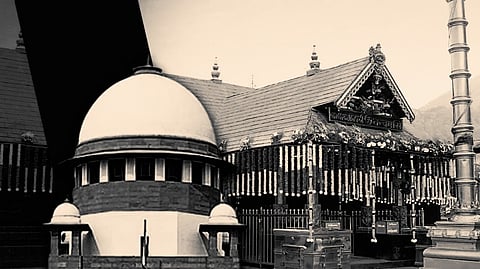

LAST WEEK, a nine-judge Constitution Bench led by Chief Justice Surya Kant heard arguments over three days on questions that have been building up since 2006, when the Indian Young Lawyers Association filed a public interest litigation that eventually led to the 2018 Sabarimala judgment, including the present reference.
Though this bench is not directly examining the 2018 judgement, it is addressing larger issues referred to it in February 2020. How much freedom do religious communities have to run their own affairs? How much can the State interfere? And when someone challenges a religious practice in court, what exactly is the court allowed to decide?
As the Court prepares to hear the Respondents this week, we review what the Union government and Review Petitioners argued last week, specifically on the issue of how Articles 25 and 26 inter-operate in the schema of fundamental rights.
Two articles, two different rights
At the heart of the hearings lay Articles 25 and 26 of the Constitution, provisions that sit at the centre of contestations defining the scope and limits of religious freedom in India.
Article 25 gives every individual the right to follow, practice and propagate their religion, subject to public order, health, morality and to the other provisions of Part III. Article 26 gives religious denominations the right to manage their own religious affairs without State interference. While the former is a personal right, the latter belongs to the religious community as a collective.
Solicitor General Tushar Mehta, appearing for the Union, opened last Tuesday with the core argument that the Constitution leaves the determination of religious content to the religion itself. Courts are not institutionally equipped, legally or theologically, to assess whether a particular practice is sufficiently central to a faith to deserve protection. “Unless we achieve that level of spiritual supremacy,” he told the bench, “we will not be in a position to assist what exactly Prophet Muhammad said, or Lord Jesus said, or what the Veda says.”
Through all three days, the precise relationship between the two articles was widely discussed. Article 25 is expressly made subject to other provisions of Part III, the chapter dealing with the fundamental rights, meaning other fundamental rights can limit it. Article 26 contains no such qualification. If Article 26 is truly free of any external constitutional constraint, a religious denomination could potentially use it to override even the fundamental guarantees of equality and non-discrimination under Articles 14 and 15. Mehta argued this could not be the right reading since after I.R. Coelho v. State of Tamil Nadu (2007) and R.C. Cooper v. Union of India (1970), no fundamental right could be read as a complete island.
Additional Solicitor General K.M. Nataraj, who argued on Thursday, offered a three-tier reading of the two provisions. Individual religious freedom sits in Article 25(1). The State’s power to regulate religion sits in Article 25(2), and institutional religious life, which is the denomination’s autonomy, sits in Article 26. His argument was that these three tiers are interdependent, not separate. A denomination is only constituted through the collective belief of individuals, so Article 26 cannot exist independently of Article 25(1). “Without individual there can be no 26,” he said.
Can the State override a denomination’s religious practices?
Article 25(2)(b) enables the State to pass laws throwing open Hindu religious institutions of a public character to all classes and sections of Hindus. The question was whether this legislative power can override a denomination’s right under Article 26(b) to manage its own religious affairs.
Senior Advocate C.S. Vaidyanathan, appearing for several Hindu organisations including the Nair Service Society, on Thursday, argued that Sri Venkataramana Devaru v. State of Mysore (1957), the judgment that had tried to reconcile the two provisions through harmonious construction, got this wrong. There, the Court held that while a denominational temple could restrict certain religious ceremonies exclusively to Gowda Saraswath Brahmins under Article 26(b), it could not altogether exclude the general Hindu public worship since Article 25(2)(b) permits throwing open Hindu temples to all classes of Hindus. The denomination’s right only remained to the extent where it did not substantially erode the public’s right to worship. While Article 26(b) is a substantive fundamental right, Article 25(2)(b) is merely an enabling provision. It permits the State to legislate, but is not itself a right that any person holds. Shirur Mutt itself had said Article 26(b) is “a fundamental right which no legislature can take away.” Devaru had not grappled with this. An enabling clause cannot, as a matter of constitutional logic, prevail over a fundamental right. Vaidyanathan further argued that Article 25(2)(b) applies only to Hindu religious institutions. It does not extend to mosques or churches. Hindu denominations are uniquely burdened by a provision from which other religious communities are entirely exempt.
“If you say only my section must attend my temple and no one else, that is not good for Hinduism,” Justice Nagarathna said. “We will be dividing the society,” Justice Aravind Kumar added. The concern was that reading Article 26(b) as an absolute right would allow denominations within the same religion to exclude each other, fracturing religious communities along internal lines.
Chief Justice Surya Kant observed that even if Article 25(2)(b) does not textually subordinate Article 26, the morality clause within Article 26 itself might independently do the same work. “Article 17 is a principle of morality,” he said, suggesting that the constitutional abolition of untouchability operates as an internal constraint on religious denominations through Article 26’s own morality exception, without needing to resolve the hierarchy between the two articles at all.
Was Article 25(2)(b) ever about gender?
On whether the exclusion of menstruating women amounts to untouchability, Mehta argued firmly that Article 17 was introduced to dismantle caste-based exclusion from temples and was never intended to address gender discrimination. He referred to Constituent Assembly debates from May 1947, noting that Article 25(2)(b) was introduced through an amendment moved by K.M. Munshi specifically in response to the practice of denying Dalits and lower-caste Hindus access to temples. The phrase “all classes and sections of Hindus,” he argued, was directed at caste-based exclusion, a reading supported by Sir B.N. Rau’s note, which Mehta placed before the bench, recording that the provision was aimed at discrimination on the ground of caste under what is now Article 17. Gender equality, he said, is already guaranteed by Articles 14 and 15 and does not need to be read into a provision with a distinct and documented historical purpose.
He was equally direct about the part of the 2018 Sabarimala judgment that drew an analogy between the exclusion of women of a certain age group and untouchability under Article 17. Referring to Justice D.Y. Chandrachud’s opinion, he remarked, “One opinion says Article 17 applies to women. You are treating women as untouchables. That's something I have a very, very strong exception to.”
Justice Nagarathna responded swiftly, “Speaking as a woman, Article 17 cannot apply for three days and on the fourth day there is no untouchability.”
Finding the right words for ‘Swadeshi jurisprudence’
Certain arguments sought to replace ‘English’ legal concepts with ‘Indian’ ones, on the basis that the English words do not adequately capture how ‘Indian religious life’ actually works. The Constitution uses the word “denomination” in Article 26. Nataraj pointed out that Article 394A makes the Hindi text of the Constitution authoritative, and that the Hindi word used is “sampradaya”. This, he argued, was far more flexible than denomination, requiring no formal organisation, no common name, and no fixed set of doctrines. Any group sharing a religious tradition transmitted through teachings, practices and lineage constitutes a sampradaya.
This matters because the current legal test for what counts as a denomination comes from S.P. Mittal v. Union of India (1982), a judgment that required common faith, common organisation and a distinctive name, drawing on an English dictionary definition. Vaidyanathan argued that this test is entirely unsuited to Indian religious life. Nizamuddin Dargah, Shirdi and Tirupati Balaji are visited by people of multiple faiths with no common organisational structure, yet nobody would seriously argue they fall outside constitutional protection. Under S.P. Mittal, none of them would qualify as a denomination. The argument was built on a gap Mehta had identified on the first day of hearings, that no judgment, including the 2018 Sabarimala decision, had properly engaged with the phrase “or any section thereof” in Article 26, which the Constituent Assembly specifically added to protect groups that do not constitute a formally organised denomination.
What can courts actually decide?
All counsel appearing for the Union and the review-petitioners agreed that courts cannot decide whether a practice is essential to a religion as that requires theological expertise that secular courts do not possess. The essential religious practices doctrine, first introduced in Durgah Committee v. Syed Hussain Ali (1961) and followed in the 2018 Sabarimala judgement, has no textual basis in either Articles 25 or 26. Shirur Mutt had spoken only of practices forming an “integral part” of religion. The word “essential” was inserted by a smaller bench in Durgah Committee without acknowledging the departure, and has been pulling courts into theological territory ever since.
Mehta suggested that factual disputes about religious practices are best resolved through civil suits, where evidence can be properly led and expert witnesses examined, rather than through constitutional petitions decided on competing affidavits. Vaidyanathan went further, arguing that even in a suit the court’s role extends only to determining whether a practice exists within a tradition and not whether it is theologically correct or necessary.
The bench was not willing to accept a complete withdrawal of judicial jurisdiction. Courts can examine whether a practice is religious in character. However, they should not go further and assess whether it is essential to the religion. Whether that line is workable in practice, or whether it simply relocates the difficulty without resolving it, is the central question the nine judges will eventually have to answer.
The hearing resumes on April 15.