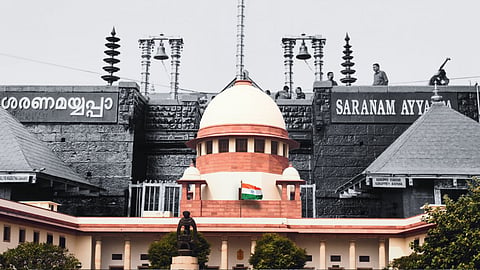
Sabarimala Reference: Decoding the debate on ‘Morality’|Key Takeaways from Union and Review Petitioner arguments

Does the term ‘morality’ in Articles 25 and 26 mean ‘public morality’? We decode the Union’s submissions last week that challenged the Supreme Court’s handling of the notion of ‘constitutional morality’.
Sabarimala Reference: Decoding the debate on ‘Morality’|Key Takeaways from Union and Review Petitioner arguments
Published on

To read what the Union and Review Petitioners argued on the interplay of Articles 25 and 26, read our detailed report here.

“MY LORD, if these judgments – Navtej Singh JoharJoseph Shine – were to be read by Dr. Ambedkar, or K.M. Munshi or Alladi Krishnaswami Ayyar, I do not know whether they would be surprised, shocked, or they would say that is what they wanted,” Solicitor General Tushar Mehta, for the Union government, argued last Wednesday, “I believe they did not want this to happen.”

Mehta was not arguing a review of the Navtej Johar (that decriminalised same sex relationships in 2018), or Joseph Shine (that decriminalised adultery) decisions, but answering a two-pronged bone of contention in the Sabarimala reference – what is ‘morality’ under Articles 25 and 26, and whether constitutional morality be the basis for judicial review? This question is so relevant that it ties the current review hearings before this nine-judge Bench to a majority of the landmark rulings of the last decade which have been rooted in constitutional morality with a domino effect. 

Last week, the Solicitor General and the Review Petitioners noted that the ‘morality’ restriction under Article 25 referred to ‘public morality’, that ‘constitutional morality’, as the framers meant it, was simply about constitutional conventions to be followed by government functionaries, and that a series of judgments had got it all wrong.

“What I am saying is that constitutional morality governs secular life and the capsule of religious rights have to be on the basis of understood morality of society vis-a-vis the religious tenets,” Mehta argued.

‘Morality is Public Morality’

Both Article 25(1) which recognises the freedom of conscience and the right to freely profess, practice and propagate religion, and Article 26 which recognises the freedom to manage religious affairs, apply subject to ‘public order, morality and health’. In the 2018 Sabarimala verdict, and really a host of decisions prior to that, the majority had interpreted ‘morality’, not as majoritarian, societal morality but as ‘constitutional morality’. One of the issues framed by the February 2020 reference order intends defining the ‘morality’ restriction under Article 25(1). Last Wednesday, the Solicitor General referred to Constituent Assembly debates to argue that it meant public or societal morality and that constitutional morality meant something very different. He first referred to a Constituent Assembly speech by Z.H. Lari, who, while criticising the enacting of Safety Acts for denying people the right to move before the High Court, observed that constitutional morality was not a natural sentiment; it had to be cultivated.

Contrary to this, the ‘morality’ in Article 25 was of a different flavour. He referred to a speech by K. Santhanam, another member of the Constituent Assembly, on draft Article 19 (present day Article 25), where he had argued that the provision was “really not so much an article on religious freedom, but…on what I may call ‘religious toleration’.” Santhanam explained that while before the Constitution there had been “unrestricted practice and propaganda” in the name of Hindu religion, the new Constitution was only restricted to rights consistent with public order, morality and health. But ‘morality’ here, Mehta said, meant something that grew with the social and moral conscience of the people. “Morality is understood in the context of societal morality, that society will evolve and the concepts of morality will change with evolution of each generation,” he noted, “That is the expectation.”

He also referred to the decision of Justice D.G. Palekar in Kesavananda Bharati v. State of Kerala (1973), where he noted: “Even the rights conferred are not in absolute terms. They are hedged in and restricted in the interest of the general public, public order, public morality, security of the State and the like which shows that social and political considerations are more important in our organized society.”This, he noted as evidence, meant that ‘morality’ in draft Article 19 was construed as ‘public morality’. 

Sabarimala Reference: Decoding the debate on ‘Morality’|Key Takeaways from Union and Review Petitioner arguments
Sabarimala Reference: How exactly do Articles 25 and 26 intersect? | Key Takeaways from Union and Review Petitioner arguments

Mehta referred to the Court’s decision in K.A. Abbas v. Union of India (1970), where referring to American jurisprudence on censorship, it had noted that censorship of films, “their classification according to age groups, and their suitability for unrestricted exhibition is regarded as a valid exercise of power in the interest of public morality, decency etc.” The decision had also noted, although in the context of freedom of speech, that “social interest of the people override individual freedom.” The 2018 Sabarimala judgment, Mehta explained, was contrary to this since individual freedom and dignity took precedence over social interest, and societal morality was reduced to be wrongly understood as mob morality.

“What I am saying is that constitutional morality governs secular life and the capsule of religious rights have to be on the basis of understood morality of society vis-a-vis the religious tenets,” Mehta argued.

He noted that for the larger interest of the community, policies and regulations were to be formulated to combat dishonesty, corruption, gambling, vice and other things of immoral tendency. For instance in State of Maharashtra v. Indian Hotel and Restaurants Association (2013), dance performances in establishments were considered obscene and treated as immoral; thus, the State could pass a law prohibiting obscene dances. But if a practice is not immoral by social standards, Mehta argued, the State cannot thrust upon society its own notion of immorality and exercise social control.

Last Thursday, Senior Advocate C.S. Vaidyanathan, representing the Nair Service Society, also argued that ‘morality’ as mentioned in Articles 25 and 26 ought to be understood as public morality and not an “abstract notion” of constitutional morality. “The phrase public order, morality and health constitutes a cluster of external regulatory grounds, all of which are directed towards maintaining social and public order,” he argued, noting ‘morality’s’ interpretation must be “consistent with this context.” 

Mehta expressed worry that the notion of ‘constitutional morality’ was essentially legitimising unconventional practices and had been justified through the scholarship of Western scholars.

Vaidyanathan referred to the Constituent Assembly speech on draft Article 19 by Lakshmi Kanta Mitra who had noted that the right “has been circumscribed by certain conditions which the State would be free to impose ‘in the interest of public morality, public order and public health and also insofar as the right does not conflict in any way with the other” fundamental rights.” Vaidyanathan argued that the phrase was always meant to be read as ‘public order, public morality and public health’, and only due to the draftsman’s convenience, the word ‘public’ was mentioned only once before ‘order’.

Is ‘Constitutional Morality’ just ‘Constitutional Convention’?

According to Mehta, constitutional morality, as has been traditionally understood, is not a tool for judicial review at all, but merely a convention according to which constitutional functionaries are expected to behave. “It is a political doctrine…not a doctrine for judicial review,” he explained, noting it to be the ‘constitutional dharma’ of functionaries determining how governments and functionaries should function in the absence of constitutional provisions.

On November 4, 1948, B.R. Ambedkar, speaking in the Constituent Assembly about why administrative details were not included in the Constitution, referred to British historian George Grote who had coined the term ‘constitutional morality’ to mean a paramount relevance to the ‘forms of the Constitution’. Ambedkar went on to note, “It is only where people are saturated with the constitutional morality such as the one described by Grote…that one can take the risk of omitting from the Constitution details of administration and leaving it for the legislature to prescribe” Referring to this, Mehta noted that it was meant to explain “the reverence to institutions” and never as a doctrine “based upon which a legislation can be tested.”

Mehta explained that a string of Supreme Court judgments like S.P. Gupta v. Union of India (1981) and Shrimanth Balasaheb Patil v. Hon’ble Speaker Karnataka (2019) had understood constitutional morality in this limited sense only. In the latter judgment, for instance, the Court while expressing regret about conduct and manner in which constitutional functionaries had acted in the case, had noted, “Being a constitutional functionary, the constitution requires them and their actions to uphold constitutionalism and constitutional morality.”

Sabarimala Reference: Decoding the debate on ‘Morality’|Key Takeaways from Union and Review Petitioner arguments
Sabrimala Review | Table of Arguments: What have both sides argued in their Written Submissions?

However, a tipping point came with the Delhi High Court’s judgment in Naz Foundation v. Govt. of NCT of Delhi (2009) which had noted that popular morality was distinct from constitutional morality, and “if there is any type of morality that can pass the test of compelling State interest, it must be constitutional morality and not public morality.” This was subsequently upheld in Navtej Singh Johar, where the Supreme Court noted that the Court “has to be guided by the conception of constitutional morality and not by societal morality.” Mehta noted that with this holding, the “individual, subjective view” of constitutional morality not only took a centre-stage but now excluded societal morality and cultural ethos entirely.

The pitfalls of this, he argued, became most visible in the Joseph Shine judgment which read down Section 497 of the Indian Penal Code, 1860 that criminalised adultery. There, while noting that historically the law had failed to account for how notions of ‘purity’ of women and ‘entitlement’ of men had defined antiquated social and sexual mores, the Court had noted that “it is not the ‘common morality’ of the State at any time in history, but rather constitutional morality, which must guide the law.” In that context, the Court had referred to the work of American scholar Katherine Bartlett in the Harvard Law Review. Similarly, in a discussion on how adultery implicated the right to privacy, the Court had cited American professor Martin Siegel. 

Mehta expressed worry that the notion of ‘constitutional morality’ which was now binding upon Indian citizens, was essentially legitimising unconventional practices, as viewed through the lens of Indian society, and had been justified through the scholarship of Western scholars. The sole Indian scholar who was cited was professor Nivedita Menon, but Mehta stated that he had a “very serious objection” to reliance on Menon’s scholarship since she was “known for her views that Indian State is illegally occupying states.” In essence, he noted that while public morality had been ousted in Joseph Shine, the alternative to it, constitutional morality was being framed through the lens of Western jurists and scholars, and the Court was forcing these values onto Indian society.

Vaidyanathan argued that only due to the draftsman’s convenience, the word ‘public’ was mentioned only once before ‘order’ in the phrase ‘public order, public morality and public health’.

“The judgment in Joseph Shine proceeds on a premise which is not only against societal morality, but even against constitutional morality,” he noted, arguing that reliance upon foreign scholars like Siegel to rule upon practices not conventionally accepted but bound the entire country, was also against constitutional convention.

“The institution of marriage and monogamy is precisely for the reason that there should not be multiple partners. That is the societal morality,” he pressed, “We cannot divorce our jurisprudence from that of societal morality.”

The Court will continue hearing the issue today, April 15.

Related Stories

No stories found.
The Leaflet
theleaflet.in