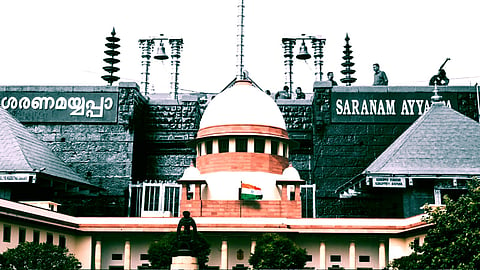

THE SUPREME COURT on April 17 continued hearing the Sabarimala reference before a nine-judge Constitution Bench led by Chief Justice Surya Kant. The day’s arguments by the Review Petitioners traversed the scope of Articles 25 and 26, the meaning of ‘denomination’ and ‘sampradaya,’ the role of constitutional morality, and the standing of non-believers to challenge religious practices by way of public interest litigation. The bench was addressed by Senior Advocates M.R. Venkatesh, Rajeev Dhavan, and V. Giri.
‘Religious practice and denomination are inherently incapable of definition’: M.R. Venkatesh
Senior Advocate M.R. Venkatesh, appearing for Atman Trust, argued that under Articles 25 and 26, expressions such as ‘religious practice,’ ‘Hindu religious institutions,’ and ‘religious denomination’ are “indeterminate” and “probably incapable of being defined.” He traced the word ‘denomination’ to its Latin roots in Christian ecclesiastical structures, arguing that it entered Indian constitutional text through the Irish Constitution and carries conceptual baggage ill-suited to India’s plural religious traditions. Articles 25(2)(a) and 25(2)(b), he submitted, are sui generis provisions crafted specifically for Indian conditions without international precedent, and ought not to be read through foreign doctrinal lenses.
Venkatesh warned against a framework that makes denominational status under Article 26 the only gateway to constitutional protection. If temples do not qualify as denominations under a rigid definition, they could be reduced to purely public spaces, “equated to a bus stand, where anybody can enter and exit,” denuded of any institutional religious character.
