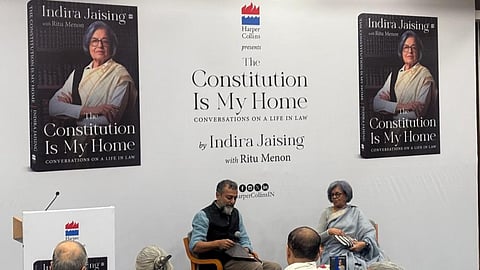

ON THE EVENING OF MAY 21, the Seminar Halls of the Kamaladevi Complex at the India International Centre filled to capacity with lawyers, academics, students and public intellectuals. The occasion was the launch of Senior Advocate Indira Jaising’s memoir, ‘The Constitution Is My Home’. The book which has been published by HarperCollins India is a conversation with the feminist writer and publisher, Ritu Menon, and is written in a distinctive conversational form.
The evening brought together a wide-ranging discussion between Jaising and senior journalist Sreenivasan Jain, followed by a keynote address by Justice B.V. Nagarathna of the Supreme Court of India, and a video message from Chief Justice of India Surya Kant.
‘I belong to the Constitution of India. I belong there.’: Jaising
Sreenivas opened the discussion by pressing Jaising on what he described as the heart of her book, the question of whether India’s legal system has truly been effective as a guardian of the Constitution over the six decades she has practised. Her answer reached immediately for the title. She explained that calling the Constitution her home was a deliberate and deeply personal choice. As a migrant, a refugee from Pakistan for whom no Indian state bears the name of her place of origin Sindh, she had long grappled with the question of belonging. “I belong to the Constitution of India,” she said simply. “It is the values of the Constitution which I identify with, and which make me identify with my fellow citizens. It is my bond with my fellow travellers.” That bond, she made clear, has been tested by virtually every government since independence.
The Emergency remains the most obvious historical example, but Jaising was careful to distinguish it from the present moment. “During the emergency, it was the Constitution itself that was used to oppress the general public. They invoked the emergency provisions. So it’s much more easier to fight a written text, a written document, to challenge it.” What is happening now, she argued, is far harder to contest. “Every other form of transformation is happening without the change in the written text,” she said, a transformation from a liberal and secular republic toward a Hindu nationalist state, driven by the ruling BJP. To call it an undeclared emergency was, in her view, actually too charitable. “An emergency, for God’s sake, is an emergency. It’s temporary. We’ve gone past the temporary stage.”
