Should ‘Constitutional Morality’ be discarded? | Criticisms and a Response

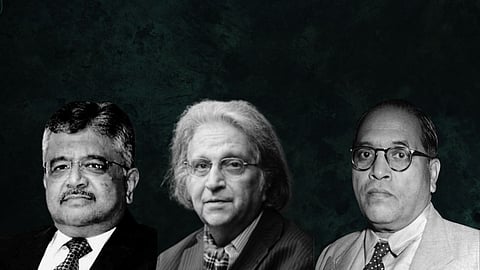
Last week, Solicitor General Tushar Mehta pressed to discard ‘constitutional morality’ - a ‘vague and subjective’ notion - that had expanded judicial review. But from M.P. Singh and Upendra Baxi to Justice Chandrachud, a long tradition of thought has challenged this framing.
Should ‘Constitutional Morality’ be discarded? | Criticisms and a Response
Published on

ON APRIL 8, 2026, Solicitor General Tushar Mehta, appearing for the Union government in the Sabrimala Review proceedings, argued against the widening of judicial review through the concept of ‘constitutional morality’. He criticised the Supreme Court’s reliance on the concept to nullify legislative and executive actions when no other constitutional ground could be found for the same. Denouncing it as a “vague and subjective” notion, he contended that it is nowhere mentioned in the Constitution and has evolved through judgments such as Joseph Shine v. Union of India (2018) and Navtej Singh Johar v. Union of India (2018). The Solicitor General insisted that when the framers of the Constitution had referred to the term ‘morality’ in Article 25 of the Constitution, they had meant public morality, and not some abstract notion of constitutional morality.  

Such allegations warrant discussion over what constitutional morality truly entails. While cynics have portrayed the concept as a vague and subjective catchphrase used to impose the moral values of the adjudicating judge over the public, supporters contend that the concept is neither a novel invention of judicial guile nor is it a “vague and subjective” concept that can be moulded according to the caprice of the person applying it. For the latter, it is a notion that embeds the Indian constitutional discourse; as the late M.P. Singh argues, it is “the guiding spirit to achieve the transformation, which, above all, the Constitution seeks to achieve.” 

A closer look reveals that the meaning of constitutional morality has not been static. It has evolved considerably from its original meaning in the Indian constitutional discourse. Nevertheless, one may still find certain common motifs anchoring the concept.  

A closer look reveals that the meaning of constitutional morality has not been static.

Constitutional Morality under the Indian Constitution

Origins

In the Indian context, constitutional morality was, for the first time, mentioned by Dr B.R. Ambedkar on the floor of the Constituent Assembly. He had employed the concept while justifying the incorporation of administrative details in the Indian Constitution. Quoting British historian George Grote, Ambedkar defined constitutional morality as reverence for the ‘forms of the constitution’, obedience to authority and the constitutional forms. But this was not to mean blind worship of the constitutional authorities. 

Ambedkar emphasised that constitutional morality also incorporated “the habit of open speech, of action subject only to definite legal control, and unrestrained censure of those very authorities as to all their public acts – combined, too, with a perfect confidence in the bosom of every citizen, amidst the bitterness of party contest, that the forms of the constitution will not be less sacred in the eyes of his opponents than in his own.” 

Ambedkar wished for a constitutional set-up where debates, disagreements, and conflicts of interest were settled through collective discourse within the designated forums established by the Constitution. It was for this reason that he was unwilling to formulate a ‘socialist’ constitution or make distributive justice the foundational aim of the Constitution, despite his unfiltered determination to uplift the oppressed sections of society, particularly Dalits, accepting upliftment through a deliberative process prominently in the legislature.  

Constitutional morality, thus, for Ambedkar, was concerned not with substantive ideals but with adherence to the constitutional processes. The Constitutional revolution, for Ambedkar, was about the consensus not over substantive objectives but rather, a form of political organisation sustained by common ways of doing things – that is, under the restrictive structure of the constitution. This organisation was the core of constitutional morality. 

Should ‘Constitutional Morality’ be discarded? | Criticisms and a Response
Sabarimala Reference: How exactly do Articles 25 and 26 intersect? | Key Takeaways from Union and Review Petitioner arguments

He warned that ‘Constitutional morality is not a natural sentiment. It has to be cultivated.’ Given that democracy was but a top dressing for a country with little constitutional history, in addition to being teeming with inequality, social differences, and power imbalances, it would take additional effort to imbibe constitutional morality amongst the Indian citizens. Under such circumstances, he maintained, “it is wiser not to trust the Legislature to prescribe forms of administration.” This was Ambedkar’s idea of constitutional morality, an idea on which he grounded his decision to lay down the administrative scheme under the Constitution. 

Therefore, an important reason for Ambedkar’s attention to constitutional morality, records Professor Pratap Bhanu Mehta, was the Constitution’s “lack of historicity”. “Constitutions”, Pratap Bhanu Mehta argued, “not only allocate authority, define the limits of power or enunciate values.” They also shape our comprehension of history and our sense of self. In the absence of any historical anchoring of the Indian Constitution to members of the society, it could be seen as a foreign document dictating its obedience without affinity. To cultivate this sense of affinity, constitutional morality becomes paramount.   

21st Century

Interest in constitutional morality revived in the first decade of the twenty-first century. In his renowned Seminar essay – ‘What is Constitutional Morality’– while Professor Mehta thoroughly engaged with Ambedkar’s idea of constitutional morality, he differentiated between Ambedkar’s understanding of the notion and contemporary constitutional morality. While the former referred to the conventions and protocols that govern decision-making to determine the substantive objects and values of the society,  the latter had come to mean the substantive moral entailment of the Constitution. 

In his renowned Seminar essay – ‘What is Constitutional Morality’– while Professor Mehta thoroughly engaged with Ambedkar’s idea of constitutional morality, he differentiated between Ambedkar’s understanding of the notion and contemporary constitutional morality.

Mehta's reference to constitutional morality as a substantive moral entailment reflects the Delhi High Court’s exegesis of the phrase in Naz Foundation vs Government of NCT of Delhi (2009). While holding Section 377 of the Indian Penal Code, which criminalised same-sex sexual relations between two consenting adults, as unconstitutional, the High Court contrasted public morality with constitutional morality. It stressed that ‘popular morality or public disapproval of certain acts is not a valid justification for restriction of the fundamental rights under Article 21.’ Citing the South African Constitutional Court’s decision in the National Coalition for Gay and Lesbian Equality v. The Minister of Justice (1998), it held that the State should not be concerned with political or public morality, but rather with “the morality. . .to be found in the text and spirit of the Constitution itself.” It found the argument made on behalf of the government in favour of the provision’s retention that ‘public morality of homosexual conduct might open floodgates of delinquent behaviour’ unconvincing, holding that “constitutional morality must outweigh the argument of public morality, even if it [the latter] be the majoritarian view.”

The Supreme Court, on appeal, overturned the High Court’s decision, but it did accept that constitutional morality supersedes public morality. “Moral indignation, howsoever strong”, for the Supreme Court, could not be “a valid basis for denying an individual his fundamental rights of dignity and privacy.” It added, “In our scheme of things, constitutional morality must outweigh the argument of public morality, even if it be the majoritarian view.” 

The concept, however, was primarily understood in the backdrop of fundamental rights and their regulation. This rendition of constitutional morality went beyond the procedural allegiance of Ambedkar. It hemmed the concept with an underlying spirit of the substantive principles of the Constitution.

In Government of NCT of Delhi v. Union of India (2008)the application of constitutional morality in matters relating to governmental operations was consolidated. Chief Justice Dipak Misra described constitutional morality as “the morality that has inherent elements in the constitutional norms and the conscience of the Constitution.” He termed it the fulcrum that kept high functionaries and citizens alike in check and ensured that they remained in harmony with the constitutional impulse. Justice D.Y. Chandrachud, in his concurring opinion, added that constitutional morality played a further role in balancing the principles of popular morality and mob rule. Constitutional morality, thus, manages the paradox of majority rule of democratic government and individual rights enshrined in the constitution.  

In Navtej Singh Johar, which quashed Section 377, which criminalised same-sex consensual relationships, and Joseph Shine, which invalidated Section 497 and decriminalised adultery, the Supreme Court again applied the concept in relation to fundamental rights. In the former, Chief Justice Dipak Misra reemphasised the Ambedkarian notion of a pluralistic society as the bedrock of constitutional morality. He termed espousal of a pluralistic and inclusive society as the foremost of all the several virtues of constitutional morality and reiterated that social morality cannot be used to violate fundamental rights of even a single individual. Justice Rohinton Fali Nariman further elaborated that constitutional morality was the soul of the Constitution, found in the Preamble and in Part III of the Constitution, particularly with respect to those provisions which assure the dignity of the individual. 

Should ‘Constitutional Morality’ be discarded? | Criticisms and a Response
Basic structure and constitutional morality: Are they meta-constitutional norms?

In Joseph Shine, Justice Chandrachud linked constitutional morality to the enforcement of “constitutional guarantees of equality before law, non-discrimination on account of sex, and dignity”. In both cases,  the narrative of constitutional morality, manifested in the principles of liberty and equality, surmounting archaic public and Victorian morality remained prominent. 

In Indian Young Lawyers Association v. The State of Kerala (2018), popularly known as the Sabarimala temple case, the practice of preventing women between the ages of 10 and 50 from entering the temple of Lord Ayappa was challenged. In this case, balancing religious rights and equality was directly in consideration. While explaining the meaning of the locution ‘public order, morality, and health’ in Article 25(1) of the Constitution, Justice Misra noted that since the Constitution was not imposed by any external force upon the Indian people and was adopted by the country’s people, the term ‘public morality’ must be seen as synonymous with ‘constitutional morality’. Thus, whatever was violative of constitutional morality, it would, at least to the extent of Article 25(1), be violative of public morality as well. 

Justice Chandrachud, on the other hand, contrasted constitutional morality to public morality and fastened it on the four precepts emerging from the Preamble. These included i) social, economic and political justice; ii) individual liberty in matters of thought, expression, belief, faith and worship; iii) equality of status and opportunity amongst all citizens, and iv) fraternity amongst all citizens. Since restricting women between the ages of 15 and 50 from entering Lord Ayappa’s vicinity violated these precepts, and therefore, even if religious texts enforced such restrictions, they were violative of constitutional morality. 

While each of these judgments quoted Ambedkar’s speech, their account of constitutional morality differs considerably from Ambedkar’s limited one of mere procedural adherence and plurality of views. They encapsulate a collection of values represented in the various constitutional provisions, referring to a recurring or overarching theme that runs through the provisions. And, thus, they include both substantive and procedural principles under the Constitution. 

What are these principles? Well, that is precisely the point of dispute. 

Similarly, Professor N.R. Madhava Menon expressed his apprehensions about the use and abuse of the doctrine in constitutional decision-making.

Criticism of the Concept 

Those against the deployment of constitutional morality point out that there is no definite criterion to describe the evasive concept. In 2018, the then Attorney General K.K. Venugopal declared that “use of constitutional morality can be very, very dangerous and we can’t be sure where it will lead us to. I hope constitutional morality dies”. If it continued to breathe, he continued, then “first Prime Minister Jawaharlal Nehru’s fear that the Supreme Court will become the third chamber of Parliament might come true”. 

Similarly, Professor N.R. Madhava Menon expressed his apprehensions about the use and abuse of the doctrine in constitutional decision-making. Menon insisted that the power of judicial review must run subservient to the will of the people as expressed in the constitutional text and on maxims of public morality, a principle that is often undermined under the garb of constitutional morality. While Menon does not suggest that fundamental rights be regulated by public morality, he is stern in his opinion that constitutional morality should not become a legitimate ground for invalidating legislative wisdom. Constitutional sentiment, he asserted, can only accumulate and diffuse in society gradually, like silt from the flowing river. It cannot come in the form of a deluge. 

A Response to the Criticisms

These criticisms connote constitutional morality as an entirely novel concept, which, as we have seen, is not the case. Professor Upendra Baxi, in countering this insinuation, pointed out that constitutional morality “stands variously embedded in the Preamble, Parts III, and now IVA” of the Constitution. Notably, the concept has been most commonly deployed in cases of fundamental rights violations of citizens or violation of other provisions of the Constitution, and has never been a standalone ground for invalidation of any legislative or executive decision.

Moreover, although flexible and not set in stone, the concept shows some degree of consistency. First, it has been affiliated with the values integrated into the Preamble and Part III of the Constitution, which include equality, fraternity, liberty, and social justice. Justice Chandrachud’s opinion in the Sabarimala and Joseph Shine verdicts and Justice Nariman’s opinion in Navtej Singh Johar are an apt example of this. 

Second, the concept is laden with the sentiment of plurality and diversity of opinion. It insists upon the coexistence of people who may have varying ways of life. This was one of two significant facets of Ambedkar’s notion of constitutional morality, and has been reiterated on multiple occasions, such as Justice Misra’s judgment in Navtej Singh Johar. 

Should ‘Constitutional Morality’ be discarded? | Criticisms and a Response
The Sabarimala review, mapped: A weekly round-up on Constitution First

Third, it is about adhering to the Constitution, both in letter and in spirit. In the Government of NCT of Delhi, Justice Chandrachud noted that constitutional morality plays a role in balancing the principles of ‘popular morality’ and ‘mob rule’. Adhering to the spirit of the Constitution is about maintaining this tenuous balance, and not sacrificing individual liberty at the altar of majoritarianism. This balancing often requires going against popular morality, but it is part of the balancing act critical in the protection of constitutional democracy. 

Conclusion

‘Constitutional morality’ is, and always has been, a shared responsibility between the three organs of government and the people of the country. It is not merely about enforcing fundamental rights and invalidating legislative and executive enactments; it is about understanding and implementing the spirit of the Constitution in its entirety. In this light, it is perhaps reasonable to criticise any organ, including the judiciary, that presents itself as the sole guardian of the concept, or completely sidelines the wisdom of the legislature in its implementation. 

However, if the legislation fails to fulfil its responsibilities in this respect, such as in relation to the decriminalisation of homosexuality despite the urging of the Supreme Court in the appeal of the Naz Foundation case, the judiciary should not remain silent as a blind spectator, as public morality and political convenience in pandering to such morality result in the stunting of the constitutional spirit. Therefore, it would be wrong to suggest that the concept of constitutional morality in its entirety should be discarded from judicial consideration.    

Related Stories

No stories found.
The Leaflet
theleaflet.in