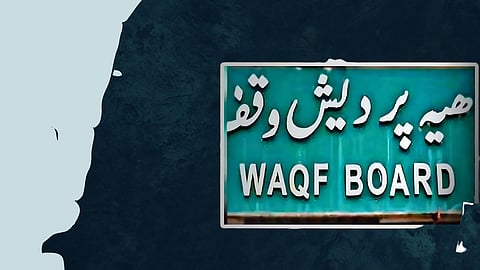
The Waqf Amendment Bill goes beyond constitutionally allowed State interference for better administration

As the Union government disregards serious concerns and rushes towards enacting the Waqf (Amendment) Bill, 2024, the Joint Parliamentary Committee needs to step up to maintain the sanctity of the Constitution, writes Mohammad Wasim.
The Waqf Amendment Bill goes beyond constitutionally allowed State interference for better administration
Published on

THE disquiet around The Waqf (Amendment) Bill, 2024 can be attributed to the apprehension that the Union government has exploited the shortcomings and misgovernance in waqf administration as a pretext for expanding the scope of government interference in waqf institutions beyond what is required for their better administration.

In fact, the prime motive seems to be to enable government interference for purposes that may prove detrimental to the raison d’etre of the institution of waqf.

In this context, let us objectively examine major concern areas on the parameters of desirability, necessity and constitutionality, and see whether these concerns are merited or hyperbolised.

At the outset, it may be remarked that waqf institutions in India suffer from pervasive and intractable corruption and chronic misgovernance. Mosques and madarsas may be among the few institutions where waqf property is being used for demarcated purposes, and to that extent they may be accepted, though the latter suffers from its own set of issues on another account.

Consequently, waqf property is beset by encroachment, sale and lease at throwaway prices and a lack of innovative economic practices for the enhancement of income from unoccupied properties to serve the goals of the waqf institutions effectively.

A Joint Parliamentary Committee (JPC) headed by K. Rehman Khan reported in 2013 that 70 percent of waqf property has been encroached upon and with regard to the remaining, there are cases of blatant corruption, including disposal of land to builders, markets, hotels, malls or industries at throwaway rents.

For instance, in Delhi alone, illegally occupied properties include the CGO complex, JLN Stadium and Delhi Public School (Mathura Road).

In Andhra Pradesh, hundreds of acres of land belonging to the Dargah Hussain Shah Vali endowment, which is valued at thousands of crores of rupees, have been illegally sold to multinational companies, particularly information technology companies.

The Waqf Amendment Bill goes beyond constitutionally allowed State interference for better administration
The year that was–11 | SC’s UP Madarsa Act judgment: Restoring the unity–diversity balance

In Delhi, 86 properties have been rented out for ₹1 each and 110 properties for rents ranging between ₹11 and ₹127. Such instances abound in other places and have led to the current pyrrhic state of the institution.

At this stage, it ought also to be clarified that the State may legislate for better administration and governance of secular affairs of a religious denomination, without alienating the right of the religious denomination to manage such properties; and the same is well established through a catena of judgments of the Supreme Court.

What, then, would comprise better administration of the institution of waqf? Here, it is pertinent to first understand what ‘waqf’ is. We do not need to go far for that.

Nearly all would agree that the definition of waqf in the Waqf Act, 1995, captures the meaning and character of this institution of great antiquity right up to the lifetime of Prophet Muhammad himself. Accordingly, waqf means “the permanent dedication by any person, of any movable or immovable property, for any purpose recognised by the Muslim law as pious, religious or charitable”.

A better administration of this institution, therefore, may conceptually entail (1) curbing corruption, (2) establishing institutions such as madarsas and orphanages to better achieve the purpose of waqf, and (3) better management of auqaf (plural of waqf) on sound economic principles to generate optimum revenue to attain the goals of the institution.

Do the amendments proposed in the Amendment Bill ensure better administration for addressing these concerns? Let us have a look at some of the major amending provisions that have ruffled many feathers.

The prime motive seems to be to enable government interference for purposes that may prove detrimental to the raison d’etre of the institution of waqf.

Composition of the Waqf Board

The Amendment Bill proposes the composition of waqf boards in Section 14, in a manner that has the potential of drastically bringing down the number of Muslim members, to the extent that they may even comprise a minority among the maximum possible eleven members. This poses a severe challenge to the autonomy of a religious denomination under Article 26 of the Constitution.

Here, attention needs to be drawn to the fact that waqf is a dedication for purposes recognised by Muslim law as pious, religious or charitable. Understandably, a person adept in Islamic law and values, or at least familiar with the same, shall be most qualified for a position in such governing bodies.

The Waqf Amendment Bill goes beyond constitutionally allowed State interference for better administration
The year that was–9 | The year of the Hindutva judge

Furthermore, it is an age-old maxim that a person or a group is the best judge of their own interests. This is the rationale for the independence of religious denominations in managing their affairs, including management of property in accordance with law, under Article 26.

To ensure better administration, domain experts and persons of eminence may be included in the boards, in so far as such inclusion does not violate the autonomy of Muslims. A finance expert, a land surveyor by training, or a lawyer may be inducted into the governing body, even if they are not adept in Islamic law and values.

But, one can surely find such persons among Muslims. It shall ensure imbibing the boards with the requisite talent without diluting the right of Muslims to manage their own affairs. There is no inescapable necessity to include members of other religions or religious denominations to ensure better administration. In any case, a board can hire domain experts from the open market if and when needed.

On the other hand, the inclusion of persons of eminence brings credibility and experience of public life to any institution. This is a way of achieving integrity in administration. Appointment to open positions without the requirement of the eminence of personality is conducive to propagating favouritism and eventual mismanagement or misuse of religious or charitable property. Again, one can find Muslim persons for such positions.

There may also not be a great objection to the representation of non-Muslims in the boards, since the same may arguably serve as a deterrent against misuse of the power of the boards, which is a statutory body, in a manner that may be detrimental to other interests, i.e., unjustifiably declaring any land as waqf land.

For instance, in Delhi alone, illegally occupied properties include the CGO complex, JLN Stadium and Delhi Public School (Mathura Road).

But the purpose of deterrent representation can be met with one or two members and any greater number may imperil the very cause for which the boards have been constituted.

The perusal of the provision for the composition of the Boards in the Amendment Bill gives rise to a reasonable apprehension of deliberate curtailment of religious autonomy under Article 26.

The committee envisaged that the Amendment Bill would be secular in character. Can a secular committee decide upon resources, herein auqaf, dedicated for religious purposes?

The Waqf Amendment Bill goes beyond constitutionally allowed State interference for better administration
Explained: The Supreme Court putting a lid on the Places of Worship Act can of worms until it is ready to examine it

Indeed, some of the acts undertaken may be secular in character, i.e., establishing orphanages or old age homes. But they form part of a whole range of activities bearing both religious and secular character, which shall invariably fall under various protections guaranteed under Article 26.

Besides, the activity has to be ‘pious’ according to Islam. The act of deciding piousness is the sole domain of believers of the religion, notwithstanding some of the activities not being purely religious in character.

The judgment of a five-judge Bench of the Supreme Court in Tharamel Krishnan versus Guruvayoor Devaswom Managing Committee and Ors. may provide guidance in the instant issue.

Therein, the court held the provisions of the Guruvayoor Dewaswom Act, 1971 were void in as much as they permitted the sanction by a secular committee of diversion of money from the Dewaswom fund, which belonged to the deity as per custom, for secular activities.

An institution similar in scope as waqf is the Shiromani Gurudwara Prabandhak Committee, the eligibility criteria for which restricts its membership to not only Sikhs but provides for additional criteria of being an Amritdhari Sikh as well as being able to read Gurumukhi, if the person is not blind.

Such provisions are in keeping with the liberties contained in Article 26 of the Constitution of India.

Do the amendments proposed in the Amendment Bill ensure better administration for addressing these concerns?

It is to be borne in mind that the prime issue with the waqf institutions is the lack of integrity and not the religious identity of the person. In turn, the same can be attributed to treating positions such as the membership of the boards as spoils of war by the party elected to power.

Correspondingly, the very appointment to the boards reeks of compromised integrity, such is the current state of affairs.

The solution lies in evolving procedures to curb potentially intemperate integrities, not in tampering with the boards based on religious identities.

This may be done by instituting provisions in the Act for the initiation of criminal proceedings under the Bharatiya Nyaya Sanhita, 2023, or the Prevention of Corruption Act, 1988 in case of corrupt practices by any member or functionary of the boards.

The Waqf Amendment Bill goes beyond constitutionally allowed State interference for better administration
From legitimacy to conspiracy: Decoding the Waqf Bill, 2024

Even in the current absence of such provisions in the Act, criminal proceedings under the aforementioned criminal Acts can be initiated, but streamlining the same with the Act shall be an immediate deterrent against corrupt practices.

Furthermore, execution of the waqf deed, as envisaged in the Amendment Bill, proper maintenance of records, mandatory auctioning of leases, etc., may also discourage corrupt practices.

Execution of a waqf deed

The Amendment Bill inserts sub-clause (1A) in Section 36 of the Waqf Act providing for compulsory execution of a waqf deed for the creation of a waqf. This is a welcome measure in the wake of dual grievances with the current state of affairs— corruption and the possibility of land grabs by waqf institutions.

Execution of a deed ensures that land or other property, with explicitly mentioned particulars, are being dedicated in the presence of witnesses and with the signature of waqif (one who makes the dedication, i.e., waqf), who hitherto had the title to the property. A properly executed deed impedes the widespread attempts at corrupt alienation of the property.

Also, this leaves less scope for the dedication of any disputed property, as the objection has been raised to that effect, particularly by Hindu right-wing organisations.

To ensure better administration, domain experts and persons of eminence may be included in the boards, in so far as such inclusion does not violate the autonomy of Muslims.

Inquiry by the district magistrate

The Amendment Bill seeks to transfer the power of inquiry into the genuineness and validity of an application for registration of waqf from the boards to the concerned district magistrate, particularly to avoid disputed property or government property from being registered as a waqf property [Section 36 (7)].

This provision puts a statutory board in the dock with regard to its capacity to make inquiries as well as its very intent, which is not a legally sustainable objection. It is a well-established principle that mala fide cannot be attributed to a statutory body.

Assuming arguendo that a board may act arbitrarily in relation to the registration of waqf property, the compulsory presence of non-Muslim members provided for in the Amendment Bill, though even one would do, as well as the necessity of execution of waqf deed for a valid waqf are adequate safeguards against such arbitrariness by the boards.

The Waqf Amendment Bill goes beyond constitutionally allowed State interference for better administration
Explained: The Supreme Court judgment on the UP Madarsa Act

Thus, this provision of inquiry by the concerned district magistrate is uncalled for and bears seeds of interference in waqf institutions and thus possible infringement of rights under Article 26 by a hostile political dispensation in the power in a State.

Tribunal

The Amendment Bill has replaced the revisionary jurisdiction of the high courts with a provision for appeal from a decision of a tribunal in the respective high courts [Section 83(9)]. This may not be a major change and in any case norms of justice require there be an appellate forum as has ordinarily been followed for over a hundred years now in common law jurisdictions.

However, scrapping the need for a member to have knowledge of Muslim law or jurisprudence is against the fundamental rationale of the provision of waqf tribunals.

Tribunals, by their very nature, are special courts dealing with special subject matter or with particular types of problems. Accordingly, members having special knowledge in that specific subject matter are ordinarily included as members of the tribunal.

Dispensing with the need for members with knowledge of Muslim law in waqf tribunals or providing for declaration of any other tribunal as a waqf tribunal for the purpose of this Act, which does not have a member with knowledge of Muslim law, jeopardises the dispensation of justice with regard to the waqf-specific subject matter.

This provision puts a statutory board in the dock with regard to its capacity to make inquiries as well as its very intent, which is not a legally sustainable objection.

Other issues

There would also arise issues with regard to the non-recognition of ‘waqf by user’ and non-enforceability of unregistered waqf, which may be addressed by providing for alternative mechanism for recognition of the former and extending timelines for registration of the latter.

There are other issues besides those delineated above and the JPC on the Amendment Bill needs to conduct a thorough analysis of the provisions therein; and to ensure that they do not infringe upon the fundamental religious liberties enshrined in the Constitution.

The statement of the Union home minister that the Amendment Bill shall be enacted soon gives an impression of utter disregard for the concerns being raised with regard to the Bill. The JPC needs to disregard such noise and fulfill its prime duty of maintaining the sanctity of the Constitution.

Loading content, please wait...

Related Stories

No stories found.
The Leaflet
theleaflet.in