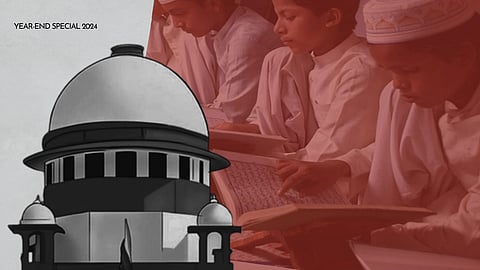
The year that was–11 | SC’s UP Madarsa Act judgment: Restoring the unity–diversity balance

The theme of forcing unity through law and suspicion of distinctness has been common in the discourse of the autonomy of religious minority institutions. The judgment in the UP Madarsa Act is a crucial stand against that trend, writes Afeef Mohammed.
The year that was–11 | SC’s UP Madarsa Act judgment: Restoring the unity–diversity balance
Mohammed Afeef

Mohammed Afeef is an advocate practising in the courts of Bengaluru, including the Karnataka High Court. he represented People’s Union for Civil Liberties on behalf of sex workers along with his colleagues Syeda Saba and Poorna Ravishankar in the Karnataka Human Rights Commission.

Published on

THE Supreme Court on November 5, 2024 overturned the Allahabad High Court decision that struck down the Uttar Pradesh Board of Madarsa Education Act, 2004 as unconstitutional.

The high court had held that the Act violated Articles 14 (equality) and 21A and the principles of secularism and was therefore against the basic structure of the Indian Constitution.

The UP Madarsa Act, in essence, regulates madarsa education across Uttar Pradesh, in terms of upholding good standards of education, qualification of tutors and conducting examinations, etc.

At that point, there were about 13,000 madarsas, providing education to over 12 lakh students in the state. The high court judgment, in effect, had left these 12 lakh Muslim students without educational recognition and without any existing alternate infrastructure to absorb them into other schools. That was the colossal impact of the high court judgment.

The UP Madarsa Act, in essence, regulates madarsa education across Uttar Pradesh, in terms of upholding good standards of education, qualification of tutors and conducting examinations, etc.

What started as a writ petition by a madarsa teacher to regularise his service, snowballed into constitutional challenges to the entire Act, after a series of petitions were tagged together before a division Bench of the high court.

The court directed that the students be absorbed by creating new schools. The UP government planned to convert madarsas into regular schools by granting them recognition. On appeal, the Supreme Court framed three issues: whether the Act violates secularism as understood in the Indian constitutional context? Can an Act be struck down for being violative of the basic structure of the Indian Constitution? Whether the state legislature had the legislative competence to enact such a law, given the federal structure of the Constitution?

The year that was–11 | SC’s UP Madarsa Act judgment: Restoring the unity–diversity balance
Why has the Allahabad HC struck down the Madarsa Act? Explained

Of these three, my emphasis will be on the first one, which is also tied closely to the question of equality under Article 14. The Allahabad High Court understood the very existence of the UP Madarsa Act as the State giving special privileges or treatment to its Muslim minority and violative of secularism.

The division Bench’s understanding of secularism was based on equal treatment of religions by the State (formal equality of religion) and a clean separation of religious activities and secular activities of the State.

The three-judge Bench of the Supreme Court corrected that approach by reiterating that secularism as a facet of equal treatment imposes a dual obligation on the State: To not actively discriminate against a group or person based on religion (negative obligation) and to ensure that the State actively provides the infrastructure and conditions to fruitfully exercise the freedom to practice religion.

The court highlighted the scheme of the Constitution. Article 25 provides that all persons are equally entitled to freedom of conscience and the right to freely profess, practice and propagate religion subject to public order, morality, health, and other provisions of Part III.

Articles 29 and 30 pertain to the cultural and educational rights of minorities. This is understood as either religious or linguistic minorities. Read together, they confer a special right on religious and linguistic minorities to instill in them a sense of autonomy, confidence and security from the interference of the executive and legislature, except to ensure the quality of education.

The Supreme Court held that the Madarsa Act furthers substantive equality for the minority community.

The exemption to minority schools from the application of the Right to Education (RTE) Act, 2009 is also defended through this reasoning. The point is the recognition and preservation of different types of people, with diverse languages and different beliefs, while maintaining the basic principles of equality and secularism, i.e. pluralism.

This requires being vary of majoritarianism and acknowledging religious minorities in general, and Muslims, as a group in this case, are disadvantaged at the national level.

The Supreme Court then connects a recognition of this disadvantage to substantive equality vis-a-vis secularism. It connects the autonomy granted to madarsas and its regulative legislation as an effort towards furthering substantive equality, which is directed at eliminating individual, institutional and systemic discrimination against disadvantaged groups which effectively undermines their full and equal social, economic, political and cultural participation in society.

The year that was–11 | SC’s UP Madarsa Act judgment: Restoring the unity–diversity balance
Explained: The Supreme Court judgment on the UP Madarsa Act

Enactment of special provisions or giving preferential treatment by the State allows the disadvantaged individual or community to overcome social and economic barriers and participate in society on equal terms. The court bats for positive secularism, which allows the State to treat some persons differently to treat all persons equally.

This connection is crucial, given the ubiquitous Hindu majoritarian idea, reflected by the Allahabad High Court, which treats minority rights and acknowledgment and consideration of difference as a ‘special privilege’ granted to Muslims to appease them.

The Supreme Court held that the Madarsa Act furthers substantive equality for the minority community. The reasoning deployed by the high court refused to acknowledge the purpose behind Articles 29 and 30 and that India's Muslim minority is in fact in a disadvantaged position.

Former Chief Justice of India (CJI) Dr D.Y. Chandrachud, otherwise verbose, did mention numerical inferiority but lost a good opportunity to reiterate the nature and extent of backwardness of Indian Muslims (economic, educational and in employment and politics).

After analysing a stream of case laws and precedents, the court concluded that a statute can only be struck down for violating fundamental rights or any other constitutional provision, and not for violating the basic structure, which is a ground to strike down constitutional amendments.

The reason is that concepts such as democracy, federalism and secularism are undefined concepts, and challenges based on this will introduce an element of uncertainty in adjudication. The court did, however, strike down higher education provisions in the Madarsa Act as it conflicted with provisions of the University Grant Commission Act, 1956.

Overall, this was a crucial response by the Supreme Court that rescued lakhs of Muslim students from educational deprivation and reiterated the recognised and correct understanding of Indian secularism— a concept often weaponised against minorities.

One could look at this judgment as a relief and yet an aberration, in two ways. First, given the chequered tenure of the former CJI Chandrachud, this counter-majoritarian judgment is some saving grace. The prompt constituting of the Bench, the timely stay on the high court judgment and the final judgment itself should be lauded.

Second, as Ronojoy Sen argues, the major trend in Article 30 adjudications by the Supreme Court has been the privileging of unity over diversity and autonomy. The theme of forcing unity through law and suspicion of distinctness has been common in the discourse of the autonomy of religious minority institutions.

This judgment is a crucial stand against that trend.

Loading content, please wait...

Related Stories

No stories found.
The Leaflet
theleaflet.in