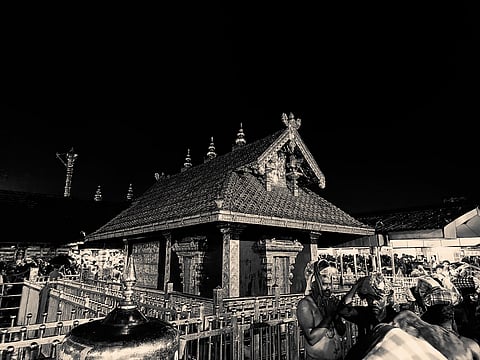

YESTERDAY, the Sabarimala reference before the nine-judge Constitution Bench opened with submissions by Advocate Ravi Prakash Gupta, appearing for the Indian Young Lawyers’ Association, the petitioner whose petition originally precipitated the 2018 Sabarimala judgment. The day’s proceedings, however, took a sharp turn almost immediately, as the Bench trained its attention less on the merits of his arguments and more on the threshold question of whether his client had any standing to be heard at all.
‘Superstition cannot be permitted in the name of religion’: Senior Advocate Gupta
Gupta drew from a Devaprasnam publication to submit that young women were not permitted to visit the Sabarimala temple, remarking that the “deity does not like young ladies entering the temple.” The submission drew pointed scrutiny from Justice B.V. Nagarathna, who pressed Gupta on the locus standi of the Indian Young Lawyers’ Association to maintain a petition before the Court. She suggested that the Association’s proper role was not to advance a cause as a party. Gupta was also posed with the question concerning the status of registration of the association which was affirmed by him as a validly registered association. When the Bench enquired whether the Association had passed any resolution authorising the filing of the petition, Gupta confirmed that no such resolution existed. The lack of existence of any resolution drew a note of disapproval from Justice B.V. Nagarathna as she reiterated upon the unbefittingness of the Association’s involvement in filing the PIL.
The difficulties did not end there. Justice Aravind Kumar remained visibly unconvinced by Gupta’s characterisation of Lord Ayyappa as a ‘Buddhist’ deity. The Bench pushed back firmly on the logic of basing the deity’s religious character on one counsel’s characterisation, particularly when that characterisation ran contrary to the prevailing understanding of Ayyappa’s place within the Hindu tradition.
Gupta also submitted that “the interplay of Articles 25 and Article 26 would not help the Bench,” a position he sought to buttress by reference to the Chief Justice’s judgment in Aligarh Muslim University v. Naresh Agarwal (2024) in which, according to Gupta, the Court had grappled not only with the minority status of the institution but with a jurisdictional question, a reference having been made directly from a three-judge bench to a seven-judge bench. On the basis of this, Gupta posed the question of whether an eleven-judge bench could be constituted to overrule a three-judge bench, and pressed for a formal guideline governing such references. Justice Nagarathna was unpersuaded that such a submission was germane to the present proceedings, given that no such reference had taken place here.
Gupta returned to the constitutional text by invoking Sri Venkataramana Devaru v. State of Mysore (1957) to argue that where a conflict arose between Articles 25 and 26, “the right of the individual and the right of the State to make a law cannot be reduced to a husk” in deference to denominational autonomy under Article 26. On the limits of judicial review in matters of religion, he cautioned that “if superstition is permitted in the name of religion and judicial review is not permitted, then all that has been done since the abolition of the practice of sati would be undone.”
The Chief Justice grew visibly impatient when Gupta offered what the Bench found to be an “inaccurate translation and a misquotation” from the Bhagavad Gita, directing him to confine himself to the framework of Articles 25 and 26. Gupta subsequently read from the religious freedom provisions of the constitutions of Bangladesh, Vietnam, Uganda, and Ireland, the last of which he noted was relied upon by the Constituent Assembly in framing the Indian right to freedom of religion.
As Gupta concluded, the Chief Justice offered a pithy summation of his argument, “If a woman can climb Everest, why not the Sabari Hills?”
‘Practice of deemed conversion on marriage is a patriarchal residue’: Senior Advocate Khambata
The afternoon belonged to Senior Advocate Darius Khambata, who appeared for Goolrokh Gupta, a Parsi-Zoroastrian woman who, having married a Hindu man under the Special Marriage Act, 1954, was denied entry into the agiary on the ground that she had undergone ‘deemed conversion’ to her husband’s religion by virtue of the marriage itself. The logic, as Khambata presented it, was that a Parsi woman who marries outside the community is treated as having “converted to the religion of her husband, with no independent religion of her own.”
Khambata began by addressing what he described as a widespread misconception: Zoroastrianism is the religion; Parsi is the community. The two are not interchangeable, and the conflation, he argued, had muddied much of the debate around exclusion from Zoroastrian spaces.
Senior Advocate Khambata submitted unequivocally that Goolrokh Gupta had not renounced her faith and remained a devout Zoroastrian. He anchored this in a 1908 Division Bench judgment of the Bombay High Court, in which approximately sixty witnesses including priests were heard, and the Court found that “Zoroastrianism does not prohibit but enjoins conversion.”
He invoked the common law doctrine of coverture, now defunct but historically operative, as an illustration of the legal architecture that had fused a wife’s legal personality into her husband’s, and not the other way around. The practice of ‘deemed conversion’ upon inter-faith marriage, he argued, was a residue of that same patriarchal logic, now dressed in the language of religious custom.
The asymmetry at the heart of the exclusion drew a sharp response from Justice Nagarathna, who observed that “marriage as a basis of classification is discriminatory against women,” noting that a Parsi man who married outside the community, along with his children from that union, retained full membership of the community and its attendant benefits, while a Parsi woman who did the same was ousted entirely. The same act, Justice Nagarathna observed, produced starkly different legal consequences depending solely on the sex of the person who performed it.
‘Article 25 is the inception; Article 26 is its subset’: Senior Advocate Khambata
On the structural relationship between Articles 25 and 26, Khambata submitted that Article 25(1) was “the inception of the entire realm of the right to freedom of religion,” while Article 26 was “a subset or manifestation” of that broader guarantee. Shutting the door on a believer who wished to continue practising her faith, he argued, was contrary not merely to the letter but to the spirit of Article 25(1), a provision he described as “a repository of ancient civilisational values of India,” encompassing tolerance, peaceful coexistence, and solidarity.
He drew the Bench’s attention to the equality dimension already embedded within Article 25(1) itself. The provision’s guarantee that “all persons are equally entitled to freedom of conscience and the right to freely profess, practise and propagate religion,” arguing this equality was distinct from and supplementary to the guarantee under Article 14. Justice Bagchi pressed him on whether this equality could be extended to govern the relationship between an individual and a denomination. Khambata replied that the word ‘religion’ carried the same meaning in both Articles 25 and 26, and that the denomination’s right could not swallow the individual’s.
He closed the day’s submissions by drawing an analogy to the relationship between Articles 21 and 22. Article 21’s guarantee of life and personal liberty is vast enough, in principle, to encompass the protections specifically enumerated in Article 22. Article 22’s presence in the Constitution, however, carves out a specific procedural framework that operates within Article 21’s ambit. Similarly, Article 26 operates within, and cannot override, the broader constitutional guarantee in Article 25.
The Court continued hearing the matter today, as Senior Advocate Khambata resumed his submissions, followed by other parties.