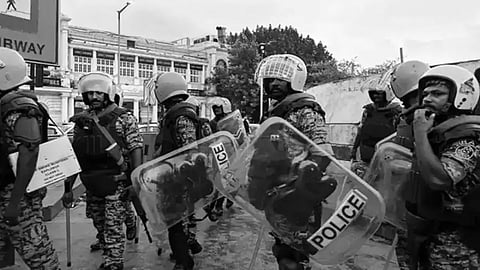
Injured protestors move Supreme Court seeking ban on use of pellet guns by law enforcement to disperse civilian assemblies

The petition filed by a former Special Director in the Intelligence Bureau and two victims of the RAF firing claims that the RAF fired metallic pellets suddenly into the crowd on July 20.
Injured protestors move Supreme Court seeking ban on use of pellet guns by law enforcement to disperse civilian assemblies
Published on

WHILE THE STUDENT PROTESTS led by the Cockroach Janta Party at the Jantar Mantar might have come to a halt with the realisation of its central demand in the form of a resignation of  Union Education Minister Dharmendra Pradhan the brunt of the brute force used by the forces deployed at the protest on the peaceful protesters have not ceased to exist. 

In a disturbing series of developments, a general diary entry filed at the Parliament Street police station explicitly records that the Rapid Action Force (‘RAF’) fired two rounds from an anti-riot gun on the directions of the Deputy Commissioner of Police (‘DCP’) of Delhi Police. 

On July 27, a PIL was filed in the Supreme Court seeking the issuance of a writ of mandamus or any other appropriate writ or direction by the Supreme Court on ‘decommissioning or banning the use of wholly or partly metallic kinetic projectiles/pellets from pump action rifles or projectile action guns (PAG)’ by the law enforcement agencies for the purposes of ‘crowd dispersal of civilian assemblies’ along with the grant of ‘exemplary compensation to all victims of pellet injuries which was caused by the state action on the said date along with ensuring the availability of complete medical treatment, care and rehabilitation of the said victims’.

RAF fired ‘splinter like pellets’ without provocation

The writ petition, filed by a former Special Director in the Intelligence Bureau and two victims of the RAF firing who bore pellet injuries, premises itself on the “Sansad Chalo” march organized by the Cockroach Janata Party on July 20, 2026. The petitioners, represented by advocate Vrindra Grover, were present at the site of the protest and personally witnessed that the police and the RAF had resorted to filing tear gas shells and lathi charge as they pushed the protesters towards the inner circle of Connaught Place in New Delhi. With no announcements made so as to caution against the plausible usage of force by the forces deployed by the government at the site, RAF personnel suddenly fired PAG whilst the protesters were fleeing from the site with many raising their arms up evidently communicating their intent of facilitating no harm almost in a "surrender" mode.  

The ‘splinter like pellets’ then penetrated the bodies of the petitioners resulting in immediate pain and bleeding. The petitioners then received medical treatment including a ‘surgical intervention for the removal of pellets lodged deep in their body’. Later reports and visuals emerged showing  RAF personnel firing the metallic pellets and people suffering injuries as a result of the same. The RAF on the other hand has also ordered a ‘verification exercise’ to examine the allegations of use of excessive force with the RAF chief expressing displeasure over the usage of PAG.

‘Lathi charge and tear gas shelling violation of SOP’

The petition argues that Right to freedom of assembly under Article 19(3) is amenable to being curbed only through the modality of reasonable restrictions acting as the foremost ground. Further, it notes that Sections 148 and 149 of the Bhartiya Nagarika Suraksha Sanhita, 2023, which deal with the dispersal of assembly by use of civil force and use of armed forces explicitly contain the employment of a command to disperse to an assembly following the usage of civil force. They note that the armed forces can be a last resort only upon receiving an order from a District Magistrate or an Executive Magistrate. The petition questions the lawfulness of the act of resorting to the usage of pellet guns when the protesters  were already in the midst of retreating from the site of protest. 

It notes that while bullets fired from a gun have a ‘targeted nature’, the latter ‘sprays into a wide area which thereby increases the propensity of injuring the eyes and other vital organs of persons in an assembly’. 

The writ petition, filed by a former Special Director in the Intelligence Bureau and two victims of the RAF firing who bore pellet injuries, premises itself on the “Sansad Chalo” march organized by the Cockroach Janata Party on July 20, 2026.

The petition also raises the ground of  violation of SOP which was developed ‘to deal with public agitations with non-lethal measures’ which permits the usage of “minimum necessary force” as the respondents directly resorted to lathi charge and tear gas shelling without any usage of the water cannons.  

Lastly the petition also makes a reference to the United Nations Code of Conduct for Law Enforcement Officials which was adopted by the General Assembly in 1979, which laid down that ‘use of force is only permissible when strictly necessary and to the extent required for the performance of their duty whilst mandating that the officials have the duty to ensure human dignity and uphold the human rights of all persons’ along with the UN Guidance on Less Lethal Weapons in Law Enforcement which was issued in 2020 which strictly advises against the usage of metal pellets.

The Leaflet
theleaflet.in