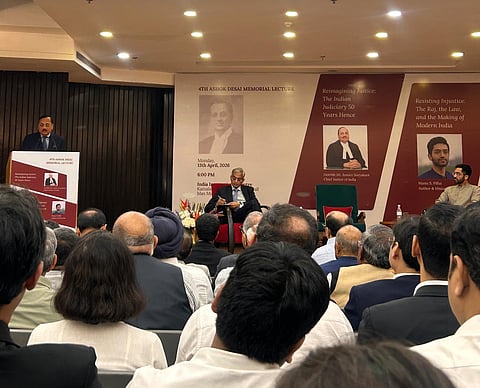

YESTERDAY, the 4th Ashok Desai Memorial Lecture opened with a lecture by historian and author Manu S. Pillai, followed by the Chief Justice of India (‘CJI’) Surya Kant. The hall drew a full house of lawyers, academics, students and public intellectuals. The lecture was organised as a tribute to the life and legacy of Ashok H. Desai, Senior Advocate at the Supreme Court, who served as Attorney General for India from 1996 to 1998 and was awarded the Padma Bhushan in 2001.
Manu S. Pillai on the Raj and the Law
Pillai spoke on ‘Resisting Injustice: The Raj, the Law, and the Making of Modern India’. Drawing on his long engagement with pre-colonial and colonial history, he argued that India’s traditional legal landscape was far more complex and decentralised than the uniform colonial framework that came to replace it and that Indians, confronted with an alien legal and administrative order, did not simply submit to it. They found creative ways to appropriate its instruments, turn its languages and concepts to their own purposes, and in doing so, helped lay the groundwork for the constitutional republic that followed.
Pillai opened with the story of Kuriyedathu Thatri, a Namboodhiri woman from the erstwhile Kingdom of Cochin who, accused of conducting affairs with sixty-five men across different castes and classes, was put to trial in 1905. While Thatri was subjected to a ‘smartha-vicharam’, a traditional tribunal of elders, her case coincided with a moment when old customary forms were colliding with new judicial instruments that came up due to colonial influence. For the first time, the accused men were permitted to cross-examine her; for the first time, the press carried regular updates and a broader public was engaged. Thatri herself, Pillai noted, responded to her interrogators with the precision of a trained barrister, recalling dates, locations and identifying marks on the bodies of men who denied knowing her. A humorous twist to the story, Pillai added, holds that the trial was abruptly ended at sixty-five names because the sixty-sixth would have been the Raja of Cochin himself!
