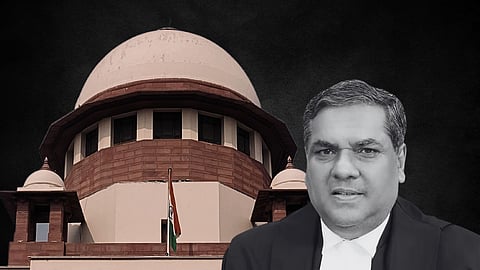

ON SUNDAY, THE IN-HOUSE COMMITTEE formed by Chief Justice of India Sanjiv Khanna to inquire into the allegations against Justice Yashwant Varma, the then sitting judge of the Delhi High Court, in whose residence sacks of burning cash were reportedly discovered, submitted its report to the Chief.
The committee was formed on March 22 under the In-House Procedure adopted by a full court of the Supreme Court in 1999. The committee to probe allegations against Justice Varma comprised Justices Sheel Nagu, G.S. Sandhawalia and Anu Sivaram, Chief Justices of the Punjab & Haryana and Himachal Pradesh High Courts, and judge at the Karnataka High Court, respectively.
Earlier, CJI Khanna decided to make public the report of the Chief Justice of Delhi High Court D.K. Upadhyaya which was submitted to the former. The Supreme Court also made public the response provided by Justice Varma to the allegation that burnt currency was discovered at a storehouse situated within the premises of the official bungalow allotted to Justice Varma.
Meanwhile, Justice Varma was transferred to his parent high court in Allahabad on March 28. Presently, he is divested of any judicial work.
As per the in-house procedure, the committee is required to conclude:
I. Is there no substance in the complaint/allegations?
II. Whether there is sufficient substance in the allegations and is the misconduct disclosed so serious as to warrant the removal of the judge concerned?
III. If there is substance in the allegations whether the misconduct disclosed is not of such a serious nature that removal of the judge concerned is warranted?
If there is no substance in the complaint, the CJI under the in-house procedure is required to close the case.
If the committee finds sufficient substance in the complaint/allegations and the misconduct disclosed is so serious as to warrant the removal of the judge concerned, the CJI has the following options available to him:
CJI will ask the judge concerned to resign from office or seek voluntary retirement
If the judge concerned refuses to resign, the CJI will ask the Chief Justice of the concerned High Court not to assign him judicial work. At the same time, the CJI will also write to the Prime Minister and President about the same and state that it has been done because the allegations against the judge concerned are found to be serious, warranting his removal.
If the committee finds substance in the allegations but the misconduct disclosed is not serious enough to call for removal, the CJI, in that case, will call the judge concerned and simply advise the judge accordingly.
The in-house procedure also has backing of the Supreme Court's decision in Addl. District & Sessions Judge ‘X’ v. High Court of M.P. (2014). In that case, a two-judge Bench held that “In-House Procedure” framed by the Supreme Court can be adopted to examine allegations against high court and Supreme Court judges.
It was also held that even though the procedure should ordinarily be followed in letter and spirit, the CJI has the authority to mould the same per the facts and circumstances of a given case, to ensure that the investigative process affords safeguards against favouritism, prejudice or bias.
At present, the report of the in-house committee on Justice Verma is not in the public domain. Therefore, it is difficult to say what the committee has concluded. Any action of the CJI under the in-house procedure is solely guided by the in-house inquiry report.
It is also not clear whether the in-house committee report will be made public. The Supreme Court in Indira Jaising vs. Registrar General,Supreme Court of India & Anr. (2003) held that the report is only for the satisfaction of the CJI. It is purely preliminary in nature, ad hoc and not final.
This decision was cited by the Supreme Court (on administrative side) to deny the report of the in-house inquiry committee, which gave a clean chit to the then CJI Ranjan Gogoi concerning allegations of sexual harassment against him. Even the victim was not given the report. Importantly, in the Addl. District & Sessions Judge ‘X’ case, the Supreme Court considered the Indira Jaising decision (2003) and held that those who are liable to be affected by the outcome of the In-House Procedure have the right to seek judicial redressal on account of a perceived irregularity. The irregularity, the Court held, could be on account of the violation of the contemplated procedure, or even because of contemplated bias or prejudice. It may be on account of impropriety.
Further, notably, the Indira Jaising decision came two years before the enactment of the Right to Information Act. With the RTI Act’s introduction, the Indian legislative framework has transformed to favour transparency in governance, and RTI’s scope has increasingly included the higher judiciary’s functioning. In 2019, a five-judge Constitution Bench even noted that judicial independence did not stand in contradiction with the need for transparency. Given this, the propriety of relying on the pre-RTI era Indira Jaising decision should be reconsidered.
Under the Constitution, a judge of the High Court and the Supreme Court cannot be removed except by process of removal by a majority of the House and a majority of not less than two third present and voting as provided by Articles 124 and 217 of the Constitution of India.
The Judges (Inquiry) Act, 1968 provides for the manner of conducting an inquiry into the allegation of judicial conduct. It kicks in when a motion of impeachment by at least hundred Lok Sabha members or fifty Rajya Sabha members is presented in the House. The Presiding Officer of the concerned House has the power to constitute a Committee consisting of three persons.
There are at least two instances in the public records when the CJI, based on the report of an in-house inquiry, called for the impeachment of the concerned judge.
In January 2018, the In-house inquiry indicted the then-judge of the Allahabad High Court, Justice Narayan Shukla, for his involvement in the alleged medical college bribery case.
A month later, the then CJI Dipak Misra had written to the Prime Minister to initiate his removal.
Justice Shukla, however, was never impeached as no motion for his impeachment was ever moved in the Parliament. He eventually retired on July 17, 2020 after a full two-and a half years of not doing any judicial work even as he received full salary for all that time.
In 2023, Central Bureau of Investigation registered a First Information Report (FIR) against him under the Prevention of Corruption Act, 1988 for allegedly amassing assets worth Rs. 2.45 crore, disproportionate to his known source of income during his tenure as a judge of the High Court between 2014 and 2019.
Previously in August, 2008, the then CJI K.G. Balakrishnan had written to the Prime Minister seeking removal of Justice Soumitra Sen from the Calcutta High Court who was found guilty of misappropriation of money which brought disrepute to the high judicial office and dishonour to the institution of judiciary.
Acting on the letter of CJI Balakrishnan, Rajya Sabha MPs belonging to different political parties signed on the "Notice of Motion" to remove Justice Sen. The then Chairman of the Rajya Sabha, after the said motion was admitted, constituted a three-member inquiry committee and thereby set the removal process in motion. Eventually, the three-member committee set up under the Judges (Inquiry) Act found Sen guilty. Justice Sen resigned before the impeachment motion could be voted upon in the Rajya Sabha. The motion was passed in Lok Sabha.
In the case of Justice Yashwant Varma, much depends upon what is in store in the report of the in-house inquiry. It is important to note that the in-house inquiry is not a substitute of inquiry which is required to be held under the Judges (Inquiry) Act if the notice to remove him is admitted in either house of Parliament.