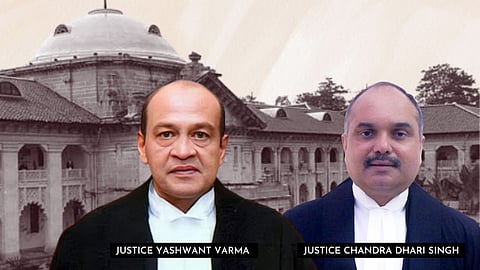

ON FRIDAY, MARCH 28, the Union cleared the transfer of Justice Yashwant Varma from the Delhi High Court to his parent high court - the Allahabad High Court. This has come despite the Allahabad Bar Association’s vocal opposition to the repatriation of Justice Varma to Allahabad.
Justice Varma has been in the eye of the storm ever since news broke out that burnt currency was discovered in a storehouse adjacent to his official residence after a fire broke out. On March 22, Chief Justice of India Sanjiv Khanna shared the video allegedly showing piles of burnt currency being discovered by fire responders.
Justice Varma is currently facing an in-house inquiry constituted by CJI Khanna and is divested of discharging any judicial function.
In a meeting held on March 20, 2025, the Collegium which comprises CJI Khanna and Justices B.R. Gavai, Surya Kant, Abhay S. Oka and Vikram Nath had decided to transfer Justice Varma to the Allahabad High Court, and a formal decision was taken on March 24.
At the Delhi High Court, Justice Varma is a part of the High Court Collegium and third in seniority. In the Allahabad High Court, he will be at serial number nine in seniority inter-se among the judges in the High Court.
Justice Chandra Dhari Singh also repatriated
On September 16, 2021, the then-Collegium headed by CJI N.V. Ramana had recommended the transfer of Justice Varma to the Delhi High Court along with Justice Chandra Dhari Singh.
The government has also cleared the transfer of Justice Singh to the Allahabad High Court, his parent high court. The Collegium, headed by CJI Khanna, had decided to send Justice Singh to the Allahabad High Court on November 29, 2024. However, the government took four months to approve the Collegium's recommendation.
Transfers to High Courts of Delhi and Allahabad
Yesterday, the Collegium also recommended the transfer of Justice Dinesh Kumar Sharma from the Delhi High Court to the Calcutta High Court.
The government has also cleared the transfer of Justice Arindam Sinha from Orissa High Court to the Allahabad High Court. Justice Sinha, originally from Calcutta High Court, is presently functioning as Acting Chief Justice of the Orissa High Court. His transfer was recommended by the Supreme Court Collegium on March 6, 2025.
Union continues to sit over other transfers
Even though the government has cleared these three transfers, it has been sitting over the recommendation of the Collegium to transfer four judges of the Gujarat High Court. On August 3, 2023, the Supreme Court decided to transfer Justices Alpesh Y. Kogje, Kumari Gita Gopi, Hemant M. Prachchhak and Samir J. Dave to the High Courts of Allahabad, Madras, Patna and Rajasthan, respectively. However, the recommendations have been gathering dust at the Ministry of Law and Justice for over a year.
The same is the case with the proposed transfer of Allahabad High Court’s Justice Prakash Padia to the Jharkhand High Court. The Collegium had recommended Justice Padia's transfer on August 10, 2023. The recommendation is yet to be given effect.
The Collegium had also recommended the transfer of Justice Rajnish Bhatnagar from the Delhi High Court to the Rajasthan High Court, for better administration of justice. Justice Bhatnagar subsequently retired from the Delhi High Court and the recommendation to transfer him was thus rendered infructuous by the government.
On November 16, 2022, the Collegium proposed the transfer of the then Acting Chief Justice of the Madras High Court, Justice T. Raja, to the Rajasthan High Court.
The recommendation was reiterated on April 19, 2023 when the Collegium requested the government to effectuate his transfer at the earliest. But a defiant Union government refused to budge. Justice Raja was allowed to retire from the Madras High Court in May 2023.
On April 20 last year, the Collegium was compelled to recall its six-month-old recommendation to the Union government to appoint Orissa High Court Chief Justice Dr S. Muralidhar as Chief Justice of the Madras High Court, conceding to the government's refusal to give effect to the recommendation.
Concerns around the cherry-picking of Collegium resolutions
The Supreme Court on the judicial side has expressed concerns over the government's cherry-picking collegium's recommendation.
On November 20, 2023, when a Bench headed by Justice Sanjay Kishan Kaul took up a contempt petition against inaction over the Collegium's recommendation, the Attorney General of India requested it to take up the matter later and assured the Court that efforts would be made to ensure the recommendations are acted upon.
The Bench acceded to the request of the Attorney General and directed to list the matter on December 5, 2023.
However, the contempt petition was never listed on December 5, as directed by the Bench. When advocate Amit Pai mentioned the matter before Justice Kaul, who was set to retire in a few weeks, he informed Pai that he had not deleted the petition from his court nor was he unwilling to hear it.
Later, when on the same day, advocate Prashant Bhushan mentioned the matter and urged the Bench to seek an explanation about the “very strange” deletion of the matter from the registry, Justice Kaul said, “I am sure the Chief Justice (of India) is aware of it.”
He added cryptically, “Some things are best left unsaid.” At that time, CJI D.Y. Chandrachud was the master of the roster.
The contempt petition, which the bench led by Justice Kaul had been hearing, has been listed for hearing only once since November 2023 - in October 2024. Meanwhile, recommendations on the transfer of judges as well as the appointment of judges continue to remain pending with the government.
CJI Khanna has not listed the contempt petition for hearing till date since taking over the office of the CJI.
The transfer of judges including a Chief Justices of High Courts from one High Court to another is made as per Article 222(1) of the Constitution.
The initiation of the proposal for the transfer of a judge is made by the CJI. The CJI recommends the transfer of a High Court judge in consultation with the four senior-most judges of the Supreme Court, which form the Collegium. The Collegium is also required to ascertain the views of the Chief Justice of the High Court from which the transfer is to be effected and of the Chief Justice of the High Court to which the transfer is to be effected.
The transfer is made for "better administration of justice". The consent of a judge for his first or subsequent transfer is not required.
In the Second Judges case (1993), a nine-judge Constitution Bench held that the opinion of the CJI not only has primacy but is also determinative in matters of transfer of High Court Chief Justices and judges.