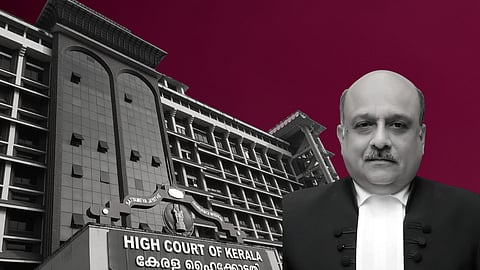

ON APRIL 3, the Supreme Court Collegium headed by Chief Justice Sanjiv Khanna formally passed a resolution to recommend the transfer of Justice Sushrut Arvind Dharmadhikari from the Madhya Pradesh High Court to the Kerala High Court.
The Collegium mulled over the transfer of Justice Dharmadhikari for the first time on March 20, the day when it initiated the transfer of Justice Yashwant Varma shortly after remains of burnt currency were allegedly discovered in the storehouse situated on his official residence.
Justice Dharmadhikari was the third senior judge in the Madhya Pradesh High Court until very recently, when Justice Atul Sreedharan was brought back to his parent high court from the Jammu and Kashmir High Court. Now, Justice Dharmadhikari is fourth in seniority in the Madhya Pradesh High Court.
Justice Dharmadhikari was appointed as judge of the Madhya Pradesh High Court on April 7, 2016, and is due to retire on July 7, 2028. If the Union government accepts the recommendation of the collegium to transfer him to the Kerala High Court, he will be eight in seniority among the judges of the Kerala High Court.
Since the collegium and opacity go hand in hand, we do not know the exact reason behind the transfer of Justice Dharmadhikari. What we do know is that all transfers are presumably made in public interest for the better administration of justice.
It is a different matter that the statement issued by the collegium regarding his transfer does not even mention this customary justification, which is often provided to explain the transfer of a High Court judge.
As per the Second judge's case (1993), the recommendation by the CJI to transfer a judge cannot be deemed to be punitive and any such transfer is not justiciable on any ground which means that it cannot be challenged in a court of law.
However, it begs the question of what material the collegium had to conclude to transfer Justice Dharmadhikari. It cannot be the case that it was decided without any material in possession forming the basis for the collegium to transfer him out ostensibly for better administration of justice.
We know that Justice Varma was repatriated to his parent High C - theAllahabad High Court, after following a controversy over alleged cash having been found in the premises of his official residence. No matter how much the collegium tried to convince the public that his transfer was independent of the controversy surrounding him, the fact remains that the proposal to transfer him was listed on March 20, 2025, before the Collegium by CJI Khanna.
CJI Khanna was apprised of the alleged cash found at the residence of Justice Varma on March 15 by the chief justice of the Delhi High Court. Thus, there is a clear chain beginning from March 15, leading to Varma's transfer.
In the case of Justice Dharmadhikari’s transfer, we have no probable information which may explain the considerations that might have weighed with the collegium to transfer him to the Kerala High Court where he stands eighth in seniority.
Certain facts need to be put out to draw the chain of events to understand the transfer of Justice Dharmadhikari.
On February 4, 2025, a Division Bench of the Supreme Court comprising Justices Abhay S. Oka and Ujjal Bhuyan censured Justice Dharmadhikari, who headed a Division Bench at Indore bench of the Madhya Pradesh High Court.
Justice Dharmadhikari was dealing with writ petitions concerning the conduct of the election of the governing body of a society, ‘Shri Astha Foundation for Education’, registered under the Madhya Pradesh Societies Registration Act, 1973.
On April 23, 2024, a Division Bench led by Justice Dharmadhikari, among other things, had ordered the Registrar, Firms and Societies to perform the statutory duty and act upon the representation made by the petitioners and conduct free and fair election of the society as per the list of members and governing body of the last election on January 30, 2016 in accordance with law.
The petitioners before the High Court were the members of Shri Astha Foundation, which is an educational society established in the year 2006, and which has 21 members (as of January 30, 2016). As per the by-laws of the society, a 2/3rd majority is required to pass any resolution, remove any member, etc. and the tenure of the elected body is three years.
This order was challenged by ‘Shri Astha Foundation for Education’ and others before the Supreme Court.
On May 15, 2024, a Supreme Court Bench of Justices Oka and Bhuyan upheld the direction to conduct elections but importantly set aside the direction to hold the election based on the list of members/voters as of January 30, 2016.
The bench observed that the elections that would be held in 2024 could not be based on the list of members or voters as prevailing on January 30, 2016.
The bench, therefore, remanded the matter back to the High Court only for a limited purpose of deciding the issue of list of voters on the basis of which election should be held.
On remand, Justice Dharmadhikari passed a final order on October 4, 2024. In his order, he commented upon the Supreme Court's order of May 15, 2024. He said:
"We must highlight that we are mindful of the specific direction given by the Hon’ble Apex Court that election shall not be held on the basis of list of members/voters as on 30.01.2016. However, considering the manner in which the parties pursued litigation in the first round, it is to be noted that such direction was given based on incomplete material placed on record before the Hon’ble Apex Court."
He added:
"While we acknowledge this instruction with all respect and humility at our command, though at the same time, we also wish to inform the Hon'ble Apex Court that upon re-examination of the matter, we encountered a substantial array of new pleadings leading this Court in a position of divergence from that specific direction for reasons mentioned above. On appreciation of pleadings brought on record on remand and examining the material placed on record from 2016 till date, i.e., 2024, the actions undertaken by the parties appear to fall short of the expectations outlined in the order of remand. "
He went on to say:
"After carefully reviewing the records, along with the Registrar's report, we are of the firm opinion that the annual list dated January 30, 2016 is the only valid and 5 legally constituted list of the Society's governing body in accordance with the 2007 byelaws till date. All (lie subsequent annual lists as brought on record lack conformity with the 2007 bye-laws and do not provide sufficient evidence to establish their legitimacy.”
As can be seen, Justice Dharmadhikari indulged in gross judicial impropriety by commenting on the order of remand passed by the Supreme Court. He even ordered, once again, to hold elections as per the list of voters as of January 30, 2016, which the Supreme Court had already found to be impermissible.
Commenting on Justice Dharmadhikari's order, Justice Oka led Bench noted that the "High Court has virtually set at naught the order of this Court."
The Bench added,
"As can be seen from the operative part of the impugned judgment and what is held in paragraph 74, the High Court directed the Registrar, Firms and Societies, Madhya Pradesh to conduct free and fair election of the society as per the list of members/voters dated 30th January, 2016. Therefore, the High Court has passed an order which is completely contrary to order of this Court."
Justice Oka further noted,
"When this Court in so many words held that election shall not be held on the basis of list of members/voters as on 30th January, 2016, the High Court has specifically directed that election shall be held on the basis of list of members/voters dated 30th January, 2016. We do not wish to offer any further comments about what is held in paragraph 74. With some justification, it can be said that the order of the High Court is an act of judicial impropriety"
The Justice Oka led Bench not only quashed the order of Justice Dharmadhikari and the elections held pursuant to the order of Justice Dharmadhikari, it also restored the writ petition and asked the Chief Justice of Madhya Pradesh High Court to assign the petition to a different judge.
For the time being, the Bench formed an ad hoc Committee headed by Shantanu Sharadchandra Kemkar, a former Judge of Madhya Pradesh and Bombay High Court to manage the affairs of the Society.
Did this incident of judicial impropriety on part of Justice Dharmadhikari lead to his ousting from the Madhya Pradesh High Court? Justice Oka himself is part of the Supreme Court Collegium, which takes calls on the transfer of judges.
Though there is no definitive answer available as the collegium has not made available the copy of the resolution in public, the chain of events as narrated above strongly indicate that the order passed by Justice Oka censuring Justice Dharmadhikari may have weighed with the collegium to make a recommendation to transfer him out of the Madhya Pradesh High Court.
Last year, the Supreme Court encountered certain averse remarks made by a Punjab and Haryana High Court judge, Justice Rajbir Sehrawat.
In a suo motu proceedings, a five-judge Bench not only expunged "gratuitous" observations in regard to orders by the Supreme Court, it also observed that compliance with the orders passed by the Supreme Court is not a matter of choice, but a constitutional obligation. This was bearing in mind the structure of the Indian legal system and the authority of the Supreme Court which heads the process of judicial adjudication of the country.
It is a different story that a full court of the Supreme Court found the same judge, Justice Sehrawat, worthy of being conferred with the senior gown on April 3, 2025. This comes even though a Bench led by Justice Oka has been expressing concerns as to how to determine the integrity of candidates who seek the senior advocate designation.
Certainly, strictures passed by the Supreme Court against lawyers or judges cannot be taken lightly and must be taken into consideration to confer what they describe as ‘privilege’ of the senior gown.
