
THE RECOGNITION OF CASTE in the Constitution of India, 1950 was not an accident. It was a well-deliberated exercise of recognising what the Hindu, Brahminical order had cemented in Indian society through centuries of brokering power, status, and resources. While the institution of caste predates most faiths and belief systems that exist on the face of earth today, it is noteworthy that the institution itself is not a time-capsule, frozen in time. It keeps shaping and getting shaped by other belief systems that interact with caste— which can be seen in many interesting examples throughout the subcontinent. Be it the Roman Catholic Brahmins (the RCBs), or the Jatt Sikh and Mazhabi/Ravidassia Sikh binary— a faith unfamiliar with caste (Roman Catholicism) and a faith built upon the claim of egalitarianism (Sikhism) both show elements of caste when it comes to practice.
The Indian Constitution recognised the discrimination experienced by the Dalits, and classified the Dalit castes into a Schedule: thus the identity being called “Scheduled Castes (‘SC’)”. A similar exercise was done for the indigenous tribes in India, leading to their identification as “Scheduled Tribe (‘ST’)”. This was not merely an exercise in classification, but an exercise in recognition of a pattern which was common across the country, and hence required additional remedial measures. The measures began with the prohibition of untouchability, and further allowed the state to make laws for the benefit of, inter alia, these protected identities.
However, the Constitution (Scheduled Castes) Order, 1950, issued under Article 341, contains a categorical religious bar: it restricts SC status exclusively to Hindus, with subsequent amendments in 1956 and 1990 adding Sikhs and Buddhists respectively. The law presumes that only these “Hindu and Hindu-adjacent” faiths retain the stigma of untouchability.
Does conversion legally extinguish caste status?
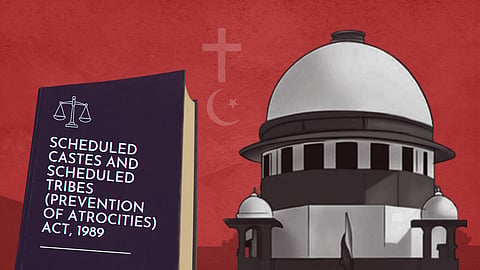
On March 24, in Chinthada Anand v. State of Andhra Pradesh(2026), the Supreme Court ruled that a person who has converted to Christianity cannot be recognised as a member of a Scheduled Caste. The appellant in the case was born into the Madiga community (categorised as SC) and later converted to Christianity and served as a pastor. He alleged that he was subjected to physical assault and caste-based slurs by members of the Reddy community in Guntur district, Andhra Pradesh. When he attempted to invoke the Scheduled Caste and Scheduled Tribes (Prevention of Atrocities Act), 1989 (‘SC/ST Act’), he was faced with a legal barrier— he was a Madiga in the eyes of the persons who invoked his caste in their caste-based slurs, but in the eyes of the law, he did not belong to a Scheduled Caste at all. The core issue framed by the Supreme Court in this appeal was – whether a person who professes a religion different from Hinduism, Sikhism, or Buddhism can remain a member of a Scheduled Caste to invoke the special protections of the special law, or does such conversion results in the legal extinction of their caste status?
The division bench of Justices Prashant Kumar Mishra and Manmohan held that the appellant’s decade-long service as a pastor constituted a public avowal of Christianity. Drawing on its previous decision in Punjab Rao v. D.P. Meshram (1965), the Court reasoned that once an individual adopts an egalitarian faith, their caste status is eclipsed. It is noteworthy that the “egalitarian faith” in question in Punjab Rao was Buddhism, which, back in 1964 when the case was heard, was yet to be included within SC status (as mentioned previously, it would only be included in 1990).Therefore, the Court in Chinthada Anand dismissed the reliance on state-level executive orders that offered benefits to converts, clarifying that such orders cannot override a Presidential Order. It consequently ruled that the SC/ST Act—a special legislation—could not be invoked by a Christian, regardless of the caste-based nature of the slur or the violence used against him.
Before looking at the judgment itself, it must be noted at the outset that the 1950 Presidential Order, with all its modifications including the ones which may be made in the future, is an instrument malleable to influence by political mobilisation. While the flexibility itself is not an issue, i.e. the inclusion and exclusion will have to be an administrative exercise, the import thereof is that this can very well be a majoritarian exercise. As shall be discussed below, this makes the exercise of conferment of SC/ST status by strategically including and excluding certain religious identities a passive, colourable method of discouraging religious conversion. The premise of a constitutional order is to protect the rights of the few against the wants of the many, and hence such a heavy reliance on an Order which can be arbitrarily modified to varying outcomes, is a less than ideal situation.
Conflating two legally different instruments: SC/ST Act v. Presidential Order
What the judgment fails to see is the lack of necessary nuance in the law. While it is true that the idea of caste and untouchability is a product of the Hindu imagination, it does not logically follow that the practice of the same is necessarily restricted to the believers and practitioners of the Hindu faith. This logical fallacy in the Court’s rationale, of creating a false equivalence between religious teachings on one hand, and the practice of the followers of the religions on the other, proved to be fatal to the appellant’s case.
This legislative vacuum emerges from the fact that the SC/ST Act defines a victim as a member of a Scheduled Caste or Tribe as deemed under Articles 341 and 342 of the Constitution, essentially tethering the Act’s protections to the 1950 Order. While it would seem reasonable at first glance, it is noteworthy that the Act was put in place to criminalise a certain class of actions, i.e. acts of “atrocities” committed by non-SC/STs on SC/STs, which were of the nature of caste-based hate crimes, indignities, and attacks on and threats to their person and property. This implies a recognition of a separate class of acts which can be considered “atrocities”, which had a definitive identity (SC/ST) concern to it, and could not be sufficiently addressed by the existing penal laws or the Civil Rights Act, 1955.
In that regard, since it is a criminal law, what should matter is if there were the requisite mens rea, i.e. knowledge or intention to commit an “atrocious” Act against a person based on their specific SC/ST identity. Bringing the religious identity of the victim/complainant into the picture would be a classic case of status reclassification paradox. The act of “atrocity” was carried out on clear caste lines, i.e. the Appellant was attacked because he was not Christian but Dalit in the eyes of the defendants, but later by the operation of the classifying law, the same defendants would now argue that the Appellant is not a Dalit.
The legal assumption that conversion provides an escape from caste is a fiction contradicted by centuries of Indian social history. Caste is a structural reality determined by birth and social treatment, not a theological choice. Extensive ethnographic data, including the Justice Ranganath Misra Commission Report, is testament to the same. The report, published in 2007, explicitly noted that placing a person in the SC list if they are Hindu but in the OBC list (i.e. excluding them from the SC list) if they are Christian is a form of religion-based discrimination. The Sachar Committee, in 2006, and the Mandal Commission, back in 1980, had similarly recognised that social disabilities persist regardless of the faith of the individual. The practice of caste in India is, therefore, religion-agnostic.
The deepest flaw in Chinthada Anand is the conflation of two legally distinct instruments serving disparate purposes. The 1950 Order is a classificatory instrument designed to define eligibility for affirmative action and reservations. Its religious bar is an executive tool for distributing state largesse. While the correctness of its existing classification is questionable in its own way (the Punjab Rao decision in 1965 and the subsequent inclusion of Buddhists thirty years later, being a prime example of this), it is important to note that the SC/ST Act is a penal instrument. Its purpose is not to grant a benefit, but to deter and punish conduct directed at a person because of their perceived caste identity.
The Court imported the 1950 Order’s definition into the Act without asking if this served the Act’s protective purpose. If a perpetrator assaults a man while using Madiga slurs, the mischief of the Act, which is caste-motivated violence, is complete. By requiring the victim to meet the test of a reservation order to access criminal justice, the Court allowed administrative classification to obfuscate penal reality.
The judgment reflects a very myopic understanding of caste, prioritising religious dogma over hard sociological evidence. In order to substantiate that Christianity is ‘egalitarian’, and hence incompatible, with caste, the Court even refers to a verse from the New Testament, that reads, “There is neither Jew nor Gentile, neither slave nor free, nor is there male and female, for you are all one in Christ Jesus.”
But to what extent does theological absence of caste or caste-like hierarchies in the Christian faith translate to the sociological reality of Indian Christian life?
Gatekeeping reservations to deter religious conversion?
Another thing worth pondering, is that there is a perceptible, although unstated mischief in this line of reasoning that aids a broader political lobby: the use of reservation gatekeeping to deter religious conversion. By making the loss of SC status immediate and complete upon conversion, the state creates a punitive environment for religious choice. The law, as interpreted here, tells the Dalit citizen that they may have spiritual freedom only at the cost of protection under law.
The absurdity of this interpretation is best illustrated by the differential treatment of SCs and STs. The Scheduled Tribes Order, 1950 has no such religious bar, i.e. a tribal person remains a member of a Scheduled Tribe regardless of conversion. This creates a statutory anomaly: if Christian tribal man faces discrimination from a non-tribal person, the SC/ST Act could still technically apply. However, the same atrocity directed at a Christian Dalit now falls outside the scope of statute by the operation of this judgment.
The ruling in Chinthada Anand, therefore, marks a retreat from substantive equality. By failing to distinguish between the classificatory function of the Presidential Order and the protective function of the SC/ST Act, the Court has left millions of Dalit Muslims and Dalit Christians in a legal vacuum.
The correct approach ought to have been a purposive interpretation: the SC/ST Act should protect anyone targeted for their caste identity, irrespective of their current faith. Until the legislature de-links SC status from religion—as recommended by the Ranganath Misra Commission—or the judiciary recognises the intersectional nature of caste and religious identity, certain provisions of the Criminal law as well as of the Constitution will remain a dead letter for those who are socially untouchable, but legally invisible. The wait for a jurisprudence that understands intersectionality and the social realities of caste and religion; and can differentiate between a theological text and religious practice, seems to continue for the time being.