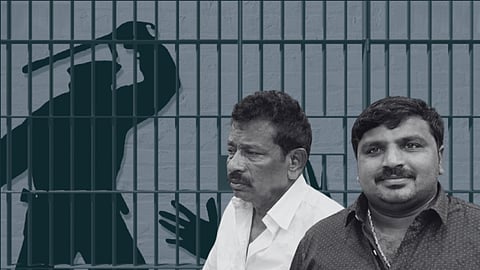
Sathankulam Horror: A Conviction and a Reminder on India’s long march to Custodial Justice

Six years after a father and son were brutally tortured and killed in custody, a trial court has finally convicted nine Tamil Nadu policemen. But amidst a breakdown of accountability institutions across India, what does the future of custodial violence in India look like?
Sathankulam Horror: A Conviction and a Reminder on India’s long march to Custodial Justice
Published on

CUSTODIAL VIOLENCE has been a never-ending saga in India. Recent figures from the NHRC reveal that only since the beginning of this year, as of March 15, there had been 170 recorded custodial deaths. During this time, Tamil Nadu has seen a series of 4 custodial tortures leading to death. Under a government that boasts of its stance on social justice, these deaths raise immense discomfort, doubt and concern. Hardly two days after the UN expert condemned the situation of torture in India, Tamil Nadu recorded its twenty sixth custodial death under the regime of the present government. This year, within the span of two months, four of those killed in custodial violence in Tamil Nadu hailed from Dalit communities. 

At the same time, recently a judgment in a criminal trial on a custodial torture and death case, that shook national conscience in 2020, has been greatly welcomed. In a state, and a country, where there is no law against torture, even after signing the UN Convention Against Torture (‘UNCAT’) in 1997, the decision reinstates a sense of faith in the judicial institutions.

The Sathankulam Horror

On June 19, 2020, in the town of Sathankulam in Tamil Nadu, Jeyaraj was picked up by the police for having his shop open after the imposed curfew during the COVID-19 lockdown. Shortly after, his son Bennicks went to the police station to inquire about the arrest of his father, while he was illegally detained. From the night of June 19 until the early morning of the following day, June 20, the father-son duo were subjected to brutal torture under the orders of the Station House Officer. They were beaten with lathis and iron rods, leading to profuse bleeding. Investigation reveals that they were forced to wipe the blood stains from the floor of the police station using their own clothes in order to hide the evidence. 

Hardly two days after the UN expert condemned the situation of torture in India, Tamil Nadu recorded its twenty sixth custodial death under the regime of the present government.

As is routine with custodial death cases, here too, the doctor in question, Dr Vinila, from the Sathankulam government hospital failed to record the injuries, clearing them as “fit for remand”. On June 20, they were remanded and taken to the Kovilpatti sub-jail, where on June 22,, 2020, both the father and the son complained of breathing difficulty. Upon being taken to the hospital, Benniks breathed his last on the night of June 22, followed by the death of his father Jeyaraj in the early hours of June 23, 2020. 

A persistent litigation for justice

Immediately after the incident, on June 24, 2020, the Madurai Bench of the Madras High Court took suo motu cognisance of the case, with the now-retired judge Justice P.N.Prakash and Justice B. Pugalendhi, ordering a CBCID probe into the matter. The Judicial Magistrate who was inquiring into the case was offered police protection and in a first of such events, the police station was ordered to be locked, in order to preserve the evidence. 

Sathankulam Horror: A Conviction and a Reminder on India’s long march to Custodial Justice
What RTI data reveals about custodial torture, lack of CCTV facilities in Tamil Nadu’s police stations

On July 7, 2020, the state government transferred the investigation to CBI, who filed a chargesheet running to more than 2000 pages in September 2025, naming ten police men as accused, including the inspector, two sub-inspectors, two head constables, four police constables, and  the Special sub-inspector Pal Durai who died due to covid-19 in the course of the trial. An additional chargesheet was filed in August 2022 and a total of 105 witnesses were investigated and 116 documents submitted by the CBI. 

Since then, the case has undergone a series of hearings and cross-examinations in the trial court. Multiple bail petitions filed by the accused persons were dismissed in the trial court and the Madras High Court as well as the Supreme Court, including the petition filed by the prime accused Sridhar to turn an approver. The result of justice being upheld in this case has been the collective effort of many witnesses who testified to the crime despite the threats, like Ms. Revathi, the police constable, who became one of the prime witnesses, the Jail superintendent of Kovilpatti sub-jail, who initiated the FIR on the death of Jeyaraj and Benniks, and the timely report submitted by the Judicial Magistrate, Kovilpatti. 

Over the course of the last six years, the case has gone through the trial court before five different Sessions judges. Advocates fought the case relentlessly – likeRajiv Rufus and Bhagavan Das, who stood with the family through the long battle, in addition to the CBI counsel offering his complete support in the prosecution. People’s Watch followed the case through advocate Mr. Pandiarajan.

After six years of wait, on March 23, 2026, the First Additional and Sessions Judge Muthukumaran pronounced all the nine accused police men guilty of the crime, with the details of the sentence to be announced tomorrow, on April 2, 2026. 

“We hope something like this will never happen to another family,” said Persis, Jeyaraj’s daughter, in an interview “Such violence usually does not happen to rich people but only to the simple ones.” The family also appreciated the support by the Joint Action Against Custodial Torture (‘JAACT’), a coalition of civil society organisations and political parties formed after the the incident, in ensuring the continuous fight for justice throughout these years. JAACT,specifically to combat custodial violence in the state of Tamil Nadu.

What did the Sathankulam trial miss out?

It is important to remind, nevertheless, that Dr. Vinila, who negligently certified the father and son as ‘fit for remand’ has never been challenged – neither for the negligence, nor for the destruction of evidence at the premises of the hospital where the police men dumped the blood-soiled clothes of the father and the son in the hospital dustbin. 

Similarly, the Judicial Magistrate of Sathankulam, Saravanan, who remanded the father and the son to judicial custody at Kovilpatti, failed to record the injuries and sent them both for immediate medical attention available in Tuticorin. He, to, has never been questioned even in a departmental inquiry by the higher judiciary of this country. 

The Superintendent of the Kovilpatti Sub Jail, where the father and son were brought to be kept in judicial custody, has never been departmentally proceeded against for his negligence in admitting them in the sub jail, instead of sending them to the Kovilpatti Government Hospital. 

The DSP Sathankulam, who was present in his office, located less than a hundred meters from the compound of the Sathankulam Police Station has unfortunately not been included under the Command and Responsibility principle for the violence that took place under his nose. 

“We hope something like this will never happen to another family,” said Persis, Jeyaraj’s daughter, in an interview “Such violence usually does not happen to rich people but only to the simple ones.”

These are questions that were raised by JAACT prior to the charge sheet being filed. JAACT, however, kept these questions to itself during the trial so that the accused do not benefit by these omissions being highlighted during the trial. Therefore, while on the one hand the Tamil Nadu government is proud of what has happened, it is also sad that other conspirators to this crime have remained outside the realm of the criminal trial over these past six years.

The pronouncement of the sentence which was originally posted on March 30, 2026 has been adjourned to April 2, 2026 since the state and the central governments have not submitted their reports on the previous conducts of the accused. This is a clear sign of non-cooperation by the state in terms of dealing with such heinous crimes.

India’s culture of custodial violence 

The report published by REDRESS states that between 2014 to 2022, the National Human Rights Commission of India received a total of 20,000 complaints of custodial death, with a prosecution rate of zero. The World Organisation Against Torture (‘OMCT’) in its Global Torture Index across different countries, has ranked India as a country with ‘high risk’ in terms of custodial torture. 

The NHRC has also surprisingly remained silent about Jeyaraj and Benniks’ case. In its recent report in answer to the question of custodial violence raised in the Lok Sabha, the NHRC responded that there has been only one case of custodial death in which disciplinary action has been recommended by it, in Tamil Nadu, while the total number of registered cases is 27 in the said period. 

Explaining the low rate of prosecution in custodial deaths,  the Supreme Court, in 2003, noted –

“Bound as they are by the ties of brotherhood, it is not unknown that the police personnel prefer to remain silent and more often than not even pervert the truth to save their colleagues – and the present case is an apt illustration – as to how one after the other police witnesses feigned ignorance about the whole matter.” 

Sathankulam Horror: A Conviction and a Reminder on India’s long march to Custodial Justice
World Organization Against Torture flags India as “high risk” country for police torture: Some reflections

Other systemic reasons, like the absence of legal protection against torture and the lack of effective functioning of NHRC, for which it is facing global pushback, are other reasons contributing to the lack of accountability. Despite signing the UNCAT in 1997, with false promises of ratification to the United Nations Human Rights Council (‘UNHRC’), India still lacks an anti-torture law. An anti-torture law was introduced in the Parliament in 2010, but it neither met the requirements of the UNCAT nor did it succeed in becoming a law. Recent efforts to bring a torture law, such as petitioning the Supreme Court for such a direction and parliamentary discussions, have also failed. 

The Legal Services Authorities Act  (1987) (‘1987 Act’), under its criteria for legal services, also includes cases where a person is in custody – yet neither the National Legal Services Authority, nor State Legal Services Authorities, which have access to a large number of lawyers practising in various courts, including the Supreme Court, have failed to provide adequate support to torture victims. 

Meanwhile, in the national capital, torture has gone unchecked – recently ten student activists were picked up by Delhi police Special Cell officers in plain clothes blindfolded and subjected to verbal, physical and mental torture, including sexual violence. The accountability for this, too, is uncertain, as the students have petitioned the Delhi High Court on a habeas corpus plea. Not far away, in Agra, a police officer demanded sex with a victim of rape in order to act upon her complaint, making police station a place of dread for the public.

“The court was our final hope”

Has the judiciary become the ‘final hope’?

“The court was our final hope”, Vinoth, Jeyaraj’s son-in-law, said in an interview. One of the significant points of this incident was when the Judicial Magistrate, Kovilpatti, was given protection as he set out for his critical judicial inquiry under Section 176 (1)(a) of the Code of Criminal Procedure

Similarly, after the custodial torture and death of Ajith Kumar in June 2025, the Madurai Bench of the Madras High Court appointed a Sessions judge in Madurai for the enquiry whose comprehensive report in less than a week’s time resulted in the timely collection of all crucial evidences in the entire investigation. 

The Supreme Court, in 1999, stated that custodial violence “strikes a blow at the rule of law”. Last year, the Madras High Court also observed that instances of custodial deaths showed how the State was “killing its own citizens.”

These instances show that at times where other accountability institutions like the NHRC have failed to act on these heinous crimes, judicial institutions have stepped in and actively seen through the justice outcomes. 

Why we need continued advocacy for an anti-torture law

The custodial torture and death of Jeyaraj and Benniks was not a case in isolation, and the collective hope is that the justice now served would not be in isolation either. It could be the beginning of many such prosecutions where justice is upheld, and the victims can see the light of day. 

Through every custodial death, the collective voice has been to ratify the UNCAT and to enact an anti-torture law to eradicate torture in India. As India awaits its next Universal Periodic Review in November 2027, the responsibility of ratifying UNCAT lies on itself, having to fulfil the recommendation from the previous UPR, especially now, as India has been re-elected to the UNHRC. While the call for accountability might seem performative, the national civil society mobilisation and continued pressure inside the Parliament would be a key factor in the anti-torture movement. That way, the government has to heed to this call, sooner or later. 

Related Stories

No stories found.
The Leaflet
theleaflet.in