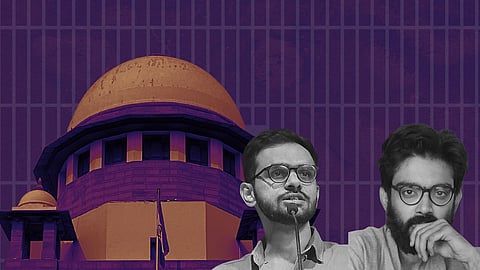

This past week, much of our editorial discussion has been around a specific aspect of the Delhi riots judgment delivered by the Supreme Court on January 5—paragraphs 84 to 95 which examine the scope of what can now be understood as a ‘terrorist act’ under the Unlawful Activities (Prevention) Act, 1967. It is well understood that through the judicial process, the statutory structure of ‘terrorism’ has been broadened now to include varying displays of demonstrations, depending on how the State subjectively assesses each case. In an editorial this week, our co-founder Indira Jaising made a very consequential observation in this context: “There is, to date, neither international nor national consensus on what constitutes terrorism.”
In a recent essay, senior political scientist Achin Vanaik noted that States adopt definitions—expansive or restrictive—of political terrorism that serve their political interests. Vanaik notes, for instance, that even the UN’s definition, echoed later in Security Council Resolution 1566, by referring to “a subjective state of mind—namely the intent to ‘cause death or serious bodily harm’—lets states off the hook. “Realpolitik”, he notes, “ensures that crimes of one’s own state and its allies are downplayed or denied, while those of rivals are exaggerated.”
It has been over five years since Umar Khalid, a promising historian, and Sharjeel Imam, an engineer turned anti-CAA activist, first walked into prison for a ‘greater conspiracy’ to cause the Delhi riots. Their trial is yet to begin. While five other co-accused in the case, including Gulfisha Fatima were deservingly released, Umar and Sharjeel’s fate is now hooked to seemingly philosophical debates of ‘Who, even, is a terrorist in today’s India’?
In a series of articles in The Leaflet this week, we explored a medley of issues in the judgment. While Indira Jaising argued that both the Bhima Koregaon and Delhi riots cases are examples of situations where the UAPA must not have been invoked, Anand Grover dove deep into the judgment’s basic failure to account for standing precedents on why prolongation of trials must be a ground for release from prison.
But a critical question that also arises is to what extent could Indian civil society depend on the Supreme Court and High Courts to continue diligently building upon painfully developed jurisprudential cultures, when their very autonomy is under duress? Senior human rights expert Ravi Nair, in a radical essay this week, explains that perhaps the time has come for civil society to push harder to instrumentalise international human rights instruments, such as the First Optional Protocol to the ICCPR, which India has continued to refuse to ratify, most recently arguing that the Indian Supreme Court “provides sufficient remedies for human rights violations.”
Perhaps a good starting point into these essays is our pronouncement report, put together succinctly by our assistant editor Ajitesh Singh, and an in-depth explainer of the 140 page judgement by Sadeeq Sherwani. One issue that comes out in our judgment summary is how, potentially, in the expanded definition of ‘terrorism’, peaceful protests will also be covered, even if it causes problems of “economic expediency.”
I was struck by this particularly, perhaps because it seemed to be a derivation from an older decision of the Supreme Court, not to do with UAPA, but with protests—the Shaheen Bagh judgment, based on the grand protest in 2019-20, that truly set off these chain of events. In Justice Sanjay Kishan Kaul’s judgment, at that time, the right to protest, already narrowed by the requirements of prior administrative permission, was further narrowed to exclude public spaces from being used for protests. A smooth ride for Delhi’s commuters, Justice Kaul had noted, overrode the fundamental right to protest.
The Shaheen Bagh judgment’s legacy has now played out definitively five years later, its reasoning seeping deeply into and shaping the logic of Monday’s judgment. In the end, the nebulous linings of ‘terrorism’ and the constitutional right to protest remain significantly indistinguishable, churning and churning into something murkier.
Please feel free to write back to us with your thoughts.
