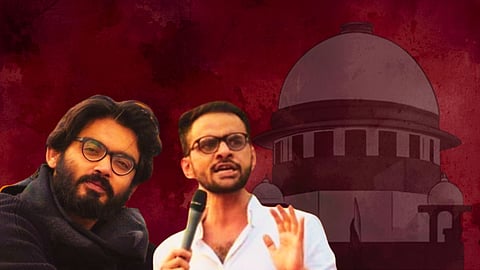
Shadows of Judicial Indiscipline: On the Supreme Court’s bail denial to Umar Khalid and Sharjeel Imam

In both the Bhima Koregaon and Delhi riots cases, a wrongful invoking of UAPA and obdurate refusal to follow precedent on delay in trial, raise legitimate questions on the independence of the judiciary.
Shadows of Judicial Indiscipline: On the Supreme Court’s bail denial to Umar Khalid and Sharjeel Imam
Published on

AT THE HEART of the controversy relating to the denial of bail to Sharjeel Imam and Umar Khalid is a simple question: what is the crime that they have committed? What if they have committed no crime at all under the Unlawful Activities (Prevention) Act, 1967? Would bail still have been denied to them?

By far the most dangerous aspect of the judgment delivered by Justices Aravind Kumar and N.V. Anjaria is the Court’s interpretation of Section 15 of the UAPA, which defines a “terrorist act”. To understand why, one must begin with the definition of ‘terrorism’. 

There is, to date, neither international nor national consensus on what constitutes terrorism. The crime of terrorism was introduced following what the United States described as the ‘war against terror’ following the 9/11 attacks. Yet, today, we do not have a definition of what constitutes terrorism. We, therefore, have to look at Section 15 of the UAPA.

Section 15 merely states, “Whoever does any act with intent to threaten or likely to threaten the unity, integrity, security , economic security, or sovereignty of India or with intent to strike terror or likely to strike terror in the people or any section of the people in India or in any foreign country,” and does so through specified terror-linked means such as bombs, explosives, firearms or other hazardous substances, or by methods likely to cause death, destruction, or disruption of essential services. The statutory design, thus, ties terrorism to both a terror-centric intent and the use of exceptional, terror-producing means, not to ordinary criminal violence.

There is, to date, neither international nor national consensus on what constitutes terrorism. 

In recent years, two of the most high profile cases where the accused have been charged under the offence of UAPA have been the Bhima Koregaon case and the Delhi riots case. In both of these cases, no overt act of violence was attributed to any of the accused who were incarcerated for five years and above.

Surendra Gadling, one of the accused in Bhima Koregaon, has been in prison for seven years without bail. Others in the case got bail after five years of waiting without trial. In both cases, none of the accused were attributed to have used bombs, dynamites, explosives or firearms intended to cause death or injuries to persons or damage to property. From a simple reading of Section 15, it is clear that none of the accused in these two cases would qualify for being charged under the UAPA. In both cases, the primary evidence was electronic evidence, which in the Bhima Koregaon case, was established to have been remotely planted in order to frame the accused as ‘urban naxals’. No link was established regarding any statements made by any of them and the violence which occurred more than 24 hours after the meeting at the Elgar Parishad on December 30, 2017. 

Shadows of Judicial Indiscipline: On the Supreme Court’s bail denial to Umar Khalid and Sharjeel Imam
Delhi riots larger conspiracy case: Supreme Court denies bail to Umar Khalid, Sharjeel Imam; grants relief to five co-accused

In the Delhi riots ‘larger conspiracy’ case, the primary evidence which appears to be used (we have no access to the evidence of protected witnesses shared in sealed covers with the Court), was messages exchanged in WhatsApp groups (again, electronic evidence requiring proof). In the Bhima Koregaon case, a letter allegedly found on the computer of Rona Wilson, one of the accused now on bail, allegedly speaks of a plan to assassinate the prime minister. Material allegedly recovered from his computer which is now proofed by experts to have been remotely planted through malware.

It would be no exaggeration to say that no occasion arose to invoke the provision of UAPA in either of the cases. The Supreme Court’s decision, suggesting that death or likelihood of death could be caused by “any other means”, is not only legally untenable but appears to be a catch-all device to bring within the definition of terrorism ordinary crimes under the Indian Penal Code

Every riot is a crime but not every riot is a UAPA crime. If one acknowledges this distinction, the question of invoking Section 43D(5) of the UAPA simply does not arise. All the accused in both the cases have been wrongly dealt with under the UAPA—one might go to the extent of arguing that there is a good case of quashing the charges.

In fact, in Asif Iqbal Tanha v State (NCT of Delhi) (2021), a bench of Justices Anup Bhambhani and Siddharth Mridul of the Delhi High Court interpreted Section 15 in reference to the object of “striking terror”. The judgement noted: 

“A 'terrorist' activity does not merely arise by causing disturbance of law and order or of public order. The fall out of the intended activity must be such that it travels beyond the capacity of the ordinary law enforcement agencies to tackle it under the ordinary penal law. Experience has shown us that 'terrorism' is generally an attempt to acquire or maintain power or control by intimidation and causing fear and helplessness in the minds of the people at large or any section thereof and is a totally abnormal phenomenon. What distinguishes 'terrorism' from other forms of violence, therefore, appears to be the deliberate and systematic use of coercive intimidation.”

On the question of delay, we have noticed an obdurate refusal to follow precedent, which can only be described as judicial indiscipline. 

On the question of delay, we have noticed an obdurate refusal to follow precedent, which can only be described as judicial indiscipline. 

In 2021, in a well reasoned order in Union of India v. K.A. Najeeb (2021), a three-judge bench led by Justice Surya Kant had noted that on the ground of delay in trial, a constitutional court is not denuded of its power to grant bail under the UAPA, notwithstanding the rigours of the statute. This decision has been plainly ignored through clever distinguishing devices.

Similarly, the judgment ignores two recent bail decisions from two benches led by Justice J. B. Pardiwala, namely, Javed Gulam Nabi Shaikh v. State of Maharashtra (2024) and Sheikh Javed Iqbal v. State of Uttar Pradesh (2025). In both these cases, it was held that Article 21 applies irrespective of the nature of the crime, and that the prosecution cannot oppose bail solely on grounds of seriousness when it lacks the wherewithal to ensure a speedy trial. These decisions reaffirmed that the presumption of innocence cannot be displaced merely because a stringent statute is invoked.

The new narrative of the prosecution in all UAPA cases is now to “investigate the larger conspiracy”. When nothing is found in the investigation, there seems to remain the residuary “larger conspiracy”, which now appears to be a crime of an invisible thought.

The issue at hand is not just about Umar Khalid and Sharjeel Imam. Almost anyone, who expresses any form of dissent, can be now labelled a ‘terrorist’. In fact that is the intent of those who call dissenters “urban naxals.” When narratives of the executive begin to start mirroring themselves in judgments of the Supreme Court, there is indeed cause for alarm. The judiciary exists to protect the rights of individuals, and protecting the life and liberty of the people is its most important function. The question that must be posed is whether this judgment does not fail the test of what is expected of an independent judiciary.

Related Stories

No stories found.
The Leaflet
theleaflet.in