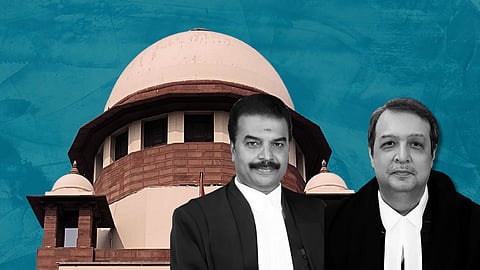

THE Supreme Court has ruled that trial courts and high courts must avoid releasing the accused in offences such as rape, murder and dacoity if the trial has commenced and the prosecution has begun examining the witnesses.
A Bench comprising Justices J.B. Pardiwala and R. Mahadevan ruled to this effect.
While ‘bail is the rule and jail is the exception’, in a series of judgments, the Supreme Court has laid down the factors to be taken into consideration while granting bail to an accused.
In Prasanta Kumar Sarkar versus Ashis Chatterjee, the court held that high courts must take into consideration:
i) Whether there is any prima facie or reasonable ground to believe that the accused had committed the offence;
ii) The nature and gravity of the accusation;
iii) Severity of the punishment in the event of conviction;
iv) Danger of the accused absconding or fleeing, if released on bail;
v) Character, behaviour, means, position and standing of the accused;
vi) Likelihood of the offence being repeated;
vii) Reasonable apprehension of the witnesses being influenced; and danger, of course, of justice being thwarted by the grant of bail.
In addition, courts grant bail to the accused if there has been a delay in the commencement of trial without fault on the part of the accused person. This is grounded on a right-based approach since speedy trial is part of Article 21 of the Constitution of India.
Recently, the Supreme Court in Manish Sisodia versus Central Bureau of Investigation observed that prolonged incarceration before being pronounced guilty of an offence should not be permitted to become punishment without trial. In that case, the trial had not even begun.
In the present case, the Bench noted that over a period, it had noticed two things. Firstly, bail is granted after the charge is framed and just before the victim is to be examined by the prosecution before the trial court.
Secondly, bail is granted once the recording of the oral evidence of the victim is complete by looking into some discrepancies here or there in the deposition, thereby testing the credibility of the victim.
The Bench observed that this was not the correct practice.
“Once the trial commences, it should be allowed to reach its final conclusion which may either result in the conviction of the accused or acquittal of the accused.
“The moment the high court exercises its discretion in favour of the accused and orders the release of the accused on bail by looking into the deposition of the victim, it will have its own impact on the pending trial when it comes to appreciating the oral evidence of the victim,” the Bench ruled.
The Bench clarified that it is only in the event that the trial gets unduly delayed and that too for no fault on the part of the accused that the court may be justified in ordering his release on bail on the ground that the right of the accused to have a speedy trial has been infringed.
There have been many cases where the accused, once out on bail, tries to coerce the complainants to withdraw their complaint. This is especially true in rape cases where the victim may be intimidated. That way, justice is sought to be thwarted by the accused.
Recently, news surfaced from Kerala that a man who had been granted bail killed a rape survivor. The accused had spent 83 days in custody and was later granted bail. The accused, after being released on bail, had been putting pressure on the deceased to withdraw the complaint against him and when she refused, he killed her.
In another case from Kaushambi district of Uttar Pradesh last year, a rape accused out on bail killed the victim.
“The accused tried to put pressure on the victim for reconciliation after being released from jail on bail recently and when she refused, he, along with his three brothers, allegedly killed her with an axe on November 20,” the media report quoted the police.
In the case of honour killing, the Supreme Court had refused to grant bail to the accused person despite him having undergone custody of over six years because the trial had already begun and out of 47 witnesses, 42 had already been examined.
Case history
In the present case, the Bench was ruling on a petition preferred by an alleged rape survivor challenging the Order of the Rajasthan High Court on February 12, 2024, granting bail to the accused.
The high court had taken into consideration some discrepancies between the first information report (FIR) and the statement of the victim recorded under Section 164 of the Code of Criminal Procedure (CrPC).
The FIR was registered on September 18, 2023, against the accused before the Supreme Court and other co-accused for the offences punishable under Section 376D and Section 342 of the Indian Penal Code (IPC). Upon conclusion of the investigation, a charge sheet was filed.
The Bench noted that in the instant case, even the victim or rape survivor was not examined. Her mother who, according to the case of the prosecution, is an eyewitness, was also not examined so far. The high court merely looked at the few discrepancies in the FIR and compared it to the statement of the victim recorded under Section 164 of the CrPC.
This, the Bench held, could not have been a good ground to grant bail to the accused in a serious offence like rape.
Even though the Bench disapproved the high court's Order, it refused to cancel the bail. The Bench, however, imposed additional conditions on the accused to ensure that the accused and the co-accused do not influence the prosecution witnesses or try to tamper with the evidence in any manner.
The Bench ordered that the accused must not enter the village where the victim resides till the completion of the trial. It also directed the trial court to dispose of the case within three months from the day of its Order.
The accused chose to remain absent in the Supreme Court despite notice to him.
