
Jungle Chup Hai
Magar Uski Khaamoshi me
Hazaaron kate hue tano ki cheekhein dafn hai
The forest is silent
But in its silence
It carries the shrieks of a thousand tree trunks which have been cut down
– Lapata Jungle, Sudhir Dhawale
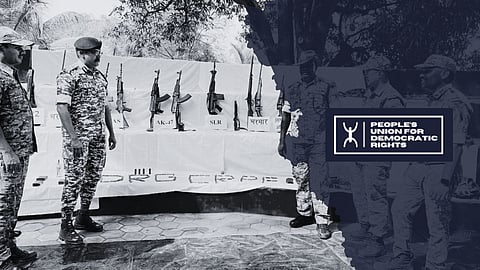
ON JUNE 11, 2026, the People’s Union for Democratic Rights (‘PUDR’) launched their most recent report on Operation Kagaar which was a compact set of security operations by both the central and the state governments between January 2024- March 2026. The foremost goal of the Operation Kagaar is synonymous with the meaning of the word itself which means to shrink something to a ‘brink’, or ‘verge’ with the operation acting as one of the most momentous blows of the government to obliterate the existence of ‘Naxalism’ or ‘Left wing extremism’ mainly in the states of Odisha, Jharkhand, Chhattisgarh and Maharashtra.
PUDR’s report focuses on seven districts in Bastar, Chhattisgarh. By taking into account the publicly reported killings, arrests and surrenders ensued by virtue of the Operation Kagaar, the report records the extent and magnitude of state accountability.
A crackdown on years of resistance
In February 2025, Home Minister Amit Shah declared that March 31, 2026 would be treated as a deadline for the complete eradication of naxalism from the country. This led to the development of a coordinated strategy involving a multitude of security agencies such as the National Investigation Agency, Central Reserve Police Force, Border Security Force, Sashastra Seema Bal. Indo-Tibetan Border Police and the forces operating in Chattisgarh. Operation Kagaar functioned as the government’s most strategically channelised blow to the entire Maoist Movement.
The age-old rift between Adivasi communities and the state stems from the time of the British colonial state’s move to dispossess the communities for securing the forest wealth which has continued even after India’s independence with various governments coming in and widening the scope for private corporations to extract forest wealth through its resources. Adivasi communities have been continuously deprived of their own land even as forest ecosystems and biodiversity they have relied on has faced extreme extraction. In the backdrop of systematic violation of rights of the Adivasi communities, political movements were ignited.
Over 600 killings, opacity around circumstances of arrest
PUDR’s report analyses Operation Kagaar through the standpoint of ‘costs and consequences’ of the armed conflict on Adivasis through reported accounts in newspapers of killings, arrests and surrenders between January 1, 2024 and March 31, 2026.
The first part of the report starts by identifying the unusual circumstances surrounding Operation Kagaar with a high number of incidents of violence allegedly by Maoists on one side and the State forces on the other hand with the violence mostly being initiated by the State forces. This violence was coordinated through a collaboration between the Home Ministry and the Inspector General of Police of Chattisgarh. The availability of public information on any such incidents of killing and surrender is primarily based on information furnished by the police or the government with no independent account of what took place and no follow-up on the legal developments in such cases.
The report records the killing of a total number of 607 persons comprising 516 alleged Maoists, 36 state forces and 55 civilians from the period of January 1, 2024 - March 31, 2026. There is also no official account of extra-judicial killings with only a sole case of custodial death in which a judicial enquiry was ordered with no follow-ups in the newspapers on the trajectory or conclusion of such enquiries.
The report also highlights the absolute lack of information on the basis on which individuals termed as Maoists were identified, on the pendency of any criminal case against such identified persons. In cases where the state seized arms and ammunition from those killed, the report highlights the need for close scrutiny of such recoveries and in cases where no such recoveries have been made, it raises questions on the requirement for such a killing with the option of arrest seeming to be a more rationally viable alternative.
With respect to arrests, the report records 487 alleged Maoists being arrested between the time period of January 1, 2024 to March 31, 2026. The arrests, however, do not contain any information pertaining to the specific spot or place of arrest, circumstances of the arrest, or mention of FIR numbers.
The record for Bastar region pertaining to the surrenders indicates the surrender of 1496 alleged Maoists from January 1, 2024 to March 31, 2026. A surrender -cum-rehabilitaion policy of the Union government is currently in place with surrender being the only alternative choice to being killed by the forces. The unidirectional flow of information which was mainly controlled by the government on incidents of killings, arrest and surrender casts aspersion on whether killing was required in each of the alleged operations, the presence of a substantive basis on warranting the arrests and whether the rights of those taken into custody were maintained.
Supreme Court’s guidelines on police encounters violated
In Peoples Union for Civil Liberties v. State of Maharashtra (2014), the Supreme Court had noted that ‘killings in police encounters require independent investigation as they have a direct bearing on the credibility of the rule of law and the administration of the criminal justice system’. The Court then went ahead and laid down certain essential requirements for investigating matters of police encounters which have resulted in death” the ‘recording of intelligence tip off by the police, an independent investigation into the encounter by CID or a police team of another police station, Magisterial Enquiry and report to be sent to the Court, FIR, diary entries, sketch etc. to be sent to the concerned court without any delay, next of the kin of the alleged criminal /victim to be informed at the earliest, compensation to be provided to family of person killed in encounter, and ensuring that no accelerated promotion is bestowed on the concerned officer except when their gallantry is established beyond doubt. PUDR’s report explicitly mentions that there are no records available to assess whether these essential requisites laid by the Court have been met in the cases of Extra-judicial killings in the Bastar region.
The report also alludes to the possibility of arbitrary arrests in light of the absence of any details on those who are arrested and the circumstances surrounding their arrest. The provisions of Unlawful Activities Prevention Act, 1967 (‘UAPA’) also gain a stronger footing in a region like Bastar with entrapment of political activists, social activists and lawyers representing accused persons within the vaguely defined sections of the UAPA pertaining to ‘association and support of Terrorist Organizations’. The references to the seizure of ‘Maoist Literature’ are also termed as highly ambiguous with no clear order banning the possession of such material or a coherence in linking such literature to the association of such a person to the banned CPI (Maoist) party.
The arrests are plagued with systemic issues pertaining to the FIRs being registered against ‘unknown Naxalites’, and in cases where names are provided such names often belong to more than one person in the village, ultimately leading to abysmally low convictions. The conspicuously low rate of conviction was substantiated in the report by making a reference to the Quill Foundation’s report of 2024 wherein 141criminal cases from the Gadchiroli district ultimately resulted in 140 acquittals.
PUDR also observes a concerning trend in the rehabilitation of the Maoists who have surrendered as the relief proposed under the concept of rehabilitation is ‘deferred and distant’ which is coupled with a mandatory ‘certified good conduct’. The report makes reference to a media report which unequivocally terms the rehabilitation centres housing the surrenderees as ‘detention centres’ with not allowing the families of the surrenderees to meet them at the centres, holding up the surrenderees for months under the garb of their protection from other active Maoists and engaging them in tasks pertaining to cleaning or construction work with a total absence of any vocational training being provided to the surrenderees so as to facilitate their transition back into the society.
Post Operation Kagaar, relentless environmental extraction has taken over Chhattisgarh
The second and last part of the report deals with the aftermath of the Operation Kagaar as the state proclaims victory over the complete eradication of the Maoist Movement which was one of the only gigantic roadblocks remaining as per the state in the development of the Adivasi community. The report addresses the ever present questions on the rights of the adivasi community, and the tussle over resources between the members of the Adivasi community and the state.
With the Maoist Movement coming to an end, the apprehension over the government's rigor for carrying out mining activities has been brought to the forefront. The report makes a reference to the Chhattisgarh state’s Industrial Policy of 2024-2030 which proposes the prioritising of the promotion of pharma, textile, IT , defence and other sectors with National Mineral Development Corporation (‘NMDC’) being allocated the majority portion of share in the development plans announced by the government with a whopping 98 percent of the investments directed towards mining or linked to activities having direct relation with mining.
With the government's focus now being redirected towards intensifying mining activities in the region, the fears of the Adivasi communities have become more tangible than ever before. The Bailadila Hills which were once known to be untouched by the presence of any private company have now been made available to private sectors by virtue of mining leases. Mining in the Bailadila Hills now exposes the Adivasi communities to the risk of contamination of both farmland and water bodies with black iron metal effluents entering the tributaries of Indravati river in the Bastar region for decades.
The report also highlights the pro mining stance of the government of India which was reflected in the amendments it brought forth by introducing the Mines and Minerals (Development and Regulation ) Amendment Act, 2025 which increased the area limits with respect to prospective license and mining leases without putting any cap on the maximum limit and also extending the duration of mining leases from 20-30 years to an additional 20 years. A District Mineral Fund (‘DMF’) was also set up where a proposal was made to provide 26 percent equity to the local community in the company which was granted the mining lease. However, this was changed into the provision of a 33 percent royalty being paid by the Company directly to the DMF thereby expunging the real stakeholders the Adivasi Community from the entire dealing. This slow and continuous progression of ousting the involvement of the Adivasi community as stakeholders in decisions pertaining to the utilisation of resources inevitably pushes them to the mercy of the government and its officials.
The report also records the amendments made in the Forest Conservation Act, 1980 in 2023 which undermined the Supreme Court’s judgment in the case of T.N. Godavarman Thirumulpad v. Union of India (1996) which had provided a broad interpretation of the word ‘forest’. However, the 2023 restricted the definition only to declared and notified forest under the Indian Forest Act, 1927, and land which has been recorded as forest by the government on and after October 25, 1980.
PUDR also highlights the mushrooming growth of police, paramilitary and army camps despite the complete eradication of Maoist Movement or Left Wing Extremism as per the Union government. Even as the government speaks of the war against Naxalism being over, the CRPF is in the process of setting up a battalion strength Counter-Insurgency training centre covering 700 hectares of prime forest in Bijapur district along with the Indian Army possibly getting over 53,000 hectares of forest area which displaces nearly 9000 villagers from Abuj Madh area of the Narayanpur district of Chattishgarh.
In light of the report’s findings and the many questions it raises on accountability against human rights abuses and environmental extraction, what becomes clear is that behind the smokescreen of military victory, the core issues of “Jal, Jungle, Zameen”, which initially resulted in the creation of Left Wing Extremism and the Maoist Movement still persist. And with that persists the incomplete project of truly enshrining the right of self-governance, provided under Article 243 and Schedule V of the Indian Constitution, upon India’s Adivasi communities.