‘Excessive and disproportionate force’: SCBA and SCAORA condemn Jantar Mantar lathi charge as Supreme Court declines to intervene

While the Supreme Court called it a waste of its time to examine videos of the crackdown, the SCBA and SCAORA demanded an impartial inquiry into the police action against Chalo Sansad protesters.
‘Excessive and disproportionate force’: SCBA and SCAORA condemn Jantar Mantar lathi charge as Supreme Court declines to intervene
Published on

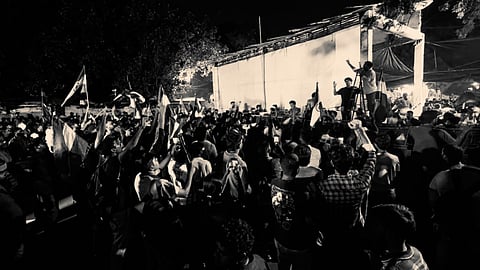
ON JULY 20, the student protest march, which coincided with the first day of the Parliament’s Monsoon Session, at Jantar Mantar in New Delhi turned into a site of heavy police crackdown on the protesting students. The internet was flooded with visuals of the Delhi Police and the Rapid Action Force (‘RAF’) brutally beating and tear-gassing protesting students. Many were left bleeding. Instances of use of pellet guns and shock batons were also reported widely across national media platforms. 

Chief Justice of India (‘CJI’) Surya Kant, while declining to take suo moto cognisance, orally remarked that it would be a “waste” of the Supreme Court’s time to look into the crackdown, even as lawyers pressed with videos of police atrocities against the protesters. “We are not interested in videos. We don’t have time to watch them,” the Chief Justice said.

The Delhi High Court, however, has issued notice to the Centre and the Delhi Police on two public interest litigations flagging the use of tear gas, lathi charges and other excesses at the protest. A bench of Chief Justice Devendra Kumar Upadhyaya and Justice Tejas Karia observed that the complaints were not about “isolated” incidents and sought a response from the police. During the hearing, the advocates for the petitioners argued that there was no evidence that protesters had turned violent, and that over 90 students had suffered injuries and pressed for an FIR against the policemen identified in the videos.

Chief Justice Surya Kant orally remarked that it would be a “waste” of the Court’s time to look into the crackdown.“We are not interested in videos. We don’t have time to watch them,” he said.

SCBA President writes to the Prime Minister and the Home Minister

The SCBA President Dr. Vikas Singh, Senior Advocate, writing to Prime Minister Narendra Modi and Union Home Minister Amit Shah seeking a judicial enquiry. Singh’s letter detailed a pattern of alleged police excess including students struck on the head with lathis, unidentified plain-clothed individuals assaulting protesters, tear gas fired at hunger-striking students near Central Secretariat metro station, and journalists and medical personnel obstructed and attacked while performing their duties. 

He argued the crackdown violated Section 148 and Section 149(3) of the Bharatiya Nagarik Suraksha Sanhita, 2023, which govern minimum force in dispersing assemblies, along with Articles 14, 19(1)(a), 19(1)(b) and 21. Singh linked the protest to a broader pattern of examination leaks stretching from the 2017 AIIMS-MBBS exam to the 2026 NEET-UG leak, arguing that repeated institutional failures under the Public Examinations (Prevention of Unfair Means) Act, 2024 left students no recourse but peaceful protest. He sought a time-bound judicial commission under the Commissions of Inquiry Act, 1952, the suspension of Delhi’s Police Commissioner, FIRs against officers who breached procedure, and accountability from the Ministry of Education for the security of national exams.

SCAORA’s statement condemned the treatment meted out to peaceful protesters by the police forces as “deeply perturbing.” 

SCBA’s statement of condemnation 

The Supreme Court Bar Association (‘SCBA’) today issued a statement condemning the lathi charge on students and members of the legal fraternity at the protest site. The SCBA noted that the lathi charge left “several students sustaining serious injuries,” along with members of the SCBA itself. It condemned the use of “excessive and disproportionate force” against peaceful protesters and urged authorities to undertake an “immediate, impartial and time bound inquiry,” with those responsible identified and held to account under law. 

The SCBA also called for medical treatment for the injured students and legal fraternity members, and for preventive measures against the recurrence of such incidents. It extended solidarity with the injured protesters and reiterated its commitment to protecting constitutional rights, human dignity and the rule of law.

SCAORA’s statement of condemnation

The Supreme Court Advocates-on-Record Association (‘SCAORA’) also issued a statement condemning the use of force against protesters. SCAORA’s statement noted that the lathi charge and tear gas used against peaceful protesters was “deeply perturbing,” noting that peaceful dissent “is not an act of defiance but an exercise of the fundamental freedoms guaranteed under Articles 19(1)(a) and 19(1)(b) of the Constitution.” 

It added that restrictions on fundamental freedoms in the interest of public order must meet the constitutional tests of “legality, necessity and proportionality,” citing the Supreme Court’s recognition of the right to hold peaceful public meetings in Himat Lal K. Shah v. Commissioner of Police, Ahmedabad (1973) and In Re: Ramlila Maidan Incident (2012). SCAORA urged an independent and impartial examination of the allegations of excessive force, immediate medical assistance for the injured, and restraint, dialogue and commitment to constitutional values in any future engagement with peaceful protesters. It noted that “the true measure of constitutional governance is not how the state responds to agreement, but how it responds to peaceful disagreement,” and that abidance by constitutional liberties remains the most effective safeguard for the rule of law at such moments.

The Leaflet
theleaflet.in