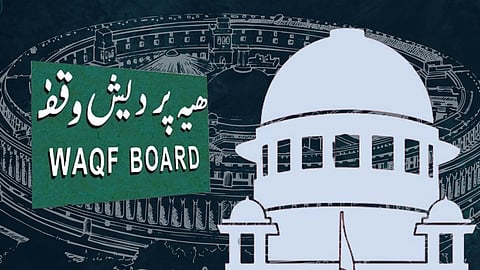

ON APRIL 17, a Division Bench of Chief Justice Sanjiv Khanna and Justices Sanjay Kumar and K.V. Viswanathan continued hearing a batch of petitions challenging as well as supporting the Waqf (Amendment) Act, 2025, for the second consecutive day.
Solicitor General Tushar Mehta, for the Union, while opening the submissions on behalf of the respondents on Thursday, requested for a week’s time to file a preliminary short reply in the matter and to place certain material on record that would help the bench understand the “fallout” of staying the application of the Amendment Act even at the interim stage.
Chief Justice Khanna accepted Mehta’s request and granted him seven days to file a short reply stating that any rejoinder(s) thereto may be filed within five days of the receipt of the notice thereafter. However, it was ordered that in the meantime no appointments under Sections 9 and 14 of the amended Act to the Central Waqf Council and the State Waqf Boards, respectively, will be made.
The Court also ordered that any waqf, whether registered or declared by notification, including any ‘waqf-by-user’, shall not be denotified. It was clarified that “registered” means registered under the provisions of the 1995 Act. The bench emphasized their belief in the principle of separation of powers, but indicated that they do not want the position to change.
CJI Khanna also stated that the Court would only entertain five petitions and asked the petitioners to identify and decide which five they want to be treated as the lead petitions. The remaining would be treated as applications within these lead petitions. Further, the batch of petitions would not be referred to by the name of the parties, but rather as ‘In re: The Waqf (Amendment) Act, 2025.’
The parties were also told to appoint nodal counsels amongst themselves. While the petitioners appointed advocate Ejaz Maqbool, the respondents appointed advocate Kanu Agrawal.
The bench was informed that certain petitions challenging the validity of the 1995 Act and its 2013 amendment were also listed along with the present batch of petitions. The bench ordered that these petitions shall be listed separately and the petitioners challenging the 2025 Amendment Act along with any Waqf boards and/or the state governments would be at liberty to file their responses in these petitions within seven days, and any rejoinder thereto will be filed within five days thereafter.
The petitioners challenging the validity of the 1995 Act have appointed advocate Vishnu Shankar Jain as their nodal counsel.
In the end, the bench clarified that the next hearing will only be a preliminary hearing for directions and, if required, an interim order would be passed.
What happened on the first day of hearings?
The matter was heard for the first time on April 16. The bench had posed two questions to the petitioners at the outset, namely:
1) Should the Supreme Court entertain these petitions, or should they be relegated to the High Courts?
2) What are the specific issues that the petitioners want to argue?
The Chief Justice remarked that the answer to the second question would help the bench decide on the first question itself.
It was also clarified that the submissions were restricted to the lawyers in only those petitions whose defects were removed by 11 am yesterday.
Petitioners: The Amendment Act violates Article 26, interferes with Muslim succession law
On April 16, Senior Advocate Kapil Sibal, on behalf of Jamiat Ulema-e-Hind, had opened the arguments for the petitioners, submitting that the Waqf Act, 2025, interferes with practices that are essential and integral to the Muslim faith and is therefore violative of Article 26 of the Constitution of India, which grants every religious denomination or any section thereof the freedom to manage its religious affairs.
Sibal argued that the rights provided under Article 26 include a religious denomination’s right to manage its affairs, run institutions, own and acquire property and administer the same in accordance with law reasonably and proportionally, and are subject only to public order, morality and health.
Sibal then individually highlighted the contentious provisions of the Amendment Act, starting with the amendment to Section 3(r), which defines “Waqf”. He argued that a person who wants to create a waqf should not be required to prove to the State that he has been a practising Muslim for five years, and that such a thing would be impossible to prove.
Section 4(ix)(a) of the Amendment Act, 2025 has inserted the words “any person showing or demonstrating that he is practising Islam for at least five years, of any movable or immovable property, having ownership of such property and that there is no contrivance involved in the dedication of such property,” to the opening portion of the principal Section.
“Why should I prove to the State that I am a good Muslim? Who is the State to say I cannot create a waqf by user?” Sibal asked while also raising contentions against the proviso inserted into the Section, which states that the existing ‘waqf-by-user’ properties registered on or before the commencement of the Waqf (Amendment) Act, 2025 as ‘waqf-by-user’ will remain as waqf properties. If the property, wholly or in part, is in dispute or is a government property, it would be excluded.
He then argued that Section 5 of the Amendment Act which inserts Section 3A(2) into the Waqf Act, which states that the creation of a waqf-alal-aulad shall not result in the denial of inheritance rights of heirs, including women heirs of the waqif or any other rights of persons with lawful claims, amounts to interfering with the Muslim succession rights and the State should not dictate inheritance.
CJI Khanna pointed out that the Parliament has also enacted laws for Hindu succession, and Article 26 did not prevent it from doing so. Sibal, however, mentioned that in Islam, inheritance begins after death, and the State is interfering before death. Sibal also questioned the authority of the State to identify a property as waqf, noting that the Act gives the State the power to identify a property as such.
“If the State does not identify, then the property is not waqf?” he asked.
He also argued that Section 3C of the amended Act was unconstitutional. Section 3C (1) states that any government property identified or declared as waqf property, before or after the commencement of the legislation, shall not be deemed as waqf property, whereas Section 3C (2)authorises an officer above the rank of Collector designated by the state government to determine the ownership of a property after conducting an inquiry in cases where question regarding the status of a property as government or Waqf property arises.
Sibal argued that this amounts to authorising a government officer to be a judge in his own cause which is unconstitutional per se.
He further argued that Section 3D of the amended Act was also unconstitutional as it states that any declaration or notification issued under this or any previous Act in respect of waqf properties shall be void if at the time of such declaration or notification such property was a protected monument or protected area under the Ancient Monuments Preservation Act, 1904 or the Ancient Monuments and Archaeological Sites and Remains Act, 1958.
CJI Khanna, however, said that any monument protected under the 1904 or 1957 Acts will not be affected by the amended Act. He noted that all such monuments, including many mosques, were already covered under waqf before they were declared as protected monuments.
Petitioners: Muslim tribal communities affected, inclusion of non-Muslims in Waqf council violates Article 26
Sibal then raised contentions against Section 3E of the amended Act, which states that notwithstanding anything contained in the Act or any other law for the time being in force, no land belonging to members of Scheduled Tribes under the provisions of the Fifth Schedule or the Sixth Schedule to the Constitution shall be declared or deemed to be a waqf property.
Senior Advocate Chander Uday Singh expanded upon this argument, stating that the Act fails to take into account the existence of Muslim tribes located in the scheduled areas and encroaches upon their right to declare their properties as waqf. He gave the example of tribes from Maharashtra to support this contention.
Contentions were also raised against the composition of the Central Waqf Council as well as the State Waqf Boards under the amended act, specifically against the inclusion of the two non-Muslim members excluding the ex officio members in the Waqf Council under Section 9(2) and in the Waqf Boards of the State and the National Capital Territory of Delhi under Section 14(1) of the amended Act.
Sibal argued that the Act does not limit the inclusion of non-Muslims in the Central Council to two members, as the language of the Act does not use the expression “only”. He said that, as per the reading of the Section, the limit provided was not an upper limit but rather provides for a minimum number of members that could not be non-Muslim.
He further stated that, according to the petitioners, all the members of the Waqf Council must be Muslims as that is their right under Article 26 of the Constitution. However, as per the amended Act, only eight of them were Muslims.
“Even one is one too many, according to us”, Sibal added.
He argued that the provisions under Sections 9 and 14 of the amended Act presage a complete takeover of the waqf bodies through nomination, pointing out that the unamended Sections 9 and 14 of the 1995 Act provided for all the members to be Muslims and Section 16 even provided for the disqualification of member from the Board if he was not Muslim.
Thereafter, he raised arguments against Section 36 of the amended Act that provides for the registration of the waqfs. Sub-section (1A) states that on and from the commencement of the Waqf (Amendment) Act, 2025, no waqf shall be created without the execution of a waqf deed.
Sibal argued that a waqf can be created by a user who does not have a deed. “If it is my property, I can create a waqf, in the sense that I can allow somebody to have a shelter home there, I don’t have to register it”, Sibal said
“Forget whether I am a Muslim or not, I want somebody else to use it in the manner that I like, who can interfere in that? As long as it is my property, why do I need to register it?” he added.
To this, CJI Khanna remarked that there is no difficulty in registering a property as waqf, as it would help in maintaining a register of the waqfs. “Would that not be beneficial?” CJI Khanna asked.
Sibal responded to this by saying that maintaining a register of the waqfs is a different matter - what he wanted to point out was that the amended provision has abolished waqf by user which is an essential part of Muslim law and faith and it has also been recognised by the Supreme Court in paragraph 1134 of the Ram Janmabhoomi judgment (2019).
Sibal asserted that the problems would arise when mutawallis would be asked to furnish details of the waqfs created hundreds of years ago and to produce the deed to prove that such properties are waqf properties.
He then pointed out that Section 36 (7A) states that where the Collector mentions in his report that the property, wholly or in part, is in dispute or is a government property, the waqf in relation to such part of property will not be registered, unless the dispute is decided by a competent court. Sibal argued that this provision was problematic, as the process provided therein could take 20 years. He further argued that this provision was even more problematic in light of Section 3C, the drawbacks of which had already been argued.
CJI Khanna noted that there was a contradiction emerging, and how the centre would interplay Section 3C with Section 36 (7A) will be an issue. However, he stated that such an issue would be limited to cases where the dispute is with regard to a property being a government property. Sibal pointed out that a collector will not be covered under the expression “competent court” as he could not be a judge in his own cause, and also because a collector’s process is not a judicial process.
The Chief inquired if the decision of the collector was amenable to the tribunal, to which Sibal stated that there was nothing to this effect in the language of the provision and emphasised that the provision also includes properties whose status is disputed. This means that a property will not be registered as waqf even if the government is not sure if it owns the said property.
Sibal then argued against the imposition of limitation under Section 36 (10) on the institution of any suit, appeal, or other legal proceeding before any court for enforcing a right on behalf of any waqf. He stated that there was no period of limitation under the 1995 Act because many of the waqf properties were encroached upon, and imposing such a limitation would not only legitimise these encroachments but also create rights of adverse possession in respect of many of these properties.
The petitioners also raised contentions against the penal provisions contained in Section 61(1) (1A), which provides for a mutawalli to be punished with an imprisonment of up to six months and also with a fine of not less than twenty thousand rupees extendable up to one lakh rupees, if he fails to do certain acts mentioned in the provision. They argued that this was unnecessary and would only be a tool to harass the mutawallis.
Furthermore, contentions were also raised regarding the interpretation of Section 85 of the principal Act, which provides that suits arising out of waqf properties will not be decided by any civil court other than a waqf tribunal. Petitioners argued that Section 85 has become vague and possibly redundant in light of the amended provisions, particularly Section 3C.
Petitioners: Allowing non-Muslims to donate to the waqf violates right to property under Article 300A; many provisions violative of Article 14
Senior Advocate C.U. Singh presented a different approach to the argument of essential religious practices under Article 26, stating that this was not required at all as far as the Waqf Act was concerned. He argued that charitable purposes do not have to answer the test of essential religious features.
Advocate Nizam Pasha argued that the omission of Section 104 from the principal Act, which allowed non-Muslims to make donations to the waqf, is violative of the Right to Property protected under Article 300A of the Constitution. He also compared the Hindu Succession Act to the Waqf (Amendment) Act, 2025, stating that while the former was a codification, the latter is a law imposed against the essential practices of Islam.
The petitioners also argued that many provisions of the amended Act are arbitrary and violative of Article 14 of the Constitution.
Other lawyers appearing for the petitioners, including Senior Advocates Rajeev Dhawan, Huzefa Ahmadi, Sanjay Hegde, M R Shamshad, Rajiv Shakhdher, P. Wilson and others, had echoed Sibal’s submissions while expanding upon some of the arguments raised by him.
Solicitor General Mehta: Limit of two non-Muslim members was the maximum limit;
The bench had then asked Mehta to respond to the contentions raised by the petitioners and answer the questions posed by the bench.Mehta began by elaborating on the exercise undertaken by the Joint Parliamentary Committee. He stated that the JPC had held 38 sittings, examined 92.28 lakh memorandums, travelled to States and then their suggestions went through both the houses of the Parliament, after which detailed discussions were made.
“Are you now saying waqf by user is void?” the CJI asked Mehta.
Mehta responded by saying that a waqf under Islamic law is a dedication to Allah for a charitable purpose. Therefore, necessarily, there must be a waqif to say that the waqf would be governed by the mutawalli as per the waqf deed.
Justice Vishwanathan then questioned Mehta as to why, in the case of waqf, persons from other religions are being allowed to be members of the Council and the Board, whereas Hindu religious endowments are allowed to be governed only by Hindus.
“As far as religious endowments of Hindus are concerned, normally only Hindus control it”, CJI Khanna told Mehta.
To this, Mehta told the bench that a waqf by the user, if registered, will remain a waqf property.
The Chief then stated that India did not have land registration laws or the Transfer of Property Act before the British came to India. He further acknowledged that many mosques were constructed in the 14th, 15th, 16th and up to the 17th centuries and asking them to produce a registered sale deed is an impossibility. Giving the example of the Jama Masjid, which is a waqf by user, CJI Khanna asked if such a waqf established under the prior versions of the Waqf Act could now be made void or declared non-existent in light of the 2025 amendment.
Justice Vishwanathan remarked that some provisions of the Amendment Act are salutary, whereas others require clarification.
Questioning the logic behind the provisions of freezing a waqf property until its status is determined by the designated officer, CJI Khanna asked if an investigation by a collector was fair, especially in cases where he is still not clear whether the property is waqf property or government property.
“What will happen to the rent from these properties? Where will it be paid?” the CJI asked. Mehta appeared clueless about the fact that waqf properties are rented out. However, he replied that it is the identity of a property as a waqf that will be suspended and not the use of the property. CJI Khanna again asked about the logic behind having such a proviso.
Mehta also clarified that the Act will not take away the powers of judicial review and stated that the Waqf Tribunal is a judicial body, as it has a former judge, and every order passed under the Act is subject to review by the tribunal.
However, CJI Khanna was not satisfied by the answer provided by Mehta and stated that his question as to whether the 2025 Act has undone waqf by user which was established under the earlier law was still not answered.
“Waqf by user has been accepted, if you de-notify waqf by user properties, there will be an issue”, the CJI said, adding that there will be no documents for waqf by user as the same is not registered.
CJI Khanna acknowledged that there could be waqf-by-user properties that are being misused. However, he stated that there will also be such properties that are genuine. “Many Muslims do not want to be under the Waqf Board. They want to have a private charity,” Mehta replied.
CJI Khanna also asked Mehta if he is arguing that Muslims will be allowed to be a part of the Hindu Endowment bodies, pointing out that the two judges in the Waqf council may also not be Muslims.
To this, Mehta replied, “Then Your Lordships cannot also hear this case.”
The CJI retorted that this was adjudication, and when the judges sit on the bench to hear a matter, they lose their religion and become secular to hear all the sides equally. However, he noted that this would change if they were dealing with a religious issue in the capacity of a member of a Council or a Board dealing with religious affairs or any other religious trust.
CJI Khanna pointed out that in a council of twenty-two members dealing with the Muslim charitable endowments, only eight would be from the community. However, Mehta claimed that the limit of two non-Muslim members was the maximum limit, and the same has been clarified by the Ministry in the report placed before the JPC.
“That is not how it reads… If your argument is to be accepted, then why do you specifically say in clause C some members are Muslim and leave some open?” Justice Sanjay Kumar asked.
Mehta responded that this was a choice given for situations such as if there is no Muslim member in the legislative assembly, and reassured that the number of non-Muslim members would not cross the threshold of two. He said that he would make this submission on an affidavit.
CJI Khanna stated that there will be a problem if public trusts that have been waqfs for over 100 years suddenly cease to be so. To this, Mehta claimed that the amendment Act was an enabling statute since it allowed Muslims to do charity outside the waqf. However, the Chief stated that the past cannot be undone.
“If there are public trusts that want to dedicate charity to Allah, can you undo that?” CJI Khanna asked.
Respondents demand another hearing to clarify their stance
He said that he intended to issue notice and the Union can file its reply. CJI Khanna said that there are three options, namely:
1) to either decide the petitions, or
2) to relegate these petitions to one High Court, or
3) to call the petitions pending before the High Courts and decide them together.
Mehta replied that the Union would file its reply and the court could take it up in two weeks.
Senior Advocate Harish Salve, who claimed that he was representing petitioners challenging the 1995 Act, stated that there was no need to call the petitions pending before the High Courts at this stage, as many of the provisions of the old Act are reflected in the Amendment Act of 2025. “The Supreme Court can see both dimensions and decide the whole matter one way or the other,” he said.
CJI Khanna then indicated that he wanted to pass an interim order. However, Mehta and other respondents requested the Court for another hearing to clarify their stand.
The Chief Justice remarked that the Court normally does not intervene when a legislation is passed. However, there are exceptions. He noted that there would be a huge problem here since waqf-by-user has existed since the 1940s. He also expressed that the violence that is taking place is very disturbing.
CJI Khanna had wanted to dictate a tentative order then but adjourned the matter for the next day, given the respondents' requests to allow them more time to make their submissions.
Correction: A previous version of the draft stated that the "petitioners appointed advocate Fuzail Ayyubi" as their nodal counsel. This has been updated to reflect that the nodal counsel for petitioners is advocate Ejaz Maqbool. The error is regretted.