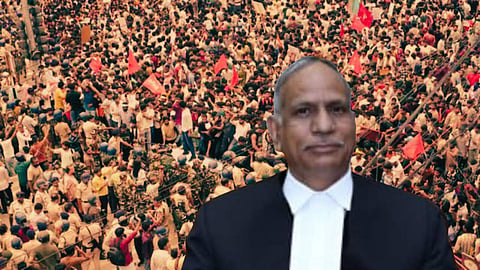
‘Anti-democratic and contrary to the Constitution’: Former Allahabad HC Chief Justice Govind Mathur on the crackdown on protesting students

Justice Mathur noted that the government’s response to the ongoing student protests amounted to repression rather than democratic engagement, and called on the government to treat criticism as central to governance.
‘Anti-democratic and contrary to the Constitution’: Former Allahabad HC Chief Justice Govind Mathur on the crackdown on protesting students
Published on

FORMER CHIEF JUSTICE of the Allahabad High Court, Govind Mathur, shared his views on the recent crackdown on student protesters with The Leaflet, marking his first comments on the issue. Various bodies, including the Supreme Court Bar Association and the Supreme Court Advocates-on-Record Association, have already condemned the police action against the protesters. The full text of his message is reproduced below.

“The Constitution of India envisions a system of governance in which the liberty, equality, justice, and dignity of every citizen remain inviolable. Democracy does not merely mean holding elections every five years; it also requires that citizens’ dissent be heard with respect, that the right to peaceful protest be protected, and that the government remain accountable to the people.

The recent attempts to suppress protest and dissent through harsh measures are contrary to these fundamental democratic principles. When people express concerns about inflation, unemployment, corruption, education, healthcare, or economic policies, it is the duty of a democratic government to engage in dialogue and address those concerns—not to respond with coercion and repression.

Democracy does not merely mean holding elections every five years; it also requires that citizens’ dissent be heard with respect, that the right to peaceful protest be protected, and that the government remain accountable to the people.

Today, students across the country are raising their voices against unemployment and irregularities in competitive examinations. Various sections of society are expressing serious concerns regarding corruption, economic inequality, and the functioning of public institutions. Such expressions of public concern are a natural feature of any democratic society. It is deeply troubling that the response of the government has increasingly been one of repression and misinformation rather than meaningful engagement.

If peaceful protesters, including students and ordinary citizens, are subjected to unnecessary use of force, mass arrests, or if dissent is viewed merely as a law-and-order problem, it raises serious questions about the health of our democratic values. Article 19 of the Constitution guarantees citizens the fundamental rights to freedom of speech and expression and to assemble peacefully. It is unfortunate that the government appears unable to appreciate the true spirit of these constitutional guarantees. The events witnessed in recent days in Delhi and in other parts of the country, where protesters were dealt with in this manner, are both anti-democratic and contrary to the Constitution.

It is deeply troubling that the response of the government has increasingly been one of repression and misinformation rather than meaningful engagement.

It is the responsibility of every government to regard criticism as an integral part of the democratic process, to engage in constructive dialogue with its citizens, and to implement the reforms that the situation demands.”

The Leaflet
theleaflet.in