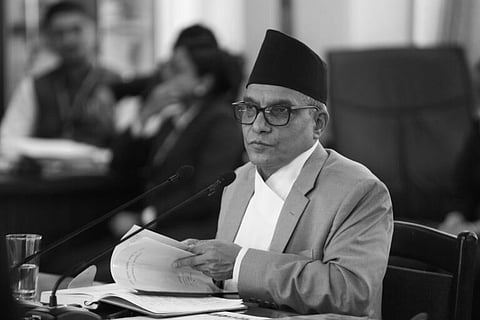

ON MAY 20, 2026, in the Singha Durbar complex in Kathmandu, Dr. Manoj Sharma, Nepal’s current Chief Justice, currently on a visit to India through an invitation from Chief Justice of India (‘CJI’) Surya Kant, was seated before a fifteen member Parliamentary Hearing Committee. The Committee, which is constitutionally required to cross question new recommendees to constitutional posts and is now dominated by prime minister Balendra Shah’s Rastriya Swatantra Party (‘RSP’).
Earlier that month, Nepal’s Constitutional Council, the constitutional body established under Article 284 of the Constitution of Nepal that appoints all the key constitutional posts in the country, had taken an unprecedented decision. Headed by Shah, the former Kathmandu mayor, whose party the RSP had won a sliding majority in the first general election after youth protests toppled the previous government in September last year, the Council recommended the appointment of Dr. Sharma, the fourth ranked judge in order of seniority in the Supreme Court of Nepal, as the Chief Justice. Similar to India, where the constitutional convention of seniority has historically determined elevation to the head of the judiciary (barring three exceptions, most infamously in 1973 and 1977 during Indira Gandhi’s regime), appointments to Nepal’s Chief Justiceship have, without exception, occurred through the seniority rule.
Through the month, sixteen complaints had poured in challenging Dr Sharma’s recommendation. MP Padma Aryal of the opposition CPN-UML party spoke into the microphone, “After being appointed Chief Justice, can you fearlessly put a check on the wrong decisions of the executive?” Sharma evaded without giving an answer.
Dr. Sharma’s recommendation had come at the cost of superseding three senior judges within the Supreme Court – the acting Chief Justice Sapana Pradhan Malla, previously a key figure in Nepal’s constituent assembly, and Justices Kumar Regmi and Hari Prasad Phuyal. In the history of Nepal’s young constitution, which came into force in 2015 – the realisation of a 65 year old foundational promise by King Tribhuvan for a constitution written directly by the people’s representatives – this was the first such supersession, and the most brazen instance of the undermining of judicial independence in the neighbouring country. It was also one of the most recent, visible instances of executive interference across the South Asian judiciary.
‘Running out the clock’
Almost immediately following Sharma’s cherrypicked appointment, wide debate sparked across political forums and the Nepalese bar. “He is not widely known for public legal commentary or academic writing, and has not been prominently associated with landmark constitutional debates,” the Kathmandu Post noted. Experts who analysed the Nepal Kanoon Patrika, the Supreme Court’s official monthly law journal, found that of 1,263 precedent-setting rulings published during his Supreme Court tenure, Sharma had only authored 48 verdicts, a 34 percent authorship rate on the benches he sat on, placing him ninth out of eleven judges. In comparison, the bypassed senior judges authored more than double his output. On three-member Full Benches, Sharma authored only 20 percent of decisions; on Grand Full Benches (Purna Ijlaas), that figure dropped to 17 percent.
Key to the supersession was a bundle of amendments introduced by Balen Shah’s government into the Constitutional Council Act, 2066 (2010 in the Gregorian calendar) – the governing statute for the body, which among other things, allowed the Council to select officials using only a majority vote (compared to requiring every member to agree), and lowered the number of members needed to hold a meeting and make a final decision. Sharma’s appointment was the first to come after these key amendments.
That day, on May 20 before the Hearing Committee, Nara Bahadur Bista, another opposition MP from the Communist Party of Nepal (Maoist) asked Sharma about the allegations that he tried to “capture” the Supreme Court.
In late April, three separate petitions were filed in the Supreme Court by several senior advocates challenging the Council’s decision to appoint Sharma. However, the Supreme Court administration, led by the then Junior Registrar Man Bahadur Karki refused to register the darpeet, the petitions. An appeal was filed against the refusal even as on May 13, several lawyers met acting Chief Justice Malla raising concerns over how the petitions were being handled.
A week passed as the writ petition remained stalled with the registry. On May 18, Chief Justice Malla, invoking Article 136 of the Constitution, which gives ultimate responsibility and administrative authority to make effective administration of justice across the court system, issued a bold three page order. The order directed to register the petitions that same day by 1 PM in the afternoon, and schedule a hearing for Tuesday.
When the petitioner, a lawyer named Prem Raj Silwal reportedly reached the registry office to meet officials and complete the registration process, the desks were empty. As informed by a noted source to The Leaflet, the Registrar and key staff physically vacated their offices and went out of contact “running out the clock.” The writs remained suppressed until May 20, the day of the Hearing Committee’s meeting.
On that day, responding to Bista’s question through the mic attached to his table, Sharma said, “The chief registrar and registrar have authority to use discretion on the matter of whether to register a writ or not. Others formed an opinion on this matter and levelled allegations.”
By all accounts, it was an unusual hearing, mired in irregularities. The Committee chairperson, an RSP MP, had made a ruling early on to conclude the process “quickly”. According to Nepal News, while earlier hearing committees called complainants and forwarded the approval process only after a few days of discussion, the RSP Committee breached the tradition and limited the hearing to a formality.
That same day, Dr. Sharma was hurriedly cleared by the Parliamentary Hearing Committee, sworn in at Shital Niwas, the President’s office, and placed in office. Once in office, on June 24, over a month after the registry kept the writs hostage, a constitutional bench led by Sharma upheld the administration’s decision to reject the writ petition challenging his appointment as the Chief Justice, noting that the challenge was now “moot”.
In a continuation of the same saga, earlier this month, Man Bahadur Karki, the junior registrar who was key to stalling of the writs, was recommended by the Constitutional Council to serve as Nepal’s Chief Election Commissioner.
A new judiciary in Nepal
Last night, the Embassy of Nepal welcomed Chief Justice Sharma at the Indira Gandhi International airport in New Delhi. On CJI Surya Kant’s invitation, Dr. Sharma will be attending an international conference marking 60 years of the United Nations Commission on International Trade Law. This morning, Dr. Sharma was seated in a delegation of foreign judges including a judge from the UK Supreme Court, from Bhutan’s Supreme Court, and judges from Brazil and Kenya, in the Chief Justice’s courtroom in India.
“India is a confluence of culture and values. We are looking forward to the interaction this evening,” attorney general R Venkataramani remarked, addressing the Bench, “This will also show the Swadeshi jurisprudence of India."
Born in 1970 in Birgunj, a border town in southern Nepal, into a family of lawyers – his uncle, Damodar Prasad Sharma, serving as Nepal’s Chief Justice in 2014 – Manoj Sharma studied for his LL.M. in Pune before obtaining a doctorate from Tribhuvan University in Kathmandu. In 2013, while Justice Damodar Sharma was still serving as a judge in the Supreme Court, Manoj Sharma was elevated to the High Court. Following the Constitution of Nepal, 2015, which eliminated the ”additional judge” category altogether, Sharma was relieved of his post — and while some judges in similar positions were later reinstated, he was not initially brought back to the bench. In 2019, under ex-Chief Justice Cholendra Shumsher Rana, who was later suspended under an impeachment motion in 2022 and forced into retirement before parliamentary proceedings formally concluded due to allegations of corruption against him from all sitting judges of the Supreme Court, Sharma was directly elevated to the Supreme Court.
Under Sharma, who is set to lead Nepal’s judiciary well into 2032, through years that commentators have noted to be crucial to Nepal’s democratic future under Balen Shah, who has previously advocated for a centralised presidential system, the Supreme Court, The Leaflet was informed through a source, is already facing critical pressures.
Interlocutory challenges against controversial executive ordinances, contested public land acquisitions, and questionable political appointments, the source said, are being “systematically neutralized or deferred”. All this while, it is mounting under a high pendency of over 21,000 cases. It is a contrast to only a few months before when several orders of the Supreme Court suspended controversial decisions of the Balen Shah government – like a move to abolish trade unions for civil servants, and another banning student unions in universities and colleges.
The key individual steering the Court at that time, acting Chief Justice Malla, who was the senior-most of the Judges in line to become the Chief Justice of Nepal, went on a 20 day leave, skipping Sharma’s welcoming ceremony, reportedly “dissatisfied after the Constitutional Council recommended Sharma.” She returned to work in early June, and in Sharma’s absence over his ongoing India visit, is currently serving as the acting Chief Justice again.
Justice Malla’s assuming charge as Chief Justice was long anticipated by women across South Asia with great expectation of gender justice. She would also have been the first woman to have been appointed as the Chief Justice across the South Asia region. Justice Malla has been an expert and steering committee member on the Convention on the Elimination of All Forms of Discrimination against Women from Nepal. Her supersession was another brutal realisation of the severe barriers confronting women in the legal profession across the region in accessing positions of leadership.
Prior to her elevation, Justice Malla petitioned or argued key cases foundational to Nepal’s gender justice and privacy jurisprudence, like Sapana Pradhan Malla v. Office of the Prime Minister (2007) where the Court held that enforcing the right to privacy for sensitive parties in legal proceedings is inseparable from other constitutional rights, including life and dignity, and essential to justice.
Other senior justices, The Leaflet learned through the source, have been sidelined “leaving an apex court that increasingly functions as an executive rubber stamp.”
Justice Kumar Regmi, the second seniormost judge who was also superseded, was on the five-member constitutional bench, alongside Justices Malla and Hari Prasad Phuyal which stayed the government’s decision to scrap civil servants’ trade unions. In early May 2026, sitting on a division bench, he also issued an interim order directing the Balen Shah government not to evict or displace squatters and informal settlers without following due procedure. It had arisen from a petition filed by Gen Z-linked informal settlers’ leaders who argued that the government was evicting people without identification, compensation or alternative arrangements.
Justice Phuyal, apart from being in the majority in the trade unions’ case, had also issued an interim order in mid-May 2026 suspending the Shah government’s policy of collecting customs duty even on goods worth as little as Rs. 100, after it drew heavy criticism from border communities.
A critical moment for the South Asian judiciary
The superseded judges were also personalities who, in the tumultuous years following deadly earthquakes in Nepal either directly played a role in framing the new liberal-democratic constitution, or in the subsequent years shaping institutional reform or jurisprudence on public interest litigation and the rule of law.
Much of Nepal’s jurisprudential culture has been inspired from India, like the public interest litigation. Speaking to Supreme Court Observer in December 2023, Justice Malla had noted, “The jurisprudence developed by the Supreme Court [of India] for years and years has inspired many of our judgments because you have one constitution and you have expanded the constitution.”
As Nepal now confronts a crisis in judicial independence, it comes as a critical moment for the South Asian judiciary. Findings by the International Commission of Jurists (‘ICJ’) show significant strain over judicial independence across the region. Its 2025 Annual Report found it to be a year of “growing democratic backsliding” with judicial independence under increasing pressure. Between 2024- 2025, Pakistan has seen two back-to-back constitutional amendments that ICJ and other bodies regard as a fundamental restructuring against judicial independence. In Maldives in February 2025, days before the Supreme Court was due to rule on a constitutional challenge to anti-defection provisions, parliament passed a bill shrinking the court from seven to five justices, and two justices were suspended the same day under a provision allowing automatic suspension based on an ongoing investigation, without a chance to challenge the decision.
The Indian judiciary faces, today, its own critical moment with several recent decisions of the Collegium on judicial appointments favouring the executive – sometimes violating constitutional convention – drawing concerns. Last year, a sitting member of the Collegium, Justice B.V. Nagarathna reportedly strongly opposed the recommendation to appoint Justice V.M. Pancholi to the Supreme Court, highlighting, among other issues, that he was ranked 57th among High Court judges nationwide and several more senior and meritorious judges from various High Courts should have been considered ahead of him.
Within this moment, Chief Justice Sharma’s visit in New Delhi comes as an opportunity to reflect upon the state of judicial independence collectively in a region confronting varying levels of friction on how a liberal democracy must function. Where the Nepal judiciary under a young constitution has looked to the Indian Supreme Court in the past as an inspirational institution, the Nepalese Chief Justice’s visit comes in a moment of shared concern – of different extent, yet effectively similar nature – over the fate of constitutional adjudication and the judicial independence crucial to it.