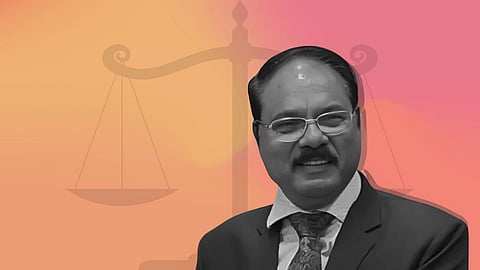

THE highly venomous contents of the speech of Justice Shekhar Kumar Yadav of Allahabad High Court, delivered at a programme organised by the Vishwa Hindu Parishad in the court premises, were marked, among others, by his open condemnation of Muslims and Islam and his blind appreciation of Hindu scriptures and denigration of Koran.
In a calculated manner, he employed communal binaries of ‘us’ and ‘them’, denoting Hindus and Muslims respectively to flag the immediate religious identities of people to treat them unequally, in complete disregard of the constitutional vision of equality and equal opportunity for all regardless of the faith they pursue.
His usage of phrases “hamaari Gita” (our Gita) and “aapki Koran” (Your Koran) flagged his prejudiced mindset against Islam and it was all the more intensely reflected in his speech when he said, “You can’t disrespect a woman who has been recognised as a goddess in our Shastras and Vedas. You can’t claim the right to have four wives, perform halala, or practice triple talaq. You say, we have the right to say ‘triple talaq’, and not give maintenance to women.”
Ambedkar's prophetic remarks
In displaying his brazen contempt for the Constitution he said, “I have no hesitation in saying that this is Hindustan, this country would function as per the wishes of the bahusankhyak (majority) living in Hindustan.”
He employed a highly derogatory term “kathmulla” to refer to Muslims and claimed that Hindus are reformed, tolerant and generous in contrast to Muslims who he said are reared from their childhood days with “hinsa ki pravritti” (violent tendencies).
Such toxic remarks of Justice Yadav, who occupies the exalted position of a high court judge and wears on his sleeves his Hindu identity to uncritically uphold scriptures and spew venom against Muslims remind us of B.R. Ambedkar's prophetic remarks in the preface of his book, Who Were the Shudras, published in 1946, about some Hindu judges.
In it, he observed how, what he called, “the mad dogs of orthodoxy” were let loose against him when he displayed courage in raising his voice against the so-called sacred books of the Hindus. Then he remarked that “Hindu judges of high courts and Hindu Prime Ministers of Indian States do not hesitate to join their kind”.
He charged, “They not only lead the howl against him but even join in the hunt.” “What is outrageous,” remarked Ambedkar, “is that they do so because they believe that their high stations in life would invest their words with an amount of terror which would be sufficient enough to cow down any and every opponent of orthodoxy”.
Justice Yadav's attack on the Constitution
Those anguished utterances of Ambedkar concerning Hindu high court judges brought out their defence of orthodoxy while opposing Ambedkar, an individual, for his interrogation of the sacred texts to explain the position of Shudras in a hierarchical caste system anchored in what he called “graded social inequality”.
Very alarmingly, Justice Shekhar Kumar Yadav, in his toxic and highly divisive speech as a judge of the high court, is not attacking an individual but a section of our citizenry on account of their faith and religious customs and ethos.
It is much more dangerous, particularly when India is celebrating the 75th anniversary of the Constitution and on this occasion, Justice Yadav, by the poisonous contents of his speech, is targeting the very Constitution and what India stands for.
Ambedkar's hopeful remarks
Ambedkar did not paint all Hindus with one brush. “The only class of Hindus, who are likely to welcome the book (Who were the Shudras?),” he said, “are those who believe in the necessity and urgency of social reform.”
“The fact that it is a problem which will certainly take a long time to solve and will call the efforts of many generations to come, is in their opinion, no justification for postponing the study of that problem,” he added.
“Even an ardent Hindu politician, if he is honest,” he pointedly said, “will admit that the problems arising out of the malignant form of communalism, which is inherent in the Hindu social organisation and which the politically minded Hindus desire to ignore or postpone, invariably return to plague those very politicians at every turn.”
He then stated, “These problems are not the difficulties of the moment. They are our permanent difficulties, that is to say, difficulties of every moment. I am glad to know that such a class of Hindus exists. Small though they may be, they are my mainstay and it is to them that I have addressed my argument.”
The quick condemnation of the abominable remarks of Justice Yadav, the withdrawal of important cases from him by the Chief Justice of Allahabad High Court and the manner in which he has been summoned by the Supreme Court Collegium to hold him accountable for what he said represent the hope which Ambedkar nursed in 1946 to boldly uphold the culture of protest against orthodoxy and fanatic approach.
It has been reported in the media that the collegium dubbed Justice Yadav’s speech as highly “avoidable”.
But how is it that such a judge was cleared for appointment by the collegium? Something must be done to avert the fears of Ambedkar, who warned by saying that “the high stations of such judges in life would invest their words with an amount of terror which would be sufficient enough to cow down any and every opponent of orthodoxy”.
The terror he referred to is now confronting the whole country and the Constitution. Ambedkar's repeated emphasis on the cultivation of constitutional morality constitutes an antidote to that terror.
