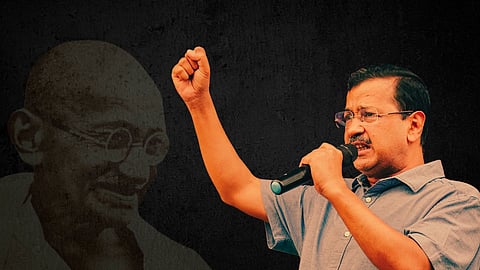

WE LIVE IN UNUSUAL TIMES. As a law teacher, to me, living in unusual times means the normative systems of law collapsing every day in a piecemeal manner. You can feel the presence of legality around you, but its legitimacy is suspect. Political theorist Judith Shklar once warned us that “procedurally correct repression is perfectly compatible with legalism.”
Last month, as Delhi’s ex-chief minister Arvind Kejriwal appeared in court one day to argue that the presiding judge, the Delhi High Court’s Justice Swarana Kanta Sharma, recuse from his case. As a law teacher, watching, reading and attempting to make sense of the case, it became my entry point to understand the current legitimacy crisis of the Indian judiciary. What especially caught my curiosity was Kejriwal’s invocation of Gandhian ‘Satyagraha’ after Justice Sharma refused to recuse herself in the Delhi Excise Policy case. The Aam Aadmi Party leader suggested he would not cooperate with the court, as he and his lawyers would not appear before it. Subsequently, today, Justice Sharma has expressed intent to appoint three senior advocates as amici curiae owing to Kejriwal, and his co-accused Manish Sisodia and Durgesh Pathak’s decision to boycott the proceedings.
This is an unprecedented development in postcolonial India. Gandhi used ‘satyagraha’ against colonial governmentality, and colonial courts were part of it. A former chief minister’s invocation of ‘satyagraha’ against a present-day court must ring an alarm bell in a democracy. How did we reach this point? Is Kejriwal right in invoking ‘satyagraha’ against a court of independent democratic India? Does he have the moral agency to invoke ‘satyagraha’? These questions may continue to haunt our judicial system.
