How systemic issues like pendency sustain the Indian judiciary’s corruption problem

The Justice Varma case represents not an anomaly, but the systemicity of corruption within the Indian judiciary. It is not the first instance of high-level corruption involving judges, and certainly not the last. At the heart of the matter are long standing ailments such as India’s massive case backlog of over 5 crore cases
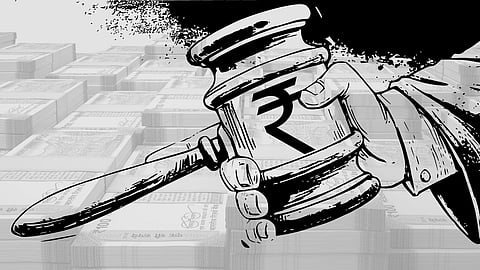
Representative Image Only
Published on

A CASH SCANDAL has rocked the Delhi High Court after an alleged fire at the residence of Justice Yashwant Varma reportedly uncovered a large stash of cash, estimated by some to be as high as ₹50 crore. At this point, it is worth trying to understand whether this case represents an exception or something more endemic to the Indian judiciary. 

Let us recall a few similar cases.

One significant case involved Justice Soumitra Sen of the Calcutta High Court. In 2011, Sen became the first Indian judge to be impeached by the Rajya Sabha, for misappropriation of funds. Sen was accused of diverting approximately ₹33 lakh while serving as a court-appointed receiver in a legal dispute, retaining the funds for personal use even after his elevation to the judiciary. 

He resigned before the Lok Sabha could impeach him. After his resignation, he was not prosecuted. A 2012 RTI query revealed that he retained post-retirement benefits, as no constitutional provision barred them for judges resigning before impeachment completion.

Systemic factors like the massive backlog of cases exacerbate corruption. Litigants often pay bribes to secure favorable hearing dates or expedite orders. 

Another prominent instance is the 2009 cash-at-judge’s-door scandal involving Justice Nirmal Yadav of the Punjab and Haryana High Court. A bag containing ₹15 lakh was allegedly delivered to Yadav’s residence, intended as a bribe to influence a case. Initially delivered mistakenly to a different judge, the incident sparked an investigation by the Central Bureau of Investigation. It appears the trial in the case is still continuing.* 

In 2010, former Law Minister Shanti Bhushan and his son, Prashant Bhushan, stirred controversy by alleging in a Supreme Court affidavit that eight of the previous sixteen Chief Justices of India (CJIs) were corrupt. Prashant Bhushan had previously stated that there was corruption at the highest levels of the judiciary. While he did not provide detailed evidence in public, the statement pointed to a perceived systemic issue at the highest levels. This claim was followed by contempt proceedings against the Bhushans. The matter did not reach a notable conclusion.

In 2012, a "cash-for-bail" scandal implicated CBI Special Judge Talluri Pattabhirama Rao, who was arrested for accepting a ₹5 crore bribe to grant bail to mining baron Gali Janardhan Reddy in an illegal mining case. This incident exposed corruption in the lower judiciary, where delays and discretionary powers often create opportunities for illicit payments. 

Representative Image Only
Justice Yashwant Varma tracker: 10 most important questions and a complete timeline of latest developments

Following an adverse report, the Supreme Court Collegium recommended his transfer to his parent court, the Allahabad High Court. While official investigations are ongoing as of March 21, 2025, the incident fueled public outrage and debates about accountability. Some argued that a mere transfer was insufficient punishment for such alleged corruption. Such decisions have the effect of transferring corruption from one court to another by judicial action, apart from trivialising the criminal offence.

Also notable was the 2019 CBI investigation against Justice Narain Shukla of the Allahabad High Court, accused of receiving illegal gratification to favour a medical college in a case he was adjudicating. He received no punishment. These instances reflect a range of corrupt practices.

India’s serious pendency problem fosters corrupt practices

In December 2023, Law Minister Arjun Ram Meghwal revealed that more than 5 crore cases were pending across India’s district, subordinate and High Courts. Systemic factors like the massive backlog of cases exacerbate corruption. Litigants often pay bribes to secure favorable hearing dates or expedite orders. 

The lack of transparency in judicial appointments, inadequate accountability mechanisms, and the judiciary’s resistance to external oversight further compound the issue. For example, the in-house mechanism for addressing judicial misconduct, overseen by the Chief Justice of India, has been criticised as opaque and ineffective, with no FIR permitted against a judge without the CJI’s approval. The courts are not too enthusiastic about providing information in RTI. 

About  25 percent of cases are decided in less than a year whereas about 40 percent of cases languish for over three years. The simple principle of first in first out is widely violated.

These cases and underlying issues illustrate that corruption in the Indian judiciary spans both lower and higher courts, driven by a mix of individual greed, systemic inefficiencies, and weak enforcement of ethical standards. 

In  Transparency International’s 2013 Global Corruption Barometer, 45 percent of surveyed households viewed the judiciary as corrupt, and when Indian respondents were asked to give a score between ‘1 to 5’ regarding how corrupt they believed the judiciary to be, Indians gave an average score of 3.3. The delays and adjournments in the courts make a fertile ground for corruption and arbitrariness. It is very easy and vitally necessary to correct these.  Here are the three fundamental approaches to the problem:

  1. The average increase in the disposal of cases is about 3 to 5 percent. The average vacancies in judicial appointments is over 20 percent. If vacancies in sanctioned positions are filled, delays and backlogs would become history.

  2. Article 14 guarantees equality before the law. This is violated daily in our courts. About  25 percent of cases are decided in less than a year whereas about 40 percent of cases languish for over three years. The simple principle of first in first out is widely violated.

  3. Adjournments are a major bane of our courts. The law does not permit an adjournment because a lawyer is in another court. Most adjournments flout the law. 

We lack the ability to punish  wrongdoers if they have power or money. We can become a leading jurisdiction  in terms of rule of law through fundamental, yet simple actions. Without this we cannot attain the position of a modern, advanced nation. 

Loading content, please wait...

Related Stories

No stories found.
The Leaflet
theleaflet.in