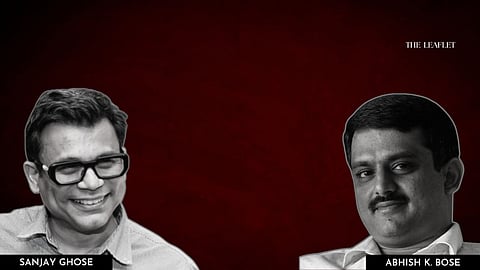
The political economy of law: An interview with Sanjoy Ghose
SANJOY Ghose is a senior advocate at the Supreme Court of India. He regularly appears before the Supreme Court of India, the High Court of Delhi, other high courts across India (including Madhya Pradesh, Punjab & Haryana, Allahabad and Uttarakhand), and judicial forums, including the Central Administrative Tribunal, the National Company Law Tribunal, the National Company Law Appellate Tribunal and National Consumer Disputes Redressal Commission on matters involving civil, commercial and criminal law.
In an exclusive interview with The Leaflet, Ghose expresses his views on a wide array of issues including constitutional amendments to protect workers’ rights, declining judicial standards and the need for reforms in the judiciary to increase transparency, accountability and improvements in judicial appointments.
Excerpts from the interview
Abhish K. Bose: The pandemic-induced economic downturn has exposed vulnerabilities in private-sector employment, with widespread layoffs and inadequate protections for workers. This raises fundamental questions about the balance of power between corporate interests and employee rights.
To what extent have private sector employers historically exploited legal loopholes to circumvent labour protections? What reforms are necessary to establish robust safeguards for employees and ensure corporate accountability?
Sanjoy Ghose: Traditionally, labour law administration has been tripartite. There are three players. The industry, which could be the private sector or the public sector, which is one part referred to in labour laws as the management.
The other part would be the workmen, that is the employees. These employees can be in the formal sector and the informal sector, referred to as organised and unorganised sectors respectively, though most labour laws address the formal sector. The third part of this tripartite structure is the labour enforcement authority.
The traditional wisdom was that given the unequal bargaining status and the economic position of the management and the workmen, in order to create a level playing field, it was essential for the State through its labour department to intervene. The history of labour enforcement since independence, however, has left both the management and the workmen in despair.
The management is content that the vast and pervasive powers given to the labour authorities such as the power to inspect, prosecute, sanction, closure and make references of disputes has led to an inspector raj which is not conducive for an economy that wants to portray itself globally as investor-friendly.
Workmen have also complained that given the economic power of the management, the labour authorities more often than not act on the management’s behalf rather than protecting the interest of the workers and the trade unions.
Pursuant to the mandate of ‘maximum governance, minimum government’, the Modi government enacted new labour codes to replace existing labour laws. The objective was to get rid of the inspector raj and bring in an era of voluntary compliance.
Many have argued that the new codes are merely old wine in new bottles. Be that as it may, the government is yet to notify the new codes.
In my opinion, the manner in which the private sector has stolen a march over the workers has been by compromising the trade union movement. This process was initiated by the Narasimha Rao government when it brought in the economic reforms in the 1990s and the judicial decisions from that era which sought to reverse labour jurisprudence that tilted in favour of the underdog— namely the workmen.
The judicial backing for the practice of awarding paltry compensation instead of reinstatement with full back wages in cases of workers’ strikes further undermined the trade union movement in India.
Trade unions today hardly agitate what in law is known as ‘interest disputes’— that is, disputes other than termination, usually relating to wage revisions, bonuses, special allowances, etc. In the last two decades, courts have also not favourably viewed workers resorting to tools of collective bargaining such as strikes, demonstrations and ticketing at factory gates.
Therefore, according to me, the key to restoring an equilibrium in industrial relations would be to effectively promote responsible trade unionism when the workers are in fact properly represented in trade unions that are not political and truly representative.
The new court makes a modest attempt at trade union law reform. However, we are yet to see the law implemented. In fact, another area that requires attention is the organisation of the unorganised sector.
Post the Covid-19 pandemic, India has also seen a massive growth in the gig economy with platforms such as Uber, Swiggy, Zomato, and Ola becoming the new driving force of the economy.
While the new code makes a beginning by requiring the registration of all gig workers, it does not go much further. The promises therein of creating a fund and providing for a contingency such as accidents are also weak without any kind of timelines.
Abhish K. Bose: India's unorganised sector employs millions, yet these workers face exploitation and vulnerability. To address this, how can the Indian Constitution be amended to comprehensively safeguard the rights of private and unorganised workers?
Sanjoy Ghose: The Indian Constitution being a product of its times addressed what most post-war constitutions perceived as their mandate, namely, protecting the citizen against the State. Therefore, most rights of citizens under our Constitution are directed against the State.
There are notable exceptions such as the right against beggar (forced labour) and exploitation and the right against Untouchability. However, with the passage of time, the State has been shrinking and most private sector players today are taking over the role of the State.
In certain countries such as the United Kingdom, even prisons have been privatised and are managed by private companies. The time has come to revisit the issue of whether the protection against discrimination should be confined only to State actors or whether India requires a non-discrimination law such as in the US which applies to private establishments as well.
For example, today, if a private employer terminates an employee on the grounds of her sexual orientation, the employee would not have recourse to legal remedy.
Therefore, given that the private sector employs a large number of people in India, a majority of them in the unorganised sector, it is indeed time to revisit our approach to the rights of citizens.
Abhish K. Bose: The Indian Constitution enshrines the fundamental principle of equality before the law (Article 14). However, the stark asymmetry in resources and legal expertise between big corporates and ordinary citizens often skews judicial outcomes in favour of the powerful.
This raises pressing concerns about the efficacy of the legal system in upholding constitutional guarantees. In light of this disparity, is it constitutionally incumbent upon the Indian judiciary to establish specific guidelines and safeguards that protect the interests of ordinary citizens?
If the current system perpetuates unequal outcomes, wherein corporates consistently leverage their financial and legal might to prevail, does this not undermine the very essence of Article 14?
Does this failure to address these concerns undermine the rule of law, eroding public trust in the judicial system? How can the Indian judiciary reaffirm its commitment to constitutional equality and ensure that justice is served, regardless of economic or social standing?
Sanjoy Ghose: Sadly, the state of the Indian judiciary is woefully pathetic. The pendency of big cases will put any conscientious lawyer or judge to shame. The problem has further been aggravated by the pandemic due to which only emergency cases received priority and attention.
The experience of the past decade also indicates that the entire judicial and political system gives priority to commercial matters. Towards this end, we have seen the enactment of the Commercial Courts Act, 2015.
Various courts have also marked special intellectual property law divisions. Arbitrations have also been given priority in consideration for disposal. Often, commercial matters where parties are able to engage top counsel for mind-boggling fees are given preference during hearing. This comes at the cost of the irregular, not-so-glamorous bread and butter matters of industrial workers, women facing violence, tribals facing exclusion from their lands and State repression.
Ideally, we need a fundamental rehaul and massive investment in upskilling of the Indian justice system. The priority given to commercial matters is equally important as the speedy resolution of pending industrial and labour disputes.
However, given the woeful delays in matters of judicial appointment and lack of adequate infrastructure in courts, it is very unlikely that labour matters will get the attention they deserve in the near future.
At the time of recruitment of judges, efforts must be made to hire judges who exhibit a clear commitment to justice and serve without being influenced by the stature of the counself. We need judges who are compassionate and grounded in the social reality of India, not just proficient in the law.
Abhish K. Bose: What specific reforms and measures can be implemented to strengthen whistle-blower protection laws, ensuring they effectively expose and hold accountable corporate wrongdoing, while also addressing concerns around national security, commercial confidentiality and false claims?
Sanjoy Ghose: India has already enacted a whistleblower legislation which is yet to be effectively implemented. The Indian system for witness protection is woefully inadequate and it also does not have effective legislation to prosecute and penalise false allegations which must also be addressed if the whistle blown up is to be taken seriously.
Here again not only legislative but also administrative support would be necessary to make any meaningful attempt at addressing this issue effective and long-lasting. The law of perjury in developed nations ensures the sanctity and the credibility of the judicial process.
One recalls the conviction of the reputed author Jeffrey Archer for perjury. In India, given the laxity of the law of perjury, litigants feel no hesitation in levelling all kinds of wild, false and baseless allegations.
Even in cases where it is established that false testimony has been given, the courts have a tendency to underplay the same and treat it as a side issue.
Abhish K. Bose: Public interest litigations (PILs) have emerged as a vital tool for advancing social justice and promoting human rights in India. By leveraging PILs, can civil society organisations, activists and marginalised communities effectively advocate for social security reforms and challenge systemic injustices?
Sanjoy Ghose: As a litigation strategy, PIL emerged first in the late 1980s to provide access to justice to marginalised and disadvantaged sections of society such as bonded labour, tribal communities and workmen being deprived of the minimum wages.
In the succeeding decade, PILs took a political turn as an increasing number of cases of corruption came to light. Several PILs were filed to hold governments to account in matters of scams and dereliction of duties by constitutional authorities.
Such litigation led to fundamental reform of legislation and the institutionalisation of the Lokpal, the Central Vigilance Commission, etc. In the past two decades, however, PILs have often been abused to scuttle economic growth or stunt economic competition.
This is an era where the political party in power has used instrumentalities of the State such as the Enforcement Directorate (ED) to gain an advantage against the Opposition. Therefore, PILs have been used in cases such as the electoral bonds and extension of the tenure of ED director to restore the field to some level of parity.
However, the trend in the last decade seems to be indicating that judges are increasingly cautious and reluctant to entertain PILs against what is perceived to be a strong and majoritarian government, which does not hesitate to express its views on matters of judicial appointments, transfers and promotions.
The government has also actively resorted to a practice of rewarding retired judges with high positions such as governorships or Rajya Sabha membership. Many judges who have attempted to display any form of neutrality such as Justice Akil Kureshi and Justice S. Muralidhar have been perceived to have been victimised on account of their independent positions.
The judiciary, therefore, faces a grave crisis of independence. Unlike the child of the Emergency, the Bar of today also is politically divided and is not united in standing up for the independence of the judiciary.
In these circumstances, the only manner in which civil society can hold the judiciary to account would be by resorting to tools such as the PILs but also by being actively aware of judicial proceedings and verdicts.
The increasing transparency brought in by live-streaming of court proceedings has certainly empowered the citizen and it is hoped that it would also have a positive impact on the judiciary, howsoever temporary.
Abhish K. Bose: The Indian judiciary faces mounting criticism over declining standards, compromised integrity and ineffectual delivery of justice. Similarly, is the Bar plagued by issues of professionalism, ethics, and competence?
Sanjoy Ghose: It is true that there has been a decline in the standards of the Bar as well as the Bench. It is said that the Bar is the mother of the Bench. After the freedom movement, which was led by several legal stalwarts, the standard of the Bar and Bench remained high for several decades. Thereafter, the legal profession witnessed a decline as law became the last option for many students looking for an education and career.
With the establishment of the National Law Universities in the 1990s, there was a renewed interest in law as a viable and lucrative career. Sadly, given the prohibitive costs of educating oneself in such law schools, most graduates prefer to apply for corporate employment and very few are able to join the Bar.
The Bar itself is filled with obstacles for first-generation lawyers and people without any contacts and networking, therefore such products of National Law Schools cannot be faulted for their aversion to trying out the harder path. Resultantly, it is also found that despite the renewed interest in law, very few young and competent lawyers are willing to join the judiciary.
There are several reasons for the same such as the lack of financial remuneration, the inadequate work environment where judges lack proper seating space, even toilets and secretarial assistance access to a library.
The problem is further aggravated by the approach of the present government which is absolutely averse to the appointment of judges critical of its policies and the viewpoints to constitutional courts.
We have witnessed cases of several competent lawyers, even products of the National Law Schools, such as Dr Aditya Sondhi, who, despite being recommended for judicial appointment, have not been accepted by the government on account of their independent views.
Sadly, this leads to mediocre judicial appointments and perpetrates the race to the bottom between the Bar and the Bench.

