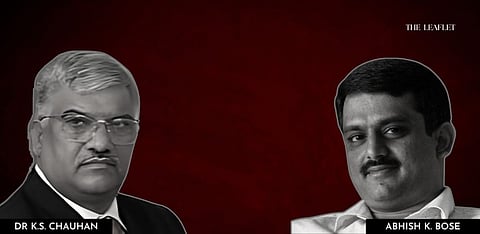

In this exclusive interview, Supreme Court lawyer Dr K.S. Chauhan expresses his thoughts on sub-categorisation, an economic criterion for reservations and the representation of Scheduled Castes and Tribes in public services in India.
—
Dr K.S. Chauhan has been practising in the Supreme Court of India for the last 38 years. He has a doctorate in law from the M.D. University, Rohtak, and has taught at the Indian Law Institute and faculty of law, University of Delhi. He was awarded the Dr Ambedkar National Award for Social Justice in 2016 by B.D. Sahitya Akademi, New Delhi.
He argued M. Nagaraj versus Union of India in 2006, in which the Supreme Court upheld the constitutional validity of reservation in promotion. The eminent lawyer has also argued the case relating to sub-categorisation (or sub-classification) of Scheduled Castes and Scheduled Tribes before the court.
He has many books and publications to his name, notable being Parliament: Powers, Functions and Privileges; A Comparative Constitutional Perspective, LexisNexis, (2013), which was forwarded by Justice (later Chief Justice of India) T.S. Thakur; and Citizenship Rights and Constitutional Limitations, Mohan, Law House, (2021), introduced by Justice Gopal Gowda of the Supreme Court and released by M. Hamid Ansari, former vice president of India.
In an exclusive interview with The Leaflet, he discussed the reservation policy in India.
Abhish K. Bose: Is the judiciary's growing inclination to link reservations to individual economic status, as exemplified by Justice Ashok Bhushan's observation, a harbinger of a fundamental shift away from the constitutionally enshrined caste-based reservation paradigm, potentially undermining the cornerstone of social justice in India?
Dr K.S. Chauhan: The Constitution of India has envisioned an egalitarian social order through the elimination of the existing hierarchical caste system in Indian society, social discrimination, social exclusion and the extreme form of exclusion in the form of Untouchability.
Indian society follows graded inequality in which a person is told that one is superior to another, and the objective of the Constitution is to establish an egalitarian social order by eliminating the Indian caste system.
The system of reservation under Articles 15 and 16 of the Constitution of India, ensures the representation of "any socially and educationally backward classes of citizens or for the Scheduled Castes and the Scheduled Tribes". The Scheduled Castes and the Scheduled Tribes are identified under Articles 341 and 342 respectively.
In Jaishri Laxmanrao Patil versus State of Maharashtra, Justice Ashok Bhushan stated that "fault lines of division between those who are employed in good jobs and those who are excluded run deep and are based on caste, religion, region and other sectarian divisions, all of which overlap with class and gender, such that even within the small section of the workforce which is productively employed in decent jobs, some groups are better represented than others, placed higher than others, while some castes and communities are practically absent in the top echelons of the private corporate sector.
“Indian society follows graded inequality in which a person is told that one is superior to another, and the objective of the Constitution is to establish an egalitarian social order by eliminating the Indian caste system.
"While private employers firmly believe that jobs should be allocated on the basis of individual merit, their views about how merit is distributed overlap strongly with existing stereotypes around caste, religion, gender and regional differences."
The view taken by the court is contrary to the express provisions of the Constitution and it means the court has disregarded the Constitution, though it is a creature of the Constitution and doing so is a violation of its oath and democratic principles.
The Constitution (103rd Amendment) Act, 2019, has introduced 10 percent reservation for Economically Weaker Sections (EWS) exclusively belonging to upper castes of society for admission to Union government-run educational institutions and for employment in Union government jobs.
The basic foundation of reservation policy is to ensure the participation of backward classes (namely Scheduled Castes, Scheduled Tribes and Other Backward Classes)— socially marginalised sections of the society— in the governance of the State.
Unfortunately, the court has taken a dual standard, on one hand, by saying social backwardness is not applicable, but on the other hand, it has suggested the application of a creamy layer which is one and the same thing. The principle settled by a larger Bench is binding.
A Bench of seven judges in State of Punjab versus Davinder Singh has tried to reorient the express constitutional principle of social justice from its social base to an individual. The discrimination, exclusion and ultimate Untouchability that come to the fore would demonstrate by illustrative examples that the economic condition of a person, who is occupying the highest position, could not dignify such a person.
Therefore, constitution makers have rightly considered the social conditions instead of individual conditions and constitutional principles are binding on the courts, they have no power to substitute their opinion for its provisions.
Abhish K. Bose: Is economic status a sufficient and reliable indicator of social disadvantage, or does its adoption as the sole criterion for reservation benefits threaten to conflate poverty with prejudice, potentially leaving vulnerable groups unprotected?
Dr K.S. Chauhan: A member of the Scheduled Castes or Classes suffers social discrimination, social exclusion and Untouchability and the adoption of economic criteria is not a sufficient and reliable indicator to remedy the social disadvantages of such a person.
The court has noted in Prathvi Raj Chauhan versus Union of India that "Untouchability though intended to be abolished, has not vanished in the last 70 years. We are still experimenting with 'tryst with destiny'.
"The plight of the Untouchables is that they are still denied many civil rights; the condition is worse in the villages and remote areas where fruits of development have not percolated down. They cannot enjoy equal civil rights."
The court further noted, "The data of the National Crime Records Bureau, Ministry of Home Affairs, has been pointed out on behalf of the Union of India, which indicates that more than 47,000 cases were registered in the year 2016 under the Scheduled Caste and Scheduled Tribe (Prevention of Atrocities) Act, 1989.
"The number is alarming, and it cannot be said that it is due to the outcome of the misuse of the provisions of the Act."
The court further noted that the Constitution mandates "the creation of a casteless society as the ultimate aim. We conclude with a pious hope that a day will come, as expected by the framers of the Constitution, when we do not require any such legislation such as the Act of 1989, and there is no need to provide for any reservation to Scheduled Castes, Scheduled Tribes and Other Backward Classes and only one class of humans exists equal in all respects and no caste system or class of Scheduled Castes, Scheduled Tribes and Other Backward Classes exists, all citizens are emancipated and become equal as per constitutional goal."
“A Bench of seven judges in State of Punjab versus Davinder Singh has tried to reorient the express constitutional principle of social justice from its social base to an individual.
In his concurring judgment, Justice Ravindra Bhat has noted that it is important to reiterate and emphasise that unless provisions of the Act are enforced in their true letter and spirit, with utmost earnestness and dispatch, the dream and ideal of a casteless society will remain only a dream, a mirage.
The marginalisation of Scheduled Caste and Scheduled Tribe communities is an enduring exclusion and is based almost solely on caste identities. It is to address problems of a segmented society that the Constitution has express provisions to give effect to the idea of fraternity.
If such economic criteria are adopted as a sole criterion to remedy discrimination, Untouchability and social exclusion could only rise with poverty and fall as poverty levels come down, which is not the case.
Dr Ambedkar is right when he wrote that "Untouchables are born and die as Untouchables" and the scorn is carried from birth to the graveyard. The emphasis here is not on individuals but to highlight the acuteness of the problem and the urgency to eradicate the evil.
The insensitivity to which Dalits are subjected and the remedy provided under the Act and the acute need to implement the law strictly.
Thus, the above cases of social discrimination, social exclusion and Untouchability of very high officials cited by the Supreme Court itself, that is the reason that the Constitution makers have provided for protective remedial measures under the scheme of the Constitution.
The Supreme Court has not considered any data or details that could justify such a view by the court, and the decision is contrary to the express principles enshrined under the scheme of the Constitution.
Abhish K. Bose: Would replacing caste-based reservations with economic criteria merely substitute one form of inequality with another, potentially papering over the deep-rooted, historically entrenched injustices faced by marginalised communities, rather than confronting and dismantling the systemic structures that perpetuate their exclusion?
Dr K.S. Chauhan: The backward classes (Scheduled Castes, Scheduled Tribes and Other Backward Classes) are identified on the basis of their social origin which is determined on the basis of caste.
Members of the backward classes (Scheduled Castes, Scheduled Tribes and Other Backward Classes) have historically suffered marginalisation, exclusion and extreme forms of Untouchability in society.
An egalitarian social order could be established if castes are developed as classes and belongingness to castes is eliminated. These classes would be merged and the social and educational backward classes would make the existence of caste irrelevant.
If the castes are categorised, then the identity of castes would be further strengthened as it would be relevant for any benefit, and resultantly, social discrimination and social exclusion would be strengthened, and Untouchability would also strengthen in the society.
The economic condition of a person is not relevant to social equality, if a person is rich or highly placed, such a person could also face inequality due to caste.
“Constitution makers have rightly considered the social conditions instead of individual conditions and constitutional principles are binding on the courts.
In his exceptional work in the book Annihilation of Caste, Dr Ambedkar stated that "every Congressman who repeats the dogma of [John Stuart] Mill that one country is not fit to rule another country, must admit that one class is not fit to rule another class".
Unfortunately, the Supreme Court has tried to rewrite the Constitution, which the Constitution has not empowered as every member of the Scheduled Castes and Scheduled Tribes is facing social discrimination, social exclusion and a severe form of Untouchability.
Abhish K. Bose: Would reservations based on economic considerations supplant rather than supplement the existing caste-based reservations, potentially abandoning the most vulnerable sections of society to the vagaries of market forces and neoliberal policies?
Dr K.S. Chauhan: Reservations based on economic considerations will not serve the constitutional purpose of the participation of historically socially deprived and socially excluded sections of society in governance.
The sections of society that are unrepresented in the public service have been ensured representation through reservation. The reason is not economic but social, therefore, reservation cannot be supplanted through economic consideration-based reservations.
The impact of ideas of taboo and impurity is manifested not only in villages but also in towns and cities. This could be illustrated by some publicly known incidents reported in newspapers and other journals.
Abhish K. Bose: Can the Indian government devise a tamper-proof mechanism to assess economic status, one that withstands the pressures of political patronage, bureaucratic corruption and social engineering to ensure that reservations benefit the marginalised rather than the powerful?
Dr K.S. Chauhan: As demonstrated above, there are many other examples of social discrimination, social exclusion and social deprivation and Untouchability in society against persons belonging to Scheduled Castes and Tribes even when they occupy high positions in public services.
Therefore, there is no mechanism to assess the economic condition of a person belonging to a Scheduled Caste or Tribe that could ensure that they would not be discriminated against.
Economic considerations are not relevant to a problem that is essentially one of social discrimination and stratification.
Abhish K. Bose: What systemic barriers and entrenched inequalities are perpetuating the gaping disparity between the mandated 15 percent and 7.5 percent reservations for Scheduled Castes and Scheduled Tribes respectively in higher education, and their dismal actual representation, effectively nullifying the constitutional guarantees meant to uplift India's most marginalised segments pointing to a catastrophic failure of policy implementation and a perpetuation of structural injustices?
Dr K.S. Chauhan: Indian society is deeply ingrained in the caste and the social conditions are determined on the basis of caste and its mechanism. The fruits of the constitutional provisions are not being disbursed to the members of the socially marginalised sections of society.
“The marginalisation of Scheduled Caste and Scheduled Tribe communities is an enduring exclusion and is based almost solely on caste identities.
As per the census for the year 2011, the Scheduled Caste population in India is 16.8 percent and the Scheduled Tribes population in India is 8.6 percent (thus, they are 25.4 percent of the total population), but the reservation percentage has still not been increased to that percentage from the existing 15 percent and 7.5 percent reservations for Scheduled Castes and Scheduled Tribes respectively.
Education is systematically denied to the deprived sections of society as the government is closing schools in the name of a merger. In 2021–22, there were 1,489,115 schools in India, of which 1,022,386 were government schools. The number of private schools in India increased by 5.5 percent in 2021–22, while the number of government schools decreased by 0.2 percent.
Haryana is a very small state, and 4,801 schools have been closed in the name of mergers in 2022–23 in the state. We need another Jyotiba Phule and Savitri Bai Phule for the revival of education in India.
After a school teacher and All India Backward and Minority Communities Employees Federation (BAMCEF) national vice-president Suresh Dravid raised concerns about the closure of schools, he is facing criminal prosecution under Section 124A (sedition) of the Indian Penal Code, 1860.
The number of government schools is decreasing and it is becoming very difficult for persons belonging to Scheduled Caste and Scheduled Tribe communities to educate their children as they have limited resources.
The cost of education is shooting up and it is out of reach for Scheduled Caste and Scheduled Tribe and is going still further out of their reach and there is no remedy. In almost all states, the post-matric scholarship meant for the students of Scheduled Caste and Scheduled Tribe communities is not disbursed timely. It has been noticed that the funds of such scholarships are diverted and are not disbursed for years.
Therefore, the states are not making any efforts to ensure the education of the students belonging to Scheduled Caste and Scheduled Tribe communities.
The examination system and the conduct of All India exams for admissions to higher education courses are also affecting the rights of these communities and the large-scale computerisation and weaker or no-Internet connectivity for Scheduled Caste and Scheduled Tribe students are also affecting their rights.
Abhish K. Bose: Can a hybrid model integrating economic and caste-based criteria strike a balance between the need to address socio-economic deprivation and the imperative to dismantle caste-based discrimination, or would it be a compromise that ultimately undermines the transformative potential of affirmative action in India?
Dr K.S. Chauhan: Scheduled Caste and Scheduled Tribe communities are socially deprived and a hybrid model integrating economic and caste-based criteria would not be useful and the social deprivation, social discrimination, social exclusion, and Untouchability would persist in case of such criteria.
“If economic criteria are adopted as a sole criterion to remedy discrimination, Untouchability and social exclusion could only rise with poverty and fall as poverty levels come down, which is not the case.
Such hybrid criteria would strengthen the deep-rooted social prejudices against members of Scheduled Castes and Scheduled Tribes. Constitutional rights have not percolated benefits to the common men or the masses, especially persons belonging to Scheduled Castes and Scheduled Tribes.
Look at the case of Bihar, for example. As per the Report on Status of Backwardness of Scheduled Castes and Scheduled Tribes in Bihar (2012) reads: "This socio-economic status and limited educational qualification is reflected in Scheduled Caste and Scheduled Tribe communities' space in government jobs.
"There is a visible concentration of members of Scheduled Caste and Scheduled Tribe communities in fourth-grade jobs and a striking underrepresentation in senior positions in the government of Bihar.
"Representation of Scheduled Caste and Scheduled Tribe communities is very negligible in senior positions and in some departments, there are no Scheduled Caste and Scheduled Tribe personnel at senior positions at all.
"These facts clearly indicate that reservations in promotions are needed to ensure their representation in government services. The report underscores the visible, though inadequate, improvement in the quality of life of SCs and STs due to policies of affirmative action.
"In fact, representation of staff under reserved Scheduled Caste and Scheduled Tribe quotas is less than 5 percent across most services having sufficient promotional positions. Only 321 Scheduled Caste candidates and 113 Scheduled Tribe candidates were recommended by Bihar Public Service Commission for promotion as against 410 and 138 vacancies of these categories respectively."
The Patna High Court has not approved the enforcement of the reservation in promotion as a constitutional mandate under the scheme of the Constitution (77th Amendment) Act, 1995 and the Constitution (85th Amendment) Act, 2001.
The average representation of Scheduled Caste and Scheduled Tribe communities in Bihar is 5 percent in promotional posts, whereas, as per the 2011 census, the Scheduled Caste population in the state is 15.91 percent and the Scheduled Tribe population is 0.9 percent (thus, they are 16.81 percent of the total population) and there is a reservation to the tune of 16 percent for Scheduled Castes and 1 percent for Scheduled Tribes prescribed in the Bihar.
Similarly, in Uttarakhand, as per the provisions of law and policy, the reservation for the members of Scheduled Castes is 19 percent and for members of Scheduled Tribes, it is 4 percent.
The government of Madhya Pradesh has been extending reservations to members of Scheduled Caste and Scheduled Tribe communities in the staffing of various departments at various levels for several decades to ensure the adequate representation of these communities with respect to their populations.
It has been observed that such reservations play a critical role in ensuring the representation of Scheduled Castes and Scheduled Tribes in government services, as the proportion of Scheduled Caste and Scheduled Tribe employees recruited without the backing of reservations is very low.
“Dr Ambedkar is right when he wrote that "Untouchables are born and die as Untouchables" and the scorn is carried from birth to the graveyard.
Overall, the degrees of representation of staff under reserved Scheduled Caste and Scheduled Tribe quotas are limited to less than 1.38 percent across most services having sufficient promotional positions for consideration within the sample of analysis, even though reservations are in place.
Class IV employees have a relatively greater proportion of Scheduled Caste and Scheduled Tribe employees, though the representation of Scheduled Caste and Scheduled Tribe communities in posts at higher levels is not commensurate with their share in the population of the state.
At present, the representation of Scheduled Caste and Scheduled Tribe communities is only 24 percent in place of 36 percent. In Madhya Pradesh, the total sanctioned posts in various departments are 818,183 out of which 383,471 are held by the unreserved category. Scheduled Castes hold 103,038 posts and Scheduled Tribes hold 88,029 posts.
“The impact of ideas of taboo and impurity is manifested not only in villages but also in towns and cities.
The number of vacant posts in Madhya Pradesh is 247,091; 21.3 percent of Scheduled Caste posts are vacant and so are 46.20 percent of Schedule Tribe posts.
