
IMAGINE TRAVELLING THOUSANDS OF MILES, not with the purpose of business, study, or leisure, but for childbirth. Birth tourism includes giving birth in a country that grants citizenship based on ‘jus soli’ and provides benefits to all children born there. Section 1 of the 14th Amendment of the American Constitution states that “All persons born or naturalized in the United States, and subject to the jurisdiction thereof, are citizens of the United States and of the State wherein they reside.”
However, a recent executive order by the Trump administration reinterprets this rule, stating that children born to undocumented immigrants are not entitled to automatic citizenship. On Feb 5, 2025 and Feb 13, 2025 respectively, US District Judges Deborah Boardman (Maryland) and Leo Sorokin (Massachusetts) ruled that the Trump administration’s efforts were against the values imbued in the Constitution and blocked the order. Further, on March 13, 2025 it was challenged by Acting Solicitor General Sarah Harris, who approached the Supreme Court and asked the justices to partially block the previous orders given by federal courts. As per reports, Indians and Mexicans are among the highest percentage of people who use birthright for automatic citizenship. This development will impact the lives of thousands of Indian-Americans residing in the US.
Analysing US policy responses to birth tourism:
Legislative reforms: The US government has made previous legislative reforms to solve this birth tourism problem. For instance, the Stop Birth Tourism Act of 2015, sought to curb birth tourism by amending the Immigration and Nationality Act by declaring that certain pregnant non-immigrants, who traveled to the U.S. so that their children could gain citizenship of the US, would be ineligible to give birth in the U.S. Though the bill did not pass, it showed that efforts were made to curb the increasing cases of birth tourism.
Visa restrictions: The state department issued regulations in January 2020, which allowed consular officers to deny tourist visas (such as H-1B, H-4, or student visas) to pregnant women if the officer found out that the primary purpose of the visit was to give birth to a child. However, there existed restrictions on the consular officers on the type of questions they could ask to avoid discrimination. This particular action was designed so that applicants could demonstrate legitimate reasons for their visit.
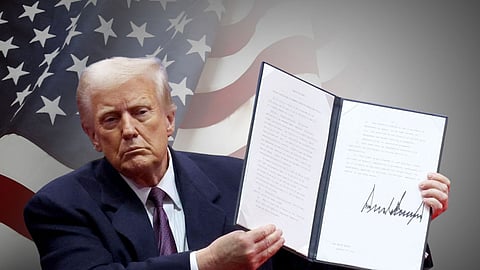
Trump’s executive order: In January 2025, President Trump signed an executive order stating that children born in the US will not automatically gain citizenship if their parents are on temporary visas or are undocumented. This policy has been in effect since February 19, 2025. This order mandates that any one parent of the child needs to be a US citizen.
Legal landscape and global perspectives on birthright tourism
The principle of birthright citizenship has been pivotal in shaping the citizenship rights of children born to non-citizens of the country. The 14th Amendment was the result of the need to clarify citizenship law for newly freed African Americans. It was made to overturn the Supreme Court’s decision in Dred Scott v. Sandford (1856), which denied citizenship to people of African descent. The 14th Amendment also established the principle that no person can be denied citizenship based on race, descent, or political background, The Supreme Court further solidified the interpretation of the 14th Amendment in United States v. Wong Kim Ark (1898) where it ruled that birthright citizenship applies universally irrespective of race or ethnicity.
Granting birthright citizenship is not a common phenomenon across the globe as many countries follow different principles. While the US follows the principle of Jus Soli (Right by Birth), many countries follow the principle of Jus Sanguinis (Right by Blood). The governments follow the principle of Jus Soli in two ways (unrestricted and restricted). Countries like Argentina, Brazil, and Pakistan are examples of unrestricted jus soli, whereas countries like Australia and Bahrain are examples of restricted jus soli. Many African, European, and Asian countries like Egypt, South Africa and India follow the jus sanguinis principle.
It is important to mention that India adhered to the principle of jus soli until 1987. The key Constituent Assembly members who opposed jus sanguinis included Dr. P.S. Deshmukh, Mr. Jawaharlal Nehru and Mr. Alladi Krishnaswami Ayyar. One of the major arguments was given by Dr. Deshmukh, who argued,
“Here we are an entire nation with a history of thousands of years and we are going to discard it, in spite of the fact that neither the Hindu nor the Sikh has any other place in the wide world to go to. by the mere fact that he is a Hindu or a Sikh, he should get Indian citizenship because it is this one circumstance that makes him disliked by others.”
However, in modern times, India has shifted to granting citizenship based on jus sanguinis.
The Citizenship (Amendment) Act, 2019, which was brought to amend the Citizenship Act, 1955, is a significant piece of legislation that brought change towards the citizenship policies in India. A key proviso inserted states, "Provided that any person belonging to Hindu, Sikh, Buddhist, Jain, Parsi or Christian community from Afghanistan, Bangladesh or Pakistan, who entered into India on or before the 31st day of December 2014 and who has been exempted by the Central Government by or under clause (c) of sub-section (2) of section 3 of the Passport (Entry into India) Act, 1920 or from the application of the provisions of the Foreigners Act, 1946 or any rule or order made thereunder, shall not be treated as illegal migrant for this Act;"
Challenges to jus soli: Birthright citizenship under scrutiny
It is often argued that the main purpose of the 14th Amendment was to reverse the judgment given in Dred Scott, in which it was held that African-Americans could not become citizens of America. It is pertinent to mention that many states and federal courts interpreted it in such a manner that it was only applicable to blacks and whites. This coerced the US Supreme Court to create uniformity, and in Wong Kim Ark, the Court held that any citizen born on US soil is an American citizen.
It is also pertinent to mention that those people who come to foreign countries to give birth to their child to gain citizenship of that country make their children eligible to gain benefits of that country. These individuals may affect healthcare systems and public infrastructure in the long term. Also, the children born through birth tourism might get enrolled in public schools, thus creating more demand for public infrastructure and resources. It is often said that countries that are not strict with their citizenship rules often face problems with their cultural and welfare schemes. In Sarbananda Sonowal v. Union of India , the Illegal Migrants (Determination by Tribunals) Act, 1983 was held unconstitutional. This ultimately led to the signing of the Assam Accord after the Assam Student Union Association protested against the lacklustre measures being taken concerning immigration. They contested that if the influx was not stopped, it would severely affect their culture as a whole. In the same case, The Supreme Court gave its stamp of approval to the Assam Accord, under which all those who had entered Assam illegally must be detected and deported from the country.
Misuse of citizenship rights
Misuse of citizenship rights through birth tourism includes exploiting the birthright citizenship for personal benefits. Critics also say that this specific practice undermines the integrity of citizenship rights. The Trump administration also highlights these issues: as per them, birth tourism can threaten national security and lead to the exploitation of natural resources of the country.
Long term implications of repealing birthright citizenship on children
Repealing birthright citizenship in the US can have a profound impact on the social, legal, economic, and overall well-being of children. One of the most immediate impacts of repealing birthright citizenship is that it will create a significant population of stateless individuals. Repealing birthright citizenship can also create a self-perpetuating class of legally disadvantaged individuals. Also, these individuals would lack access to essential services like healthcare and education.
Studies show that denying citizenship to children of undocumented parents could significantly increase the unauthorised population over time. As per a report, by 2050, the unauthorised population in the US will increase to 16 million if birthright citizenship is repealed. This would affect the future generations of the US through perpetuating cycles of poverty and marginalisation.
Repealing birthright citizenship would also complicate the administrative process as it will bring certain challenges like verifying parental status, creating of national registry, and managing complex citizenship applications,
Birth tourism and birthright citizenship are two contentious issues in the debate on global immigration policies. The 14th Amendment of the US ensured citizenship for all individuals who are born on American soil, but recent policy changes by the Trump administration have sought to restrict the rights given by the 14th Amendment. The concerns regarding birthright citizenship notwithstanding, repealing birthright citizenship is a flawed solution as this will create a situation of statelessness, increase unauthorised population and produce administrative burdens.
Moving forward, a balanced approach is the need of the hour. Governments need to strengthen visa policies to prevent misuse. They also need to ensure that children born under their jurisdiction do not face the situation of statelessness or discrimination in society. International cooperation, efficient immigration reforms, and a systematic verification system can solve these issues while upholding constitutional values. Repealing birthright citizenship is not the solution, but refining birthright citizenship with legal safeguards will be in the national interest without violating human rights.