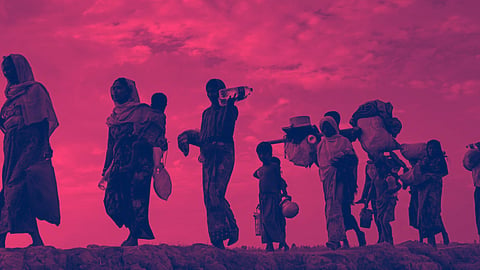

ON December 25, 2025, the Chief Minister of Delhi, Atishi Marlena, had a special message for the migrant children, particularly Rohingya children living in her state.
She wrote in Hindi on X, “On one side are the BJP [Bharatiya Janata Party] people who bring Rohingyas to Delhi by making them cross the border from Bangladesh and give them EWS [Economically Weaker Section] flats and facilities meant for Delhiites.
On the other hand, there is the Aam Aadmi Party [AAP] government of Delhi which is taking every possible step to ensure that the Rohingyas do not get the rights of Delhiites. Today, the education department of the Delhi government has passed a strict Order that no Rohingya should be given admission in the government schools of Delhi.
We will not let the rights of the people of Delhi be taken away!” (translated to English from the original Hindi post)
To understand the background of this particular message, it is important to remember that the Delhi legislative assembly elections are just around the corner. And like all elections in India, this election too, shall be contested on the foundation of hate and misinformation against the disenfranchised and poor, particularly belonging to the Muslim community.
One can barely forget the recent distasteful and inhuman advertisement by the BJP during the Jharkhand elections in which they directly attacked poor Muslim workers, especially cotton carders to represent dark animalistic living standards.
However, what particularly stood out was the vilification of poor Muslim children in the advertisement. Indeed, the Election Commission of India pulled down this advertisement and disallowed its dissemination. However, the damage done remains irreparable.
Contemporary Indian elections are using the poor and the most vulnerable people in society as fodder for their hateful political campaigns. Even children are not exempt from such cruel attacks.
Atishi’s message on X explicitly denying the basic right to education to a certain class and community of children demonstrates that viciousness that has compelled the collective Indian political conscience to stoop so low.
Yet, one must always remember that targeting children and women is a reflection of one's own cowardice and weakness. Therefore, Atishi’s message may have much for Indian society to reflect upon.
In this message by Atishi, she claims that “Rohingya children” living in Delhi shall not be entitled to education. Her quest, she states, is not to allow the rights of Delhiites to be taken away by others. She further goes on to share that the education department of her AAP government in Delhi has apparently passed strict Orders to this effect.
Throughout her message, Atishi uses the terms “Bangladeshi” and “Rohingyas” interchangeably. However, a close reading of the official state government Order shared in the post reveals something else.
While problematic and with its own legal gaps, the Order has no mention of Rohingyas. The entire post and the message, therefore, remain an exercise in creating animosity amongst communities and spreading misinformation.
Clearly, as the Delhi elections proceed closer, we brace ourselves for another continued campaign filled with hate, lies, communal slurs and, invariably, attacks on the displaced Rohingya community.
The circular in context
The circular shared by the Delhi government on December 23, 2024 states that schools must ensure strict admission procedures, verification of students’ documentation to prevent “illegal Bangladeshi” migrants’ enrolment, and implementation of greater scrutiny to detect and prevent unauthorised admission of “illegal Bangladeshi migrants” in particular.
Legally speaking, this circular is not sustainable in accordance with the Constitution of India. The AAP government in Delhi may need a reminder that the right to education as a fundamental right is not just guaranteed to all citizens of India but to every single person within the territory of India.
Therefore, even if someone is admittedly an ‘illegal migrant’ by the definitions of the Foreigners Act, 1946, as long as they are in India, they are entitled to education between the ages of 6 and 14 as a matter of right. No circular of a state government may take such a right away.
Perhaps, this is why the circular is also worded in a manner that it seems more about “verification of documents” which may include any document issued in India or abroad and the prevention of “unauthorised admission” which leaves the matter rather vague.
On the face of it, there is no updated scrutiny or instruction to explicitly deny admission to even “illegal Bangladeshi migrants”.
Therefore, in the absence of properly defined instructions and proper legal definitions, this circular is nothing more than substandard populist rhetoric to fuel the upcoming storm of misinformation and hate speech against the migrant communities living in Delhi.
Are Rohingyas Bangladeshi?
If our politicians, particularly those with a Rhodes Scholarship and erudite degrees in history from Oxford University (as Atishi has), were being honest, this particular piece would not be necessary. They can indeed provide a lesson or two on the history of migration of the Rohingya community.
The Rohingyas are a Bengali origin, primarily Muslim community, who migrated from India as workers to Myanmar during the British colonial rule.
Over the years, with the growing disturbances and changing political landscape of Myanmar, Rohingyas have gradually been denied access to any citizenship or identity documents.
They have been rendered as Stateless people, which means that they do not officially have the recognition of any country in the world as their citizens. In Myanmar, Rohingyas have been forcibly retained in the Rakhine state, which essentially serves as an open detention and labour camp for the Rohingyas.
There have been several reports of torture, including gang rapes, sodomy, and burning of villages, human beings and cattle. Between 2016 and 2017, approximately 9,000 Rohingyas were brutally killed.
Children were impaled on steel rods and thrown into fires, adults were shot, and entire villages were set ablaze by the Myanmarese military. The persecution of the Rohingya refugee community has been noted as a “textbook example of ethnic cleansing” by the United Nations Organisation in 2017.
Reports from the United Nations, various international organisations, and the media indicate that the genocide against the Rohingyas in Myanmar has escalated further since the 2021 coup d’état.
Naturally, several Rohingyas, particularly women and children, have been compelled to flee Rakhine state amidst immense threats to their lives and bodies. Many of them have been raped and impregnated on the way.
Escape from the Rakhine state is not easy either. The Burmese military guards the borders and the Naff River which connects Myanmar to Bangladesh. On the other bank of the river, the border is guarded by Bangladeshi guards.
Rohingyas either take a boat though they often swim across the river or wear a rubber tyre to prevent themselves from drowning. They are often met with indiscriminate shooting by border guards.
Those who survive are either forced back to Myanmar and tortured or are able to somehow reach the refugee camps of Bangladesh after walking several kilometres on foot. Bangladesh hosts the largest refugee camp in the world at Kutupalong in Cox’s Bazar, where many Rohingyas live.
Rohingyas and the India connection
Most Rohingya women have been trafficked at some point in their lives. Yet, most of them choose to remain silent regarding their story, particularly that of sexual violence because of the immense patriarchal arrangement of the Rohingya community at large.
These women and children reach India through trafficking with promises of better living standards, marriage and safety from their traffickers. Yet, upon reaching the country, they are faced with a stark reality of further sexual abuse, forcible nonconsensual prostitution, marriage with older men, domestic abuse and the monster of arbitrary and indefinite civil administrative detention.
Arbitrary and indefinite civil detention in Delhi
In the Northwestern suburb of New Delhi— at Shahzada Bagh— is a ‘detention centre’ where Rohingyas awaiting deportation are housed. Most of these Rohingyas hold the United Nations High Commissioner for Refugees (UNHCR) refugee card which has been granted to them after several rounds of “refugee status determination” process.
According to the Standard Operating Procedure (SoP) dated March 20, 2019 circulated by the Union home ministry, all foreigners “claiming to be refugees” must be first assessed on the basis of whichever document is available to them, whether issued in India or abroad.
Further, the SoP also defines the term “refugee” as one who has a well-founded fear of persecution on account of race, religion, sex, nationality, ethnic identity and membership of a particular social group or political opinion.
The SoP is very clear about the process that is to be followed prior to detaining a person. It involves an elaborate statement from the foreigner regarding the circumstances under which they left their country of origin and a subsequent evaluation of the general perceived conditions in the home country of the people belonging to the community of the foreigner in question.
However, as was exposed in the documents submitted by the Foreigners Regional Registration Office (FRRO) in the case of Sabera Khatoon versus FRRO and Ors, no such evaluation appears to have been conducted by the ministry before detaining Rohingyas.
In fact, only when the court demanded information regarding the evaluation was the ministry even bothered to get a “personal data form” filled up by the detained person in question, after nearly three years of her detention.
The form did not even have the utterance of the word— persecution. Similarly, quite apparently, most of these detention at Shehzada Bagh are in violation of the procedures established by law.
Rohingya detention and the tug of war between the Centre and the Delhi government
In the case of Sabera Khatoon versus FRRO and Ors, a joint inspection by the FRRO and the Delhi Urban Shelter Improvement Board (DUSIB) was ordered to be conducted in the Shehzada Bagh detention centre.
It was probably the first ray of sunlight that exposed the horribly degrading and inhuman living conditions. The report exposed that there was no facility of warm water for use even during the harsh winters of Delhi.
The report further exposed that the detainees did not have even basic access to clean pillows, mattresses and bedding inside the detention. The toilets were so unclean that they were practically unusable. Of course, the deeper rot was still yet to unfold.
The Delhi Urban Shelter Improvement Board under the Delhi government administration is supposedly in charge of maintaining the building as a shared responsibility arrangement with the FRRO, which falls under the Union home ministry.
However, in their counter affidavit before the court, they denied any responsibility towards the detention centre tooth and nail. In fact, it was only after the Delhi High Court ordered the immediate reconstruction of the dilapidated toilets in the detention centre that they reconstructed proper and usable toilets inside the detention centre.
Regarding laws that govern detention centres in India
It shall be relevant to mention herein that detention centres in India are governed by the Model Detention Manual, 2019 and also the Prison Manual, 2019.
According to this manual and the laws therein, it is mandatory that detention centres have not only hygienic conditions including basic facilities such as electricity, clean drinking water, beds, sufficient and clean toilets, communication facilities and nutritious kitchens but also necessary play areas for children, recreation facilities including television and newspapers, and open, ventilated spaces for free physical movement.
In accordance with the provisions of the Constitution and the Right to Education Act, 2009, children in detention are entitled by law to be sent to local schools and to obtain education at the same standard as that of any other child in the country.
It is also mandatory that nursing mothers, children and the sick must be given special attention and all detainees must be treated with human dignity.
These directives are also in line with the fundamental right to life and personal liberty that includes the right to human dignity health and human dignity under Article 21 of the Constitution of India and are available to every person within the territory of India including noncitizens and indeed “illegal migrants” or even the worst kind of criminal or antisocial person for that matter.
Yet, in the case of the Rohingyas in detention, the utilisation of this legislation or rights remains a cruel joke.
Shadiya Akhtar—Right to health and personal liberty
Sabera Khatoon’s sister, Shadiya Akhtar, who is in detention at the Shahzada Bagh detention centre was ordered by the High Court of Delhi to be hospitalised for a couple of days for a thorough check-up.
This is when she was diagnosed with Hepatitis C. However, it was not until an Order was passed by the court in the case that Shadiya Akhtar was given adequate medicines to treat her condition.