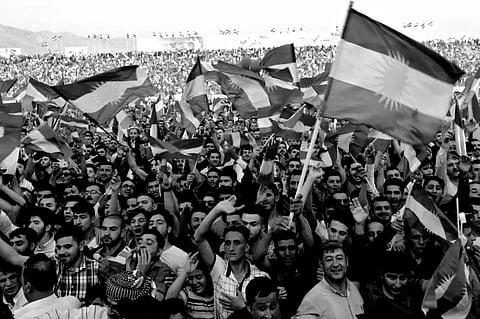

TO UNDERSTAND the human rights violations against Kurds today, it is essential to recognize that this issue originates not only in contemporary political decisions but also in nearly a century of State practices. The issues faced by the Kurdish people in Turkey are not merely a conflict of an ethnic group’s culture but represent a historical problem directly tied to the establishment of the modern Republic of Turkey and intertwine the Turkish State’s conception of identity, its interpretation of citizenship, and its vision of sovereignty.
The erasure of Kurdish identity
Following the dissolution of the Ottoman Empire, the Republic of Turkey was founded on the concept of a modern nation-State in a multilingual region inhabited by diverse ethnic groups, including the Turks, Kurds, Arabs, Laz, Circassians, Armenians, Greeks, and Syriacs. This model rested on the principle of ’one nation, one language, one identity'. The Republic’s founding ideology framed ethnic and cultural diversity not as a source of richness, but as a threat to be controlled.
Within this framework, Kurds were denied recognition as a distinct people, labelled as ‘mountain Turks’. The Kurdish language was systematically excluded from the public sphere, Kurdish identity was erased from official discourse and uprisings were suppressed through military force. The strand that runs common through these issues is a coherent administrative logic that excludes Kurds from the normal regime of citizenship and permanently situates them, using the language of law, within a framework of exceptionalism.
