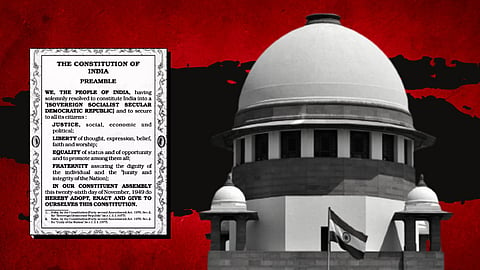

THE Constitution of India embodies a grand transformative vision. Securing social justice is, in fact, one of the prominent features of that vision. Though the word ‘socialist’ came to be inserted much later into the Preamble of the Constitution, securing social justice for all citizens was very much a part of the original constitutional scheme.
It is incontrovertible that certain principles embodied in the Indian Constitution were premised on the bedrock of socialism. Since most of the members of the Constituent Assembly had a socialist commitment, they laid emphasis on social justice.
However, since the word ‘socialist’, along with the word ‘secular’, was inserted into the Preamble of the Indian Constitution through the Constitution (forty-second amendment) Act, 1976, which was enacted during the dark days of the Emergency, some people tend to think that these words have defiled the Constitution.
It seems to make no difference to them that in the post-Emergency era, two amendments— the forty-third and the forty-fourth— were carried out to undo the damage done to the Constitution through the forty-second amendment but the words ‘socialist’ and ‘secular’ were not removed.
Later, in 1994, even the Supreme Court of India, in S.R. Bommai versus Union of India, had stated in clear terms that by inserting these two words, the forty-second amendment had only made explicit what was implicit.
Notwithstanding such a categorical assertion by a constitutional Bench of the Supreme Court, some people still seem to be unconvinced. In the recent past, a writ petition had been filed in the Supreme Court challenging the insertion of ‘socialist’ and ‘secular’ into the Preamble.
