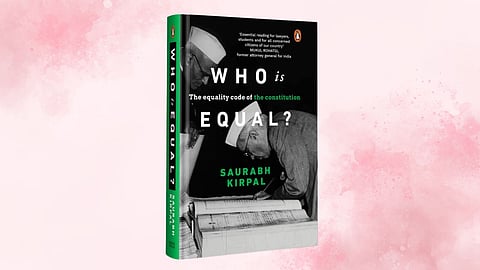

Review of Who is Equal? The Equality Code of the Constitution, Penguin Random House India, Hardbound, pgs. 273, INR 699
THERE is an African adage: ‘The child who is not embraced by the village will burn it down to feel its warmth.’
Senior advocate Saurabh Kirpal’s Who is Equal: The Equality Code of the Constitution, is an examination of the resonance of this adage within the Indian constitutional framework.
He deftly navigates the judicial interpretation of the 24-word equality provision and probes whether the clause keeps the marginalised insulated from the harshest blizzard of inequality.
In a subtle yet significant departure from the traditional male-dominated language of the law, the author consciously uses feminine pronouns, i.e., ‘she’ and ‘her’, throughout the text. The shift is welcome to make a statement on equality in a manner that challenges the pervasive gender bias and that true equality requires linguistic reforms along with legal reforms.
Kirpal opens his exploration with two fundamental questions: What is equality? Why does it matter? Addressed from a rigorous academic perspective, his work anchors readers in a commitment to the pursuit of equality. He unpacks the rule of law through layered interpretations, revealing how it operates against arbitrary actions, grounded in the reading of the equality clause and rooted in principles of natural justice offering a work that goes beyond abstract wisdom while he discusses philosophers and precedents.
