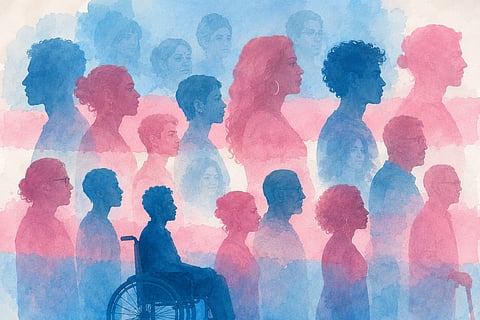
Navigating a ‘Constitutional Borderland’: How the Transgender and Disability Movements share the aspiration to move beyond a selective, imagined personhood

Trans and disability rights movements confront common challenges when it comes to the Indian state’s unequal treatment of marginalised bodies in its nationalist project, the judiciary’s liberal legalism, and the emphasis on a Swadeshi jurisprudence. Our Pride Month special explores the possibility of a solidarity of counter-politics.
Navigating a ‘Constitutional Borderland’: How the Transgender and Disability Movements share the aspiration to move beyond a selective, imagined personhood
Published on

TWO MONTHS AGO, the Transgender Persons (Protection of Rights) Amendment Act, 2026 received presidential assent, as it dismantled a decade of hard-won legal recognition for transgender persons in India. Where the Transgender Persons (Protection of Rights) Act, 2019 (‘2019 Act’) had foregrounded self-identification and embraced a broad, inclusive definition of transgender personhood, the 2026 Amendment replaced it with a closed enumerated list of State-approved identities, like kinner, hijra, aravani, and jogta, all drawn from an imagination that treats transness as either divine or ‘congenital’. Those outside this list who arrive through self-determination find themselves, in law, without existence.

To understand what the 2026 Amendment does, and what it portends, it is necessary to read it alongside another movement that has been navigating the same terrain for longer – the disability rights movement in India. At first glance, the pairing may seem unlikely. Yet, both movements inhabit what this piece calls a ‘constitutional borderland’ – a zone in which the formal grammar of rights coexists with the substantive grammar of exclusion, where the promise of equal citizenship is perpetually about to be redeemed and perpetually deferred. 

Both movements have experienced the same double bind of the ‘liberal legalism’ underlying court victories that celebrate the visible and the spectacular while leaving the margins unmoved. Its judicial framings have validated a narrow band of acceptable embodied experiences while naturalising the exclusion of the rest.

Both these movements have also navigated a complex relationship with the State. The disability movement has navigated a type of postcolonial nationalism that has sought to homogenise political bodily experience by validating only those disabled identities that are already assimilable to its ideological project (known as ‘crip nationalism’). The transgender community has had to deal with a Hindu nationalist State endorsing a selective, imagined transgender personhood, that simultaneously criminalises and excludes those transgender persons who do not fit within a fixed Brahminical imagination (we call this ‘homoelectivism’, which we explore in more detail below, borrowing from the concept of ‘homonationalism’).  At the same time, the piece argues that the invocation of ‘Swadeshi Jurisprudence’ by several judges hints at the Supreme Court’s resort to methodological nationalism. In this methodological proposition, the Supreme Court is showing an insular approach, while stigmatising learnings from foreign jurisdictions as ‘imported concepts.’ In this insular methodological approach, courts, while dealing with subaltern sexualities and subaltern embodiments, may resort to the Brahminical canon. 

Together, these frameworks reveal that what is unfolding through the 2026 Amendment is not an aberration but a coherent political project that the disability movement has been contending with, in its own register, for years. Both movements, in other words, hold lessons for each other which the piece attempts to draw out.

The language of liberal legalism

The sexual subalterns and embodied subalterns hold precarious citizenship. Interestingly, the liberal progressive narrative that promises them substantive equality within liberal legalism also coincides the rise of authoritarian power in India. India’s transgender and disability rights movement navigate within an illiberal governance style of the present day. The liberal story of progress of trans and disability rights has its own ruptures, and more importantly, enables a tendency in these movements to allow visible, politically benign actors to dominate the ‘mainstream’ of these movements, who then attempt to fit into the nationalist paradigm valorized by neo-liberal economic concerns. 

Heterogeneous, messy embodied experiences tend to make postcolonial nationalism, which foregrounds itself on hegemonic masculinities, anguished and troubled. Such monolithic nationalism attempts to control, sanitize, and homogenize these embodied experiences with the framework of ‘homonationalism’ and, in the context of disability, ‘crip-nationalism’. Both these frameworks, in essence, are attempts to explain how “post-colonial nationalism seeks to homogenize political bodily experience.”

In every sense, disabled and queer people live at the ‘constitutional borderland’ where physical existence itself is defined by precarity. Their precarity is also produced and sustained by the fact that modern charters of rights and the social contract they produce exclude subaltern lived experiences. Martha Nussbaum, in her book ‘Frontiers of Justice’ (2007), underscored three ‘unresolved problems’ of the social contract model of political and legal philosophy. One of these unresolved problems was identified by Nussbaum as the omission of people with physical and mental impairments. 

While modern charters on human rights, like the UN Charter, are often read in a hagiographic fashion in law schools, courtrooms, and even in daily civic life, the erasure within them is often overlooked in the mainstream workings. Within the workings of these Charters, heteronormativity and able-bodiedness were given the status of ‘natural order of things.’ However, neo-liberalism produced a condition of limited tolerance for and celebration of visible, spectacular marginal identities. Modern charters that stand accused of erasing marginal identities were given a liberal reading by the Indian judiciary to provide limited accommodation (often called ‘reasonable’ accommodation) to visible, politically benign, and ‘spectacular’ trans persons and persons with disabilities. 

These liberal readings can be, at best, called ‘segue’ readings of these charters to soften the inherent conservatism in them that assumed the ‘normality’ of male, heteronormative, abled-bodied experiences. Even the most conservative thesis of the social contract of Thomas Hobbes suggested that the safety of people requires that justice be equally administered to all degrees of people, including poor and obscure persons (italics are ours).  The obscurity of trans and disabled identities is maintained in order to ensure ‘normal’ status of heteronormativity and able-bodiedness. 

It does not come as a surprise that while denying queer citizens their rights in Suresh Kumar Koushal (2013) (which was subsequently overturned) and providing rights to the disabled in Vikas Kumar (2021), the Supreme Court of India used the terms ‘minuscule minority’ and ‘insular and discrete minority’ for queer and disabled, respectively. While both judgments impacted the queer and disabled communities differently, they assumed the normality of heteronormativity and able-bodiedness. 

In their book, Desire and its Discontents (2024), academics Dipika Jain and Oishik Sircar warned against such ‘common sense’ readings of queer emancipation through the judicial lens. Critical voices in the disability justice movement, also, are warning against a similar common-sense trajectory of selective inclusion of some disabled bodies through judicial decisions. For example, in Omkar Ramchandra Gond v. Union of India (2024), the Supreme Court celebrated a few disabled citizens as “some of the shining daughters and sons…in India who scaled extraordinary heights.” Not only did such an ominous framing valorize a certain kind of disabled individual – typically middle-class, caste-Hindu disabled bodies – but, by calling them ‘sons’ and ‘daughters’, also assumed the normative gender roles of the citizens based on their biological sex. 

The nation is unconsciously assumed as a heteronormative family in such judicial reasoning. Moreover, such framings do not allow dissenting disabled and queer bodies any political space. They cannot escape repression, such as in cases of G.N. Saibaba, Father Stan Swamy, or activist Hem Mishra, and even if they somehow escape direct repression, they cannot escape the violence of the law. 

The stories of G.N. Saibaba and Father Stan Swamy have a lesson for every subaltern movement of India, including the LGBTQ+ community – i.e. dissent cannot be permitted beyond the state-sanctioned, state-approved paradigm. Only a limited segment of these movements will be accommodated that seek their rights within state-approved discourse. Ratna Kapur opines that the state merely tolerates a ‘prescriptive gay’ subject. The same is true for disabled subjects as well. 

Further, the omission of the self-determination clause in the 2026 Transgender Amendment Act has an ominous similarity with the ordeal of several disabled people who are asked to get their disability certificates reverified. In the backdrop of the Puja Khedkar episode, where a former probationary IAS officer was accused of submitting fabricated disability certificates, several state governments are asking their disabled employees to appear before medical boards and get their disability and disability certificates verified to ascertain the genuineness of the disability and the certificate. 

In the age of the social model of disability, the disabled body has become a perpetual object of State doubt. This is the return of the ghost of the medical model of disability with vengeance, even as India has a law on paper that promotes the social model of disability. Making disabled bodies perpetual suspects and erasing self-determination for transgender persons shows a totalitarian tendency of the State that wants to control the bodily autonomy of its citizens. 

To understand what the 2026 Amendment does, and what it portends, it is necessary to read it alongside another movement that has been navigating the same terrain for longer – the disability rights movement in India. 

Violence through the Swadeshi Jurisprudence

In the era of ‘Swadeshi jurisprudence’, as decolonization is being misappropriated and weaponized against the several progresses made in rights discourse pertaining to queer and disabled persons, the precarity of queer and disabled lives may only increase. In April this year, the Union Minister for Social Justice and Empowerment Dr. Virendra Kumar, shared on his X handle an article by a right-wing thinker titled ‘Jaruri tha Transgender Kanoon me Badlav’ published in the Hindi daily Dainik Jagran. In that article, the author asserts that transgender activism and sexual autonomy are not merely about the rights of a particular marginalized group, but they were part of a broader ideological movement rooted in a radical Western framework. 

The Social Justice Minister’s epistemic valorization of such an article after the passage of the 2026 Amendment Act is telling. The progressive ideas of human rights are discarded by terming them as ‘radical Western constructs’. As petitions have been filed challenging the Amendment Act, posing faith in the Supreme Court and its liberal legalism, some insights can be found in the disability movements’ tryst with right-wing ideological agenda and the judicial double-speak on that. 

Divyang’ (‘one with a divine organ’) is a term to refer to disabled citizens of India, promoted by Prime Minister Narendra Modi in 2015. For long, critical disabled scholars have opposed this term, calling it ‘diabolical’ and ‘hermeneutically marginalizing’, highlighting that the term blocks disabled people from participating in meaning-making and meaning-sharing of their lived experiences.  

In M. Karpagam v. The Chief Commissioner for Persons with Disabilities (2021), where a disabled petitioner challenged the term ‘Divyangjan’ as derogatory, the Madras High Court rejected the plea, sermonizing the petitioner to stop following ‘the fad of political correctness.’ It comes as no surprise that just after the passage of the 2026 Amendment Act, the Kerala High Court reportedly observed that the “intention behind Transgender Amendment Act might be to prevent western concepts of kids identifying as cats, etc.” In passing these orders and obiter dicta, our courts are showing a profound lack of understanding of evolving human rights jurisprudence across the world, emphasising increasingly on Swadeshi jurisprudence.  

The current Chief Justice of India has already discarded the ‘Handbook on Combating Gender Stereotypes’ (2023) by calling it ‘too Harvard-oriented’. Incidentally, the ‘Handbook Concerning Persons with Disabilities’ (2024) is also being given a slow death. The Disability Handbook was a non-confrontational document that ignored problematic terms such as ‘Divyang’ (even though it listed the term ‘specially-abled’ as stereotype-perpetuating). However, even this Handbook is discarded, as, while circulating the new cause list under the current Chief Justice, the term ‘specially-abled’ resurfaced and several judicial orders are now frequently using this term, which perpetuates a stereotype of the disabled. 

Homonationalism and its limits

Another issue that has plagued the transgender and disability movements simultaneously is how, in the view of the Indian state, both marginalized groups are treated as homonationalist subjects. Homonationalism describes the process by which certain queer subjects are incorporated into the nationalist project with their legibility purchased at the price of reproducing the racial, caste, and religious hierarchies that structure the nation. 

American academic Jasbir Puar first used the term in the post-9/11 American context to describe the structural logic by which certain queer subjects’ visibility is deployed as evidence of the nation’s tolerance and civilisational superiority against the Muslim ‘Other’. Puar explained that this rights framework did not simply expand the circle of the rights-bearing subject but reconfigured whose counted as a grievable life and whose did not. She showed how the American gay soldier was accommodated into the image of civilisational superiority, while Muslim queer people were treated as the constitutive outside. 

While modern charters on human rights, like the UN Charter, are often read in a hagiographic fashion in law schools, courtrooms, and even in daily civic life, the erasure within them is often overlooked in the mainstream workings. 

It showed how homonationalism operated within queer movements, how it produced subjects who had successfully negotiated the terms of national legibility and therefore acquired a structural interest in maintaining the exclusions that make that legibility possible. But Puar was theorising a specifically American conjuncture, one in which liberal tolerance itself became a weapon of nationalist consolidation. The Hindu nationalist State has no investment in liberal tolerance. Its imagination of transness is based on civilisational ideas and religious conformity, while that of disability is based on something that is caused from birth, both, “for no fault of their own.”

Trans scholars like C. Riley Snorton and Jin Haritaworn have argued that by dissolving trans identity into affects, capacities, and intensities, we effectively discard the material vulnerability of trans bodies at precisely the moment when that vulnerability needs to be named and politicised. Trans women of colour in the US, for example, occupied a specific position in the necropolitical order that the framework was not equipped to theorise. They were not simply excluded from the homonationalist charmed circle. They were dying, and the framework had no language for that dying that did not aestheticise it.

By 2017, the mainstreaming of transgender visibility in American culture had made the homonationalist incorporation of certain trans subjects impossible to ignore. Puar argues that this visibility operated through a highly specific economy of trans authenticity that incorporated certain trans lives into the biopolitical project of the nation while abandoning others at the margin. 

Puar also described this through the concept of ‘debility’. In The Right to Maim (2017), she explains that instead of being an exceptional, dramatic condition that rights discourse can name and address, ‘debility’ is the slow, structural wearing down of bodies deemed unworthy of protection, the mundane attrition of lives rendered ungrievable through accumulated State indifference and social violence.

In the Indian context, it is debility, more than exclusion, that most precisely describes what the 2026 Transgender Amendment Act does to those it renders legally non-existent. And yet the concept of ‘debility’ may also not be sufficient to explain the Indian context because it does not account for the specific economy of authenticity through which the 2026 Amendment operates, an economy that is not liberal, as in Puar’s American context, but theological and congenital. 

The Amendment offers exactly two routes to legal existence: the divinely ordained identities inscribed in Hindu sacred texts, cosmologically assigned, ritually grounded in the Brahmanical sacral imagination and the biologically congenital intersex variations legible to medical science. What both routes share is the elimination of self-determination as a basis for legal existence. Self-determined trans persons are, in the most precise sense, legally unthinkable.

This is where the concept of homo-electivism, as one of us calls it, becomes useful.  ‘Homo-electivism’ is the selective recognition of transgender identity by the Hindu nationalist State along the axis of Brahmanical cultural legibility.

Homo-electivism operates at a categorically prior threshold – not the distribution of recognition but the legislative determination of who crosses into legal personhood at all. Unlike homonationalism, it is not a politics of visibility and incorporation. It is a politics of ontological certification where the State does not say ‘We accept you’ or ‘We tolerate you’. It says, drawing on the authority of scripture or biological science simultaneously, that ‘We decide whether you are ‘real’’. 

Within the Indian trans movement, what is operative in the present conjuncture is not merely the assimilation of queer subjects into national belonging. There is a far more targeted mechanism wherein the State, on one hand, is actively electing  particular transgender identities as authentically Indian, spiritually grounded, and therefore legally recognisable, while simultaneously relegating other identities – those that are the ‘Others’, i.e. Muslim, Dalit, syncretic, or simply self-determined – to the outer margins of legality. The 2026 Amendment is its most unambiguous legislative expression.

Similar concerns have been seen in the writings of Critical Disability Studies scholars, where it is being highlighted that ‘Divyang’ is ‘birthed within Hindutva ecosystem, absorbed into governmental modalities…is shaped and structured by the exclusion of Hindutva.’ In a way, ‘Divyang’ is a form of ‘crip-electivism’ in which certain disabled bodies are celebrated as inspirational while outlawing the unruly dissenting disabled bodies who refuse to fit into nationalist inspirational stories or who cannot fit into the crip-electivism framework due to their religion, caste or gender, as they are excluded from the hegemonic nationalist imagination. 

The current Chief Justice of India has already discarded the ‘Handbook on Combating Gender Stereotypes’ (2023) by calling it ‘too Harvard-oriented’.

The ‘real’ transness

The 2019 Act had adopted an inclusive definition of transgender personhood that foregrounded self-identification and explicitly encompassed trans men, trans women, genderqueer individuals, and persons with socio-cultural identities. The 2026 Amendment Act dismantles this architecture as it installs a closed, enumerated list of those qualified to be identified as trans. The effect is that the State can now opt and determine whose gender identity exists in law and whose does not, or who the “real trans” persons were. 

What is striking about the four retained categories – kinner, hijra, aravani and jogta – is their precise cultural provenance given that these communities were already culturally legible to the State by virtue of their ritual roles at births, weddings, and Hindu ceremonial occasions. Grace Banu, the Tamil Nadu-based trans rights and anti-caste activist, pointed out recently that this selection reflects an ideologically coherent choice: “Hijra and Kinner appear in their texts. So they get listed.” By contrast, the Thirunangai and Thirunambi of Tamil Nadu (terms that carry the honorific ‘thiru’ and represent a tradition of dignified self-naming) are absent from the Act. The Nupi Maanbi and Nupa Maanba of Manipur, and the khwaja sira of Punjab and Kashmir, rooted in syncretic Muslim traditions, are similarly erased. 

In the Indian context, Hindutva governance need not embrace queerness in the abstract. It only needs to certify the trans identities already inscribed in the Hindu sacral imagination, while marking self-determined identities as either foreign or fabricated. The result is a patronaged homo-electivism that is simultaneously anti-trans as it becomes inclusive of the ritually sanctioned and exclusionary of the politically inconvenient.

During the debates before the passage of the Amendment Act in March, the Social Justice Minister had stated that the Amendment was designed to protect “only those who face social boycott due to their biological condition,” bringing benefits exclusively to persons facing “severe social exclusion due to their biological conditions for no fault of their own or without any choice” (A flawed reasoning given that the Indian government has consistently failed to provide the benefits under the legislation, as the Supreme Court has highlighted on two occasions). 

The phrase ‘without any choice’, as used by the Social Justice Minister, encodes that legitimate transgender identity is not chosen, willed, or self-determined but ordained. The trans person who is ‘born this way’ can be pitied, celebrated and administered – like the trans persons who worked at a canteen in the ministry’s office building, or those who were invited by him with free passes to attend the Republic Day parade. In contrast, the transgender person who asserts self-determination, organises against the Bill, or speaks the language of constitutional rights is ungrateful and, by the logic of the criminalisation provisions in the 2026 Amendment Act, potentially a subject of coercion or recruitment.

The failure of the homonationalist subject

An analysis by Shreshtha Das and Aijaz Ahmad Bund in The Wire noted that Hindu savarna ‘respectable’ queers, by screaming for State power to be deployed against trans activists, assumed the position of homonationalist subjects. Homo-electivism represents the Indian State’s own version of this manoeuvre by selecting and celebrating a category of trans persons deemed appropriate and whose identity affirms rather than disrupts Brahmanical Hindu social order. 

The logic of homo-electivism does not operate only at the level of the State. It also produces, within the trans and queer movements themselves, a stratigraphy of subjects, of those who accept the terms of nationalist legibility and, in doing so, acquire a provisional, conditional visibility; and those who refuse, or whom the State refuses, and are therefore rendered legally non-existent. 

Take for instance, the case of transgender activist Laxmi Narayan Tripathi, the Acharya Mahamandaleshwar, a supreme spiritual title, of the Kinnar Akhada, and principal petitioner in the NALSA (2014) case, who was also the first transgender person to represent Asia-Pacific at the United Nations. She has navigated the fault-lines of homonationalism and electivism from within the trans community itself, in ways that are both more embedded in community life and more internally contradictory. Her founding of the Kinnar Akhada, a Hindu religious order for kinnars, in 2015 and her successful campaign to secure participation in the Shahi Snan at the Kumbh Mela in Prayagraj in 2019 was framed as a project to reclaim the lost position of kinnars in the Hindu Sanatana Dharma. The theology is rooted in ancient sacred texts that describe kinnars as demigods, and having been granted the power to bless by Lord Ram. 

Self-determined trans persons are, in the most precise sense, legally unthinkable.

The critical trans and queer movement has not been silent about the implications of this trajectory. In November 2018, a community statement was issued in response to Tripathi’s endorsement of the inauguration of a Ram temple on a historically contested site in Ayodhya, characterising her as “a dominant-caste brahmin trans woman” who had been “appealing to Hindutva ideology and justifying the existence of the caste system”. The statement identified that Tripathi’s framing “negates the politics of communal harmony that is espoused by Hijras and Kinnars, who have historically maintained a syncretic faith of belonging to both Hinduism and Islam.” 

The denouncement of this trajectory contains its own uncomfortable lesson about the structural limits of the majoritarian State’s electivism. When the 2026 Amendment was passed, Tripathi condemned it without qualification. “We believed that the government stood with kinnars, transgender persons, trans men, and non-binary people,” she said in an interview, “but today, it feels like a dagger has been driven into our chest.” She subsequently became a co-petitioner, alongside Zainab Javid Patel, in a writ petition before the Supreme Court challenging the Amendment as a violation of Articles 14, 15, 19, and 21 and the right to privacy. Tripathi found herself before the Court challenging a law passed by the political project she had, in material ways, aligned herself with. It is a lesson about the nature of homo-electivism as a mode of governance rather than a mode of recognition.

This elective fine thread of homonationalism contains a structural instability that its most visible beneficiaries could not have prevented by being more strategically careful. The State’s logic of selective recognition is not a contract. It elects identities according to its own political needs, and it revises those elections when those needs change. The demigod status of the kinnar in the Hindu sacred imagination, for instance, is an asset to the nationalist project as long as what the State requires is a spectacle of ancient transgender authenticity, a counterpoint to what the government characterised as Western self-determination discourse. When the political project shifted toward medicalisation and the administrative dismantling of NALSA’s legacy, the demigod was asked to submit to a district magistrate’s certification  under Section 6 of the 2026 Amendment Act. 

The movement’s ability to access the symbolic economy of Hindu nationalism has depended, structurally, on the ability to speak the language of Vedic scripture, Sanskrit textual authority, and sacral Hindu community membership. The khwaja sira, the Dalit trans woman, the thirunangai from a non-Brahmin community cannot access this language on the same terms. This selective recognition of identities is therefore at its foundation, a caste project wearing the costume of spiritual recognition.

“We believed that the government stood with kinnars, transgender persons, trans men, and non-binary people,” Laxmi Narayan Tripathi said in an interview, “but today, it feels like a dagger has been driven into our chest.”

The contentions around ‘constitutional morality’

The precarity of transgender legal recognition in India cannot be understood without situating it within the broader jurisprudential contest over religious freedom and constitutional morality that has occupied the Supreme Court during the Sabarimala Reference hearings.

One issue at the heart of the case has been the concept of ‘constitutional morality’, a tool of constitutional interpretation that has been extremely useful for the Supreme Court, and other higher courts, to advance queer and trans rights in India.  In Navtej Singh Johar (2018), the Supreme Court had held that “constitutional morality must outweigh the argument of public morality, even if it be the majoritarian view”. In that judgment, the Court overturned its own decision from five years before, in Suresh Kumar Koushal (2013), where it had upheld the constitutionality of a provision that criminalised gay sex, by dismissing queer people as ‘minuscule minorities’. The NALSA (2018) decision (which recognised transgender persons as a third gender) and Navtej Singh Johar had overturned this reasoning by deploying ‘constitutional morality’ as a counter-majoritarian shield where fundamental rights of minorities are not subject to the veto of the numerical majority. In NALSA, Justice A.K. Sikri had noted: 

“As we have pointed out above, our Constitution inherits liberal and substantive democracy with rule of law as an important and fundamental pillar. It has its own internal morality based on dignity and equality of all human beings. Rule of law demands protection of individual human rights. Such rights are to be guaranteed to each and every human being. These TGs, even though insignificant in numbers, are still human beings and therefore they have every right to enjoy their human rights.” 

During the Sabarimala Reference hearings, last month, the Union government searingly criticised the tool of ‘constitutional morality’, calling for it to be abandoned. Solicitor General Tushar Mehta argued that ‘morality’ as mentioned in Articles 25, 19(2), and 19(4) (as a restriction upon these fundamental rights) was always understood as public or societal morality, not as an individualised, judicially-constructed standard capable of replacing it. 

The Solicitor General argued for abandoning ‘constitutional morality’ by noting that the Navtej Singh Johar case had relied on a Harvard Law Review article by an American academic, and a US Supreme Court judgment, highlighting that foreign scholarship influencing a binding judgment of the Indian Supreme Court was a problem. In an extension of his Swadeshi jurisprudence argument, he also pressed that Navtej Singh Johar was bad law and that in Indian culture ‘sodomy’ had “always been immoral.” Interestingly, as in the context of disability rights and identity, the erosion of disability identity is also happening through reliance on Swadeshi jurisprudence.

Together, the disability and transgender movements in India navigate what this piece has called a ‘constitutional borderland’, that is, a zone in which the formal grammar of rights coexists with the substantive grammar of exclusion.

Conclusion

Together, the disability and transgender movements in India navigate what this piece has called a ‘constitutional borderland’, that is, a zone in which the formal grammar of rights coexists with the substantive grammar of exclusion. The liberal story of progress in both movements has harboured its own ruptures. It has valourised the visible, the spectacular, the politically benign, the upper-caste, and the heteronormative-in-all-but-name. The switch to Swadeshi jurisprudence – visible in the realms of both disability rights and queer rights – is its conservative completion.

While shades of ‘homonationalism’ and ‘crip-nationalism’ have been somewhat evident in how the Indian state has aimed to assimilate trans/queer and disabled bodies, respectively, into the ideological project, in both cases, a form of ‘electivism’ (what we call ‘homoelectivism’ in the trans movement’s context) is also visible. While the Kinnar Akhada continues celebrating Kumbh Melas and the Supreme Court reduces nomination fees for “specially abled” advocates, in both cases, the mechanism is of selective inclusion of the ritually or medically manageable, criminalisation of the politically insurgent, and the deployment of affective benevolence to aestheticise what is, at its core, a structure of dispossession.

The Sabarimala Reference adds a third dimension to this picture. It reveals that the assault on constitutional morality is not merely a jurisprudential position but a political project to restore societal morality as the operative constitutional standard, and thereby to insulate from scrutiny precisely those practices of exclusion, certification and naturalisation that constitute the content of Hindutva governance. The Solicitor General’s argument that ‘constitutional morality’ must yield to societal morality, and that a binding judgment of the Supreme Court was suspect because it drew on a Harvard Law Review article, is another version of what the Madras High Court told the petitioner in M. Karpagam: that objecting to ‘Divyangjan’ was “the fad of political correctness.” Both arguments use Swadeshi jurisprudence to name the counter-majoritarian impulse as foreign contamination, and in doing so, rehabilitate the logic that the rights of the “minuscule minority” bend to societal consensus that NALSA and Navtej Singh Johar had displaced.

What both movements urgently require, and what their convergence might produce, is a counter-politics that refuses the terms of managed belonging. While the trans movement refuses the State’s authority to narrate the lives of those it has consistently failed to protect, the disability rights activists demand that ‘Divyang’ be retired. It is a rejection of the hermeneutic violence by which the state imposes meaning on bodies it does not inhabit and in both cases, the demand is for the right to self-determination, to be recognised in a manner that conforms with one’s self-perceived identity, lived experience and rejects what falls in line with the State’s convenience.

The constitutional borderland in which disabled and transgender persons live is the product of an active and ongoing legal-political project. To inhabit the borderland is to be inside the Constitution’s most precarious seam, where the promise of equal citizenship is always about to be redeemed and always already deferred. The task for both movements and for the scholars, advocates, and activists who work alongside them is not to seek admission to the national family on the family’s terms, but to demand the rewriting of the terms themselves.

Note: The authors express their gratitude to VQueeram for their valuable inputs regarding earlier drafts of this piece.

The Leaflet
theleaflet.in