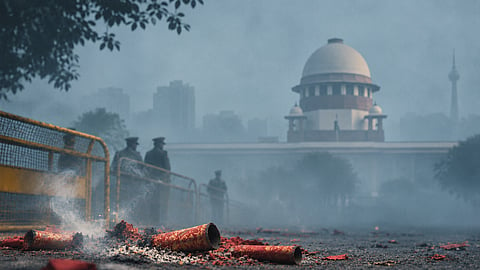

Delhi’s air is at its worst around Diwali, and this year was no different. On November 9, the day after the festival, the city’s AQI stood at 368, with 15 monitoring stations in the “severe” zone. Crackers had been burst well past the 10 pm deadline the Supreme Court had set. Even before Diwali, Rohini had touched 484. And within a day of allowing certified green crackers for two days, the Court was already expressing concern over reports that every kind of cracker was on sale openly.
None of this should surprise anyone who follows these orders. Each year the Court finds that its earlier order was not enforced, and each year it responds by loosening the order. I want to set that out in some detail, because it tells us whether the Court checks the executive or only supervises it.
The Court has never lacked in flagging the principles. In Subhash Kumar v. State of Bihar (1991), it held that the right to life under Article 21 includes pollution-free water and air. Vellore Citizens’ Welfare Forum (1996) added the precautionary principle: prevent harm before it happens, and make the developer show that the activity is safe. In November 2024, the Court repeated that the right to live in a pollution-free atmosphere is fundamental, and its 2026 Diwali order says the same.
The firecracker litigation began in 2015 as Arjun Gopal v. Union of India. After Diwali in 2016, PM2.5 levels were about 29 times the WHO standard, and Delhi’s AQI crossed 700, as the Court later recorded. On November 11, 2016, it suspended all firecracker licences in the NCR, but left bursting itself alone because that would be hard to monitor. From the start, the Court was drafting around what the authorities could manage.
In 2017, the licences were returned in September and suspended again in October, with Justice Sikri remarking that it was “not a cracker-free Diwali”. In October 2018, the Court allowed green crackers for two hours, from 8 to 10 pm, with the police to enforce its order. On Diwali night, AQI reached 642, and Delhi Police registered 579 cases. In October 2021, the Court made senior officials and police personally liable if banned crackers were found in their area. The morning after Diwali that year, AQI was 454; in 2023 it was 438.
In November 2024, the Court told the Delhi Police that its enforcement was an “eyewash”. The Delhi government’s position was that the ban was to be enforced by the police. A full ban followed in December 2024, and in April 2025 the Court refused to relax it. Six months later, on October 15, 2025, it relaxed it anyway, as a trial. The morning after Diwali that year, AQI was 350.
The October 2025 order concedes much of the argument. The Court said the ban had not really stopped the bursting, that conventional crackers were being smuggled in, and that QR codes meant to identify green crackers were being sold to unregistered manufacturers. It recorded being told that Delhi’s AQI in 2018 and in 2024, the year of the ban, was not much different. It recorded that the Delhi government and the Centre both wanted the ban relaxed. The Court said commercial interests and the festive spirit “should take a back seat” when health is at stake.
Paragraph 17 of the order shows this most clearly. The Solicitor General, putting forward the case of the Union and the Delhi government, made a fervent plea to the child in all of us to lift the ban. The bench said it would “desist and suppress any such instinct”. A few paragraphs later, it called the amicus curiae a lone voice whose concerns were of utmost significance, and then allowed the sale of green crackers from October 18 to 20 as a test case. The plea to the child in us was turned down in one paragraph and, in substance, accepted soon after. The governments that were meant to enforce the ban asked for it to be eased, and the Court agreed.
The 2026 order goes further. The Court found that the measures had failed mainly due to poor implementation, and that the States had not complied with its October 15, 2025 directions, which had requested to monitor air quality and submit the reports. It also found that the full ban was helping illegal sales. So it moved to regulating green crackers, with QR codes, sealed boxes, designated sale points and security deposits from traders.
This is where I part ways with the Court’s reasoning. A ban that is not enforced testifies to the failure of the executive. The Court’s answer has been to relax the ban, as the executive had asked for it. The 2025 relaxation was called a test case and was to be reviewed after three weeks. The States did not comply, the Court noticed, and the same experiment has been repeated this year. I could not find any public account of what the first test showed.
The Court also keeps promising consequences. In 2021, it threatened personal liability for officials. This year it threatened contempt if compliance affidavits are not filed by December 14, with a hearing scheduled for December 16. The reports I came across do not mention any officer actually facing either. And the Court itself observed that bursting crackers would certainly cause pollution. Green crackers cut particulate emissions by 30% to 80%, depending on the formulation, according to NEERI as recorded in the Court’s order. That is less pollution, not none, and Delhi’s winter air has little room for even a reduced dose.
The same habit shows up elsewhere. In the Aravalli case, the Court accepted a 100-metre definition recommended by a government committee, despite its own amicus’s warning. It stayed the order only after public protest. In March 2026, it declined to stop the BMC from removing over 45,000 mangroves, and asked for annual reports on restoration. A report is a promise to inspect later, while a mangrove is gone the day it is cut. The Andhra Pradesh High Court, hearing a challenge to the Google-Adani data centre in Visakhapatnam, let work continue at the developer’s own risk. That case is still pending, so it is too early to say what has failed. But the trees being cut at the site will not come back if the petitioners win.
The judges know that a total ban can be impossible to enforce. It would only encourage black market to sell crackers illegally. The court is quite aware about it. Regulated sales with QR codes gives the police something concrete to check. Firecrackers are also only one source of Delhi’s winter pollution, alongside stubble burning, vehicle emissions and dust.
The Court has summoned the Delhi Police, stayed its own Aravalli order, and previously refused relaxations. And it has no police force of its own to enforce its order.
But that last point cuts both ways too. If the Court cannot enforce its orders, it should be careful about issuing orders that depend entirely on the executive for its implementation. And if it keeps issuing them, it should explain why such orders could not be implemented.
Name the officers responsible for implementing the order. Test compliance reports against independent data before easing anything. Do not relax a ban in the same year the Court found it was not enforced. Article 21 mandates that the right to life means a right to breathe clean air. The Court itself has expanded the scope of right to life in such broad terms and it cannot helplessly watch its own order getting violated with impunity.
