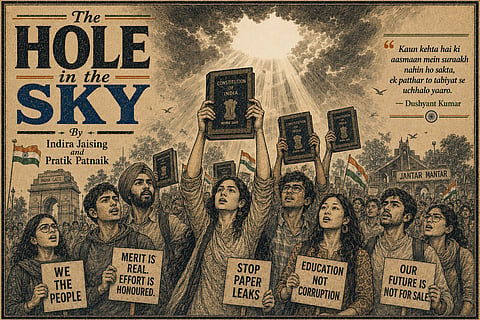
The Hole in the Sky

The education minister’s resignation happened because the young believed there is no wrong season for justice, no convenient hour at which a wrong at last becomes worth calling out.
The Hole in the Sky
Generative AI
Published on

kaise ākāsh meñ sūrāḳh nahīñ ho saktā, ek patthar to tabī.at se uchhālo yaaro

– Dushyant Kumar

THEY LIFTED A BOOK and made a hole in the sky.

Remember the young woman in Mumbai who stood with her arms flung wide and brought a police van to a halt? Remember the young woman at Jantar Mantar, thin from many days without food, lifting the Constitution of India above her head, not in anger, but in the way one lifts a lamp. 

For weeks they had been told to lower it, to fold it away, to go home and wait for a season that never comes, to wait for the law to take its own course. And then, on an ordinary afternoon, the minister resigned, and the book did not come down. It rose higher.

We should say the word plainly, because our generation has grown shy of it. This was a victory. Not a compromise, not a managed retreat, not a face saved. A wrong was named, and a power that had refused to answer, answered. The young did that, with empty hands, after a leaked question paper had made two million of them sit their examination a second time, and had cost some of them, in the despair that came after, their lives.

To those older than Gen Z, who call this a half-baked revolution, we say: you and I made none. Our ancestors did, and we let the gains of their inheritance slip through our fingers. And to those who look at these young people and murmur that they did not go far enough, we say only this: ‘Neither did we’. The distance between today and tomorrow is not measured by the clock. It is measured in a leap of faith, taken without a rope, and the courage to act inside it before the fear catches up. History is made by bodies, not by opinions alone. By the bodies that stood before the batons and did not run. By the bodies that stayed awake on the street through the cold and the rains. By the bodies that went without food so that a country might be made to feel ashamed. 

What was stolen was never a mere scheme, or a form. It was our dignity, our self-respect, the faith of the young that merit is real and effort is honoured. Our losses were real, the citizenship of many thrown into doubt, livelihoods taken, and the young built on those losses and turned them into gains, the way they turned humiliation into the power of their own voices. But let no one mistake whose victory this is. It was the students, not us.

To those older than Gen Z, who call this a half-baked revolution, we say: you and I made none.

And they did not arrive here alone. We stand on the shoulders of giants, and we should say their names. Remember the thin man who walked to the sea for a fistful of salt and left an empire holding the whole statute book by morning and rather less of its legitimacy by night. Remember the students who emptied their classrooms in the seventies and shook a government that believed itself permanent. Remember the young who filled India Gate one December night in 2012, holding candles for a woman they had never met, and would not go home until the law itself had been rewritten. In every decade, in every square, they were told the same thing: ‘The hour is wrong, the method is wrong, go home and wait’. Their fight was our fight, their unfinished future now ours. That is the thread that binds us, and beside it, little else matters.

A generation the country had written off as indifferent had been listening all along. It is we who were not listening.

At the March on Washington, Dr King’s prepared speech was going flat until Mahalia Jackson called out from behind him, “Tell them about your dream, Martin”, and he set the pages aside. These moments never come from the careful, only from the voice that refuses the cautious version. Betrayed, this generation could have reached for the gun. They kept the candle instead and routed the rage they had been taught to admire through the Constitution rather than the trigger. Which is why one couplet of Dushyant Kumar’s has stayed in our heads for days:

Kaun kehta hai ki aasmaan mein suraakh ho nahi sakta, Ek patthar to tabiyat se uchhaalo yaaro. Who says a hole cannot be made in the sky. Throw a stone, with all earnestness, my friends.

The victory was not abstract, and it was not free. A mother came on the first day with a steel tiffin and never left, feeding other people’s children as her own. Remember the Mothers of the disappeared in Argentina, who circled the square for their vanished children until a nation could no longer look away? Others came holding a photograph and a grief no resignation can lift. Strangers fed the protesters; students slept on stone and passed the Constitution hand to hand through the hours, keeping it warm as though it were alive. And then, on the twentieth of July, on the road to their own Parliament with the Constitution in their hands to the very building where it should reside, the state gave its answer. It sealed the metro stations so they could not gather. It cut the internet around the seat of our democracy, as though the Republic were ashamed to be seen. It brought its lathis down on the heads of unarmed young people, fired tear gas into their bodies, sent men in plain clothes with no name on their chests into the crowd, and dragged the fasting from the ground and the detained into buses. The country watched all of it.

These young people came out for a stranger they will never meet, a boy or girl not yet born who will one day sit an examination. They came out so that it would stop with them, so that no other student needed to run into a barrage of sticks to beg for an honest morning.

And now the harder truth, because to celebrate honestly is to refuse to be satisfied. History does not, in the end, remember the march. It remembers the law the march made. Washington in 1963 is remembered not for the dream alone, but because the dream manifested into the Civil Rights Act. And we have our own proof, at home. The grief and fury after December 2012 became the criminal law that followed it. A year of farmers at the gates of Delhi became the repeal of the very laws they had come to oppose. And our country still awaits its own Civil Rights Act, an equality and anti-discrimination law, to give life and blood to the guarantee the Constitution already makes.

Our country still awaits its own Civil Rights Act, an equality and anti-discrimination law, to give life and blood to the guarantee the Constitution already makes.

So, we name the unfinished work, three debts, and we name them plainly.

The first is the examination. A leak of that scale is not a misfortune, it is a system, and the Agency that presides over the futures of millions cannot be permitted to treat their trust as a clerical matter. The integrity of an examination must be made a duty enforceable in law, with a reckoning, real and named, for the two million sent back to their desks and the families whose children did not live to return to theirs.

The second is the police. What was done on July 20 was not the maintenance of order, it was its opposite. A baton brought down on the skull of an unarmed student is not a regulatory act. It is a blow to the seat of thought, of speech, of sight and movement, a gateway to disability or to death. A tear gas shell fired into a body is not crowd control. A man in plain clothes with no name plate is not an officer of the law but its counterfeit. 

And still the state has not produced the standard operating procedure the courts have been asking to see, again and again, since 2018, and we are entitled to ask why the courts themselves have taken a vow of silence, a maun vrat, or could not find the time to watch the videos. There is no procedure. There is only discretion, and discretion that is unpublished and unaccountable is merely power choosing whom to spare and whom to put behind bars. Every officer who raised a hand that day must be named; the one who cannot be named is a confession wearing a helmet.

The third debt is the nearest to us, and the hardest, because it is ours. We wear the black and white. We are officers of the very courts we must now indict. It does no good to demand accountability of a minister while we grant ourselves the silence. When the vindication of a right must wait so long that the protest is over before the hearing has begun, justice has not been done, it has merely been outlasted. A court with time for everything except the citizen at the barricade has forgotten what it is for. Judges are the servants of justice, not its masters. Deliver, or make way. We have seen the cost of forgetting. The images of the students of Jamia, running into their own library and folding themselves under the tables as the police came through, still haunt us. Years have passed. The law is still taking its own course, not one officer has been held to account, and the case sits in the Courts to this day.

And here we must say a word about ourselves, all of us who love these institutions and mistake that love for loyalty. An institution is not a building, and it is not a robe. It is a promise, held in trust, and we are its trustees, never its owners. To guard a thing is not to shield it from criticism. It is to hold it to the very standard that made it worth guarding. The lawyer who will not question the court, the citizen who will not question the state, the elder who counsels only patience, are not the keepers of our institutions. They are the reason the young had to bypass those institutions and take to the streets. Guardianship is vigilance, not obedience.

There is a marching song this generation grew up on, from Lakshya, its drums rising slowly, one shoulder finding another until a whole line moves as a single body. That is what we heard at Jantar Mantar, beneath the chanting, a rhythm older than any of us, the sound a people make when they stop asking permission to hope. It begins so softly you could miss it, and it ends by scattering the dark clouds of fear that hang over us. The sky has a hole in it now, the light is pouring through, and every person who stood in that square made it. But a hole in the sky does not stay open on its own. It closes, quietly, if no one keeps their eyes upon it. You hold it open by turning a resignation into a statute, and a season of courage into a permanent expectation that power will answer when the people ask.

For the debt is never fully paid, and the young know it. Faiz gave them their anthem, and it asks for everything:

Dr King wrote from a jail cell that the time is always ripe to do right, and the young believed it when almost no one older than them still did.

Hum mehnatkash is duniya se jab apna hissa maangenge, ek baagh nahi, ek khet nahi, hum saari duniya maangenge. When we who labour come to claim our share of this world, we will ask not for a garden, not for a field, but for the whole of it.

Dr King wrote from a jail cell that the time is always ripe to do right, and the young believed it when almost no one older than them still did. They believed there is no wrong season for justice, no convenient hour at which a wrong at last becomes worth calling out.

They opened the sky and asked for nothing back. Somewhere a child not yet born will walk into an examination hall on an honest morning, under a sky these young people tore open years before and will never know whose rain it was that fell so that the room could stand dry.

They stood in the storm so that the ones who come after need only come in from the rain.

The Leaflet
theleaflet.in