
THE EXCLUSION OF WOMEN [from Sabarimala] was first litigated in the Kerala High Court in 1991, through a PIL filed by a man complaining about young women making the trek up the hill and offering prayers at the shrine. In S. Mahendran v. The Secretary, Travancore Devaswom Board, the Kerala High Court held that excluding women was constitutionally protected as it was a long-standing custom. In fact, before this ruling, the restriction applied only during specific festive seasons, while on regular days, women of all ages were permitted to visit the temple. The High Court decided that it should apply throughout the year, and felt that there was ‘no reason why women should be permitted’.
This line of inquiry was flawed from the outset. The correct question is not whether permitting women is necessary or justified but whether excluding them is. It is the deviance from constitutional norms that has to be justified and not the adherence to them.
In order to evade constitutional scrutiny, the court has to first accept that the exclusion is not what it seems, which is patent gender discrimination and menstrual taboo, and that it is, in fact, a ‘nuanced’ religious requirement of the specific deity. One argument in this vein is that the restriction is not on women but on menstruation and, therefore, it is not based on gender. It doesn’t take any legal training to see this claim for what it is. Given that it is only women who menstruate, gender discrimination is not an unfortunate side effect here; it is the whole project. This is a childish and superficial level of reasoning that has no place in serious legal and judicial discourse.
The fact that there are restrictions on men too, in the form of the vratham, is also of no assistance, because in the case of men, the classification is based on choice, whereas for women, it is based on natural biological functions which are specific to their gender. Additionally, no verification is done for men to test whether or not they have observed the prescribed celibacy and austerity; they are simply taken at their word. In the case of women, the risk of menstruation is evidently so unthinkable that a blanket ban on all women between the ages of ten and fifty is preferred.
It is also pointed out that many female devotees embrace the prohibition and are happy to wait till they have aged out of it. This is no justification. Those who do not wish to visit the temple need not, but their choice cannot be used to deny the choice of others. Even if it is only a small minority of women who would undertake the pilgrimage, they have a right to do so. The logic of a minuscule minority being undeserving of constitutional protection has been comprehensively and rightfully demolished by the court in Puttaswamy.
The restriction then, clearly discriminates against women as a class of people, meeting the first requirement for an Article 14 violation. The next question is whether the carving out of this class is arbitrary. The restriction is not based on the actual fact of ongoing menstruation but on average menstruating age. It is a fact that there are girls who menstruate before the age of ten, just as there are women who menstruate after the age of fifty. Equally, there are women within that age bracket who have not started menstruation, who have ceased to menstruate, or who do not menstruate owing to medical conditions, pregnancy or lactation. The rule is framed in this way because it is not legally possible to verify whether or not a woman is menstruating. But a blanket ban is an obviously discriminatory and unconstitutional response.
The next question is whether the exclusion is a necessary means to achieve a legitimate objective. It has been presented as necessary because of the celibate nature of the deity and the belief that visitors must also exhibit the same degree of celibacy for which the forty-one days of austerity and abstinence are prescribed. Assuming that protecting the celibacy of the deity (and the devotees) is a lawful object, what is the connection between celibacy and menstruation?
The vow of celibacy is taken as a way of disciplining one’s mind and instincts and cultivating self-control and responsibility. The idea that the mere presence of a woman will cause a man to deviate from this path is in keeping with classic misogynistic tropes of the evil seductress against whom men are helpless. It is also in keeping with the Taliban-esque requirement of full coverage for women, so fragile is a man’s ability to control himself. This kind of thinking is what drives rape culture, where a woman is blamed for provoking men, and men are never held accountable for their own actions. In the context of the temple, it also implies that men are a preferred class of devotees and their comfort and convenience are more important than women’s rights. After all, those who are not in full control of their senses have clearly not achieved the level of discipline the temple requires and should logically refrain from the pilgrimage. Keeping men shielded from women is no indication of their conviction or ability to resist temptation.
There is then no part of the argument in favour of the restriction that meets constitutional standards. It discriminates against women as a class of people, the classification is arbitrary and irrational and it does not meet the stated objective of protecting celibacy, as there is no connection between celibacy and menstruation, except for one that is patently unlawful, which is that women are responsible for how men behave. Having addressed the equality arguments and the ostensible goal which is not served by the ban, let us now turn to the real reason behind it. If it is against all women, and it cannot logically or legally be because of celibacy, then what is the reason?
Menstrual taboos and notions of purity and pollution may not be openly stated in a court of law today, but they become evident when it is argued that part of the pre-visit penance is refraining from any contact with women, even one’s mother or sister, or that women cannot observe the vratham because they are unable to maintain ritual purity for all of those days, or that their touching the feet of the idol would desecrate him. Whether or not the constitutional bar on untouchability under Article 17 originally envisaged menstruation (and we will soon see that there is every reason to believe it did), there is no reason it cannot be interpreted in that way today. If untouchability is about stigmatizing a group of people, deeming them unclean and impure by virtue of a group into which they were born, then there is no basis to limit that to caste and exclude menstrual taboos from its purview...
The untouchability argument was a critical piece of the legal matrix because the constitutional bar on untouchability under Article 17 is absolute. It is not subject to any exception, nor does it apply to state actors alone. A finding of untouchability would automatically render the practice invalid. That is why its application had been vigorously opposed by the TDB and other respondents on the basis that Article 17 pertained to caste and not gender. The discussion on this aspect among the framers in the Constituent Assembly debates, which finds mention in Justice Chandrachud’s opinion, is illuminating.
Article 17 is simply worded. It says, ‘“Untouchability” is abolished and its practice in any form is forbidden. The enforcement of any disability arising out of “Untouchability” shall be an offence punishable in accordance with law.’ In the course of its drafting, various suggestions had been made to define ‘untouchability’ or to specify its application to caste discrimination, which were not accepted. One of the members, Prof. K.T. Shah, even pointed to the untouchability experienced by women during menstruation as an example of how the law could be ‘misused’ if it was not given a narrow definition. Not only was this suggestion rejected, it also shows that the framers of the Constitution were acutely aware of the exclusion of women during menstruation, and they were aware that it could be viewed as a form of untouchability under Article 17. And yet they made a deliberate choice not to give the term untouchability a specific meaning, leaving space for it to be read expansively.
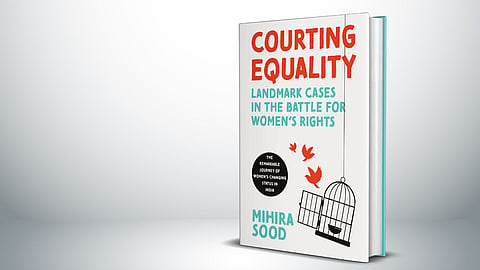
Courting Equality: Landmark Cases in the Battle for Women’s Rights by Mihira Sood is published by Juggernaut.
