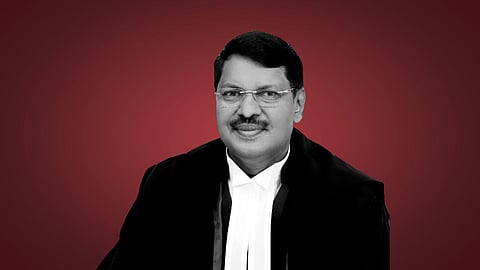
Justice Gavai’s ‘Parasites’ remark betrays the Constitution’s welfare ethos

Two months ago, the Supreme Court, itself, dismissed a series of petitions challenging the insertion of ‘socialist’ and ‘secular’ into the Constitution, ruling that the document envisaged a “welfare State" committed "to ensuring equality of opportunity." In a country where inequality has reached unprecedented levels of misery, Justice B.R. Gavai’s oral remarks seriously undermine the Constitution’s promise to the masses.
Justice Gavai’s ‘Parasites’ remark betrays the Constitution’s welfare ethos
Published on

ON February 12, 2025, while hearing civil writ petitions concerning the implementation of the Scheme of Shelter for Urban Homeless, Justice B.R. Gavai, the second senior-most judge of the Supreme Court, described homeless people as “parasites” because they were getting, among others, food grains and other benefits free of cost. 

Justice Gavai, who is set to take up the mantle of the Chief Justice of India, on May 14, 2025 asked from the bench, “Sorry to say, but by not making these people part of mainstream society, are we not creating a class of parasites?”  

He went on to assert,

“Because of freebies when elections are declared, people are not willing to work…they are getting free rations without doing any work! Would it not be better to make them part of mainstream society so that they can contribute to the nation?”

These remarks symbolised a definitive disconnect between how judges in higher courts perceive the nation’s pressing concerns, and the complex ground realities that inform everyday life in the republic. But beyond this, it also represents a certain alienation from the Constitution’s binding promises.  

These remarks symbolised a definitive disconnect between how judges in higher courts perceive the nation’s pressing concerns, and the complex ground realities that inform everyday life in the republic.

Justice Gavai’s remarks contradicted the Constitution’s socialist spirit 

Only two months ago, on November 25, 2024, as our Constitution completed 75 years, a Division Bench of Chief Justice Sanjiv Khanna and Justice P.V. Sanjay Kumar dismissed a batch of petitions challenging the inclusion of the words “socialist” and “secular” in the Preamble to the Constitution. The words had been inserted through the 42nd Constitutional Amendment in 1976 by Prime Minister Indira Gandhi's  government, shortly following the invocation of the Emergency. Chief Justice Khanna and Justice Kumar explained that ‘secularism’, as it existed in the Constitution, referred to the State’s perceived neutrality towards religion, and noted that the word ‘socialist’ in the Preamble signified  a welfare state which was not, in any way, conflicted with the growth of the private sector. Chief Justice Khanna noted, “In our context, socialism primarily means a welfare state…the State is a welfare state and must stand for the welfare of the people and shall provide equality of opportunities."

Justice Gavai’s ‘Parasites’ remark betrays the Constitution’s welfare ethos
This Constitution Day, a secular, socialist gift from the Supreme Court of India

If socialism indeed amounts to equal distribution of resources and equality of opportunity,  the provision of free grains or similar essential commodities or benefits to the public, be they in terms of cash or kind, can hardly be considered to be in negation of the socialist ideals protected through the Preamble. 

American historian Granville Austin, after a deep journalistic and academic study of India’s constitutional history, has suggested that the Constitution is “first and foremost a social document.” He went on to assert, “The majority of India’s constitutional provisions are either directly arrived at furthering the aim of social revolution or attempt to foster this revolution by establishing conditions necessary for its achievement.” Austin explains, in so many words, that the contents of the Constitution are meant to perpetuate the core values of socialism. 

Every member serving the esteemed Indian judiciary should be guided by the Constitution’s letter and spirit while adjudicating cases, pronouncing judgements or supplying oral remarks. By saying that the State, by providing free rations and other social and economic entitlements, has rendered a class of citizenry lazy, Justice Gavai has, unfortunately, not only made a denunciatory moral judgement on the poor and the deprived populations of the country, but may have directly contradicted the socialist tenets inherent to our constitutional framework.

Every member serving the esteemed Indian judiciary should be guided by the Constitution’s letter and spirit while adjudicating cases, pronouncing judgements or supplying oral remarks.

A barrage of criticism 

Expectedly,  hundreds of  citizens, activists, and grounded organisations working on the rights of socially and economically deprived individuals, and bridging the gap in access to the government’s welfare measures have criticized Justice Gavai’s oral remarks. On February 15, 2025, over three hundred concerned citizens wrote that the statement was “symptomatic of the callousness and insensitivity that is often a mark of the powerful and the privileged.” Earlier today, 71 retired civil servants and diplomats  have also issued an open letter to Justice Gavai emphasising that “homeless people do not choose the streets of their own volition.” They highlighted, in fact, that homelessness was a symptom of the State’s failure to effectively uphold its obligation.

Justice Gavai’s ‘Parasites’ remark betrays the Constitution’s welfare ethos
SC order to evict illegal houses will render over a lakh homeless in Haryana

Recalling criticisms against ‘food stamps’ in the U.S.

In the 1960s, under President Lyndon Johnson, the United States government introduced ‘food stamps’ which enabled access to food and basic nutrition for millions of impoverished Americans. At that time, various elite commentaries bemoaned the welfare measure as enabling a “lazy” workforce that would ultimately result in a shortage of labour supply across the country.  Several studies that followed, dismantled the premise of such erroneous arguments on the impact of welfare measures such as ‘food stamps’ on the economy. In 2015, the Supplemental Nutrition Assistance Program, which issued the ‘food stamps’ published a research which stated that the monthly benefits through the stamps effectively reduced hunger, lifted people out of poverty and improved the lifetime health of the beneficiary’s children. This study was later relied on by the White House Council of Economic Advisors to bolster the program.

In discussions surrounding the Indian economy’s state of crisis in the last eleven years, worsening unemployment in the country, and widening inequality (to the point that it is reportedly worse than it was under the colonial regime in the 1920s), we need to lay greater emphasis on the systematic dilution of welfare initiatives in the country. As we do, we must recall and rely upon the vast collection of research substantiating the affirmative consequences of welfare initiatives such as food stamps upon the economy and human development. 

Homelessness is a symptom of the State’s failure to effectively uphold its obligation.

Being antipathetic to India’s spurging inequality  

In March 2024, scholars Nitin Kumar Bharti, Lucas Chancel, Thomas Piketty, and Anmol Somanch authored a report titled ‘Income and Wealth Inequality in India 1922-2023: The Rise of Billionaire Raj’, which revealed massive levels of income and wealth inequalities among Indians. As of 2023, the super-rich of India, who constitute the top 1 percent demographically, held 22.6 percent of total income of the country, and sat on 40.1 percent of the net wealth.

Justice Gavai’s ‘Parasites’ remark betrays the Constitution’s welfare ethos
Widening of inequality is a natural consequence of capitalist planning

Seven decades after independence, ‘billionaire Raj’ in India is evident. Under Prime Minister Narendra Modi’s regime, the skewed distribution of income and wealth has accentuated, fostering unforeseen levels of inequality.  Those who have accumulated wealth and resources disproportionately under the regime have found themselves in positions to influence politics, economy, and media narratives that preserve their dominance.  The flip side of such hegemonic dominance is a conscious disengagement with the everyday oppression and scarcity that define life in the country. It is much simpler to be antipathetic to these concerns. Judges in India’s higher courts may have also imbibed these antipathies. 

Gandhi on livelihood

As we talk of the ‘billionaire Raj’ in India, it would be  quite instructive to recall Mahatma Gandhi. Over a 109 years ago Gandhi foresaw the tribulations India would confront the day an extremely privileged minority of individuals exercised hegemony over the nation’s polity.   

On December 22, 1917, while addressing the Muir College Economic Society in  Allahabad, Gandhi noted “Indeed, the test of orderliness in a country is not the number of millionaires it owns, but the absence of starvation among its masses.” He further asserted that “the securing of one’s livelihood should be and is found to be the easiest thing in the world.”

Those who have accumulated wealth and resources disproportionately under the regime have found themselves in positions to influence politics, economy, and media narratives that preserve their dominance.  

It is indeed a challenge to positively assert that in India today, the “securing of one’s livelihood” - or empowering the impoverished masses of the country - is a task that could be easily achieved by the Indian government. The challenge particularly exists because of the gross state of inequality. In such a grave crisis, is there any value in criticising the distribution of free grains and some social and economic benefits to the deprived sections of society? 

Gandhi at the time of India’s independence had said in a prayer meeting that democracy meant the welfare of people. The so-called “freebies” are a very small proportion of the welfare benefits India’s masses are constitutionally entitled to. At least, an esteemed and respected judge of the nation’s highest constitutional court should not grudge that.  

Loading content, please wait...

Related Stories

No stories found.
The Leaflet
theleaflet.in