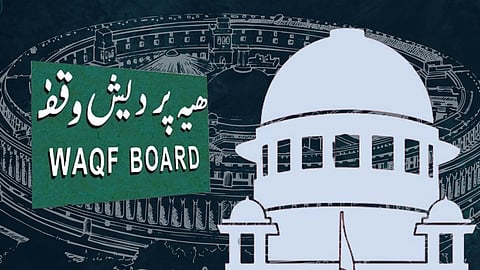

ON MAY 22, THE SUPREME COURT RESERVED ITS INTERIM ORDER in Re: Waqf (Amendment) Act, 2025. The bench comprising Chief Justice of India B.R. Gavai and Justice Augustine G. Masih heard the batch of petitions for three days, starting May 20.
The scope of the hearings was limited to whether an interim relief, such as a stay on specific provisions of the Act, was warranted.
What did petitioners argue?
Senior Advocate Kapil Sibal, along with Senior Advocates A.M. Singhvi, Rajeev Dhavan, Huzefa Ahmadi and others, led the petitioners challenging the validity of the Act. They opposed the Union’s attempt to limit hearings to three issues (denotification, waqf-by-user, and board composition), insisting that the Act’s broader constitutional implications required a comprehensive review.
The petitioners contended that certain provisions of the Act are vague, arbitrary, intrusive, and unconstitutional, and that the law facilitates executive overreach to undermine the religious rights of the Muslim community and encroach upon the property rights of people wanting to create a waqf.
They argued that activating the Act’s provisions would cause irreparable harm by altering waqf property status and management, potentially leading to loss of religious and cultural heritage.
Sibal described the Act as a “creeping acquisition” of waqf properties by the Union, undermining Muslim religious autonomy. He argued that waqf properties, as endowments to Allah, are inalienable under Islamic law, and the Act, despite being framed as a measure to protect waqf properties, is designed to “capture” them through a non-judicial, executive process which bypasses judicial oversight, allowing the government to control waqf properties arbitrarily.
Tracing the legislative history of waqf laws, Sibal argued that the 2025 Act marks a “complete departure” from established principles of waqf by user and dedication. He noted that prior laws, including the 2013 Act, mandated registration but did not penalise non-registration by altering a property’s waqf status – rather, they provided for action against the Mutawalli (caretaker).
The 2025 Act, however, invalidates unregistered waqfs, fundamentally changing their character.
“The waqf status is lost the moment an inquiry begins,” Sibal stated while criticising Section 3C, which empowers District Collectors to inquire into waqf property ownership and suspend waqf status pending inquiry. Sibal said the provision lacks judicial oversight and pushes waqf owners into litigation without legal remedies, violating due process and Article 300A.
He highlighted that the Act enables the Government to declare waqf properties void, which he argued amounts to a “complete takeover” of these properties, taking away the perpetuity of waqf and stripping the properties of their religious character.
He also challenged the requirement under Section 3(r) of proving that a person has practised Islam for five years before creating a waqf. He said such a requirement is arbitrary and violative of Article 25, as it imposes state-defined criteria on a religious act. Calling the provision “per se unconstitutional” and “wholesale takeover of a community’s rights,” Sibal questioned, “Who is the State to tell us how inheritance will be in my religion?” and “If I want to create a waqf before I die, do I have to wait for 5 years?”
Sibal further argued that including non-Muslims in the Central Waqf Council under Section 9 and State Waqf Boards under Section 14 of the amended Act infringes Article 26 of the Constitution, which guarantees religious denominations the right to manage their affairs and maintain their institutions for religious and charitable purposes.
He called this a “parliamentary usurpation” of the faith of 200 million people of the country, noting that similar bodies for Hindu and Sikh endowments are managed exclusively by members of those faiths.
The removal of the “waqf-by-user” doctrine, which recognises properties as waqf based on long-term religious or charitable use, even without formal registration, was argued to threaten centuries-old mosques, dargahs and graveyards lacking formal documentation, potentially extinguishing their waqf status.
Citing the Supreme Court’s recognition of the doctrine in the Ayodhya verdict (2019), Sibal argued that such removal is a deliberate attempt to weaken legal protections for waqf properties.
“Many of these waqfs were created 100 years ago. Where do you find the records? They will now ask for a waqf deed for a 300-year-old property… that’s the problem.” Sibal stated.
He further argued that provisions such as Section 3D would remove the waqf status once a property is declared a protected monument under the Ancient Monuments Preservation Act 1904 or the Ancient Monuments and Archaeological Sites and Remains Act 1958.
It was stated that the Amendment Act retrospectively takes away the status of waqf properties under the 1904 and 1958 Acts, even though they are only meant to maintain and preserve a structure and do not interfere with the rights of a community protected under Articles 25 and 26.
To substantiate this, Sibal presented a list before the Court showing that certain structures, such as the disputed Shahi Jama Masjid of Sambhal, were already being notified as having ceased to be waqf properties.
The list obtained from the official ASI website cited the exclusion of “protected monuments” from the waqf provisions of the amended Act as the reason behind this notification. This was done even though the ownership of certain structures and the validity of the Amendment Act are both under challenge before the Supreme Court.
“This shows the impact of the Act. It is disturbing,” Sibal said while referring to the list. He emphasised that earlier laws preserved waqf status without transferring ownership, but the amended Act fundamentally alters this framework.
He also argued that Section 3E impedes the right of Muslims belonging to the Scheduled Tribes to declare their property as waqf, and pointed out that Sections 3D and 3E were not in the original Bill and were, therefore, not discussed in the Joint Parliamentary Committee (JPC).
These sections were only introduced during voting in Parliament and were passed without prior debate or discussion, as the Speaker suspended the rules. He argued that this lack of transparency and consultation renders the legislative process procedurally flawed.
“Nobody is making huge profit”, Sibal said while highlighting the community’s role in preserving waqf properties. Comparing their management to temples, he pointed out that the property, including mosques and burial grounds, is maintained through the income of the waqf, as there is no “chadhawa” like in the temples.
He also clarified that a dargah is different from a mosque.
Sibal argued that the Act imposes stricter requirements on Muslim waqf properties compared to endowments of other religious communities, making it “manifestly arbitrary” and discriminatory. He stated that it expropriates Muslim rights, particularly through provisions that allow properties to lose waqf status without due process.
He warned that activating the Act’s provisions would cause “irreparable injury” by restricting the creation and management of waqfs, undermining the constitutional protections under Articles 14 (equality), 25 (freedom of religion), and 26 (religious autonomy).
Senior Advocate Rajeev Dhavan argued that waqf properties sustain religious beliefs and practices, and their takeover undermines secularism, as property is integral to religion.
He countered the Union government’s claim that waqf is merely charity, not a practice essential to the Islamic faith. He argued that waqf is integral to Islam, rooted in the faith’s emphasis on charity, which is one of the five pillars of Islam.
Contending their argument, Dhavan cited the JPC report and the Union’s own counter-affidavit, which acknowledged that Islam encouraged the creation of waqf for religious and charitable purposes.
He emphasised that waqf is “interwoven with the entire religious life and social economy” of the Muslim community, as recognised by the Supreme Court’s precedents, including the Ram Janmabhoomi judgment (2019). He highlighted that the judgment clearly states that whether or not a property is waqf property by long use is a matter of evidence, which cannot be done away with by amending a statute.
Dhavan contended that the Act is an attempt by the Union government to downplay the waqf’s essentiality, designed to disentitle Muslims from their constitutional rights protected under Articles 25 and 26.
Senior Advocate A.M. Singhvi challenged the provision requiring proof of practising Islam for at least five years to create a waqf for being vague, arbitrary, and discriminatory. He argued that the provision violates Article 15, as no other religious endowment law imposes such a requirement.
Questioning why Muslims alone must prove adherence to their faith, Singhvi called the provision a “recipe to infuse terror” by compelling the mutawallis to make endless visits to the bureaucracy.
Singhvi described provisions, like Section 3C(2), 36(7a), and 36(10) as non-judicial process that risks obliterating waqf properties retrospectively, violating due process and secularism, since they allow a District Collector to declare a property as disputed, treat it as non-waqf during pendency, and bar judicial access if unregistered, with no time limit for resolution.
He also argued that the Act’s superimposition of ancient monument laws on waqf properties could have a ripple effect, weakening protections under the Places of Worship Act.
What were the Union’s counter arguments?
Solicitor General Tushar Mehta, representing the Union, defended the Act as a secular reform aimed at improving transparency and accountability in waqf property management, not interfering with religious practices. Mehta argued that the Act regulates only administrative aspects, leaving faith and worship untouched.
He stressed that the Act, passed after extensive deliberations by a JPC with over 98 lakh representations, and with 288 votes in the Lok Sabha and 128 in the Rajya Sabha, enjoys a presumption of constitutionality. He argued that courts should not stay a statute without a detailed hearing unless there is a clear constitutional violation, an urgency that does not exist here.
He defended the Section 3(r) requirement for a person to demonstrate that he is a practising Muslim for at least five years before creating a waqf. He pointed out that the right of non-Muslims to create a waqf did not exist in previous iterations of the Act and was only introduced in 2013.
He stressed that creating a waqf is different from donating to a waqf, and non-Muslims can still donate their properties under Section 72 of the amended Act to an existing waqf. The Act only prevents them from creating a waqf, since that can be misused to defraud creditors. Mehta, however, did not place any data on record to substantiate this argument.
Justice Masih mentioned that Section 72 does not cover immovable properties, to which Mehta said that waqf, as an Islamic concept, cannot be made mandatory for non-Muslims. However, Justice Masih quipped that a donation is always voluntary.
Mehta countered claims of executive overreach by stating that Section 3C inquiries do not eliminate judicial review, as disputes can still be contested in courts, ensuring due process.
Section 3E, barring tribal lands from being dedicated as waqf, was justified as a protective measure for vulnerable Scheduled Tribes, as waqf creation is irreversible and could prejudice tribal rights.
Mehta also claimed that Scheduled Tribe Muslims have practices that are distinct from Islam, and they do not follow Islam as understood by Muslims in the rest of the country. However, Justice Masih remarked that practices and traditions may differ, but “Islam is Islam”.
He categorically stated that the Act’s abolition of "waqf-by-user", as assured by Union Minister Kiren Rijiju in the Parliament, applies prospectively and would not affect registered waqf-by-user properties. He argued that mandatory registration has been required since 1923, and non-registration historically has had penal consequences for the mutawalli.
He clarified that the Act does not demand documentation for ancient waqfs, and property disputes require judicial resolution, not administrative action.
Mehta claimed that waqf-by-user is only a statutory right, taken away by the statute.
He contended that waqf is a form of charity, not an essential religious practice under Article 25, making it subject to state regulation. Waqf Boards and the Central Waqf Council handle secular functions like property management, not religious practices.
He also defended the inclusion of non-Muslims in waqf bodies, clarifying that non-Muslims are limited to four out of 22 members in the Central Waqf Council and three out of 11 in State Waqf Boards, ensuring they remain a minority. He argued that Waqf Boards are statutory, not religious, bodies, and diversity would enhance their secular administration.
He also argued that all the endowment acts cited by the petitioners are relevant to their states, and Article 14 protection cannot be claimed by comparing central laws to state laws.
He also cited the “shocking” 116 percent rise in waqf land (from 18.29 lakh acres pre-2013 to 39.21 lakh acres post-2013) due to misuse of provisions, including encroachments on private and government properties. And maintained that the amendments strengthen registration processes to prevent misuse.
Mehta defended the provisions excluding “protected monuments” from waqf provisions and cited issues like unauthorised alterations or commercial use of waqf properties (e.g., shops in monuments) to claim that the provision aims to preserve historical structures more effectively.
What were the rejoinders by petitioners?
On May 22, Sibal countered Mehta’s claim that Section 3C inquiries only correct revenue entries, asserting that the provision suspends waqf status upon inquiry initiation, effectively stripping rights without judicial recourse. He argued this violates Articles 300A and 26.
He also argued that some waqfs remain unregistered because states have not done their job.
“How is it fair to make the mutawalli or the community to pay for it?” questioned Sibal while claiming that the registration was based on a process which was not fulfilled by the survey commissioners. He stressed that the right of a community cannot be taken away because the process was absent due to the fault of the bureaucracy.
Singhvi challenged the lack of legal remedies when a collector declares a property non-waqf, forcing waqf owners into costly litigation. He said that a statute cannot be read as per a counter-affidavit, reiterating that there is no time limit, no inquiry, and no procedure described in the Act, and the entire process would be held behind the back of the mutawalli, which is ex facie arbitrary.
Sibal and Ahmadi reiterated that removing waqf-by-user threatens undocumented historical waqfs, as proving registration for centuries-old properties is impossible. They disputed the Union’s claim that the provision is prospective, citing potential retrospective impacts.
Countering the Union’s 116 percent rise claim, Singhvi argued that the data presented by the Union was inaccurate and lacked context, as it did not account for legitimate waqf growth or verification processes. He explained that the increase in waqf properties reflects updates to a digital portal started in 2013, not an actual surge in auqaf declarations. He argued that the government’s narrative misrepresents an administrative exercise as evidence of misuse.
Sibal and Singhvi rejected Mehta’s argument, asserting that any non-Muslim inclusion in waqf bodies violates Article 26, as it dilutes the community’s right to self-governance. They contrasted this with Hindu endowments, where non-Hindus are not similarly included.
Singhvi also emphasised that waqf-by-user is historically and judicially recognised, and the law never created the concept, but merely acknowledged its existence. He said that the Act’s requirement for registration under Section 36(1), combined with its abolition of waqf-by-user, creates a “vicious circle” where unregistered waqfs cannot be registered, and properties can be declared non-waqf by a Collector without adequate legal remedy.
What did the Court note?
No interim stay was granted during the hearings. However, the Union had previously assured (on April 17) that waqf properties would not be denotified, and appointments to Waqf Boards or Councils would not be made until the Court decides the case finally.
The court noted the presumption of constitutionality for parliamentary legislation but acknowledged serious concerns, particularly regarding waqf-by-user and non-Muslim inclusion, requiring detailed consideration.