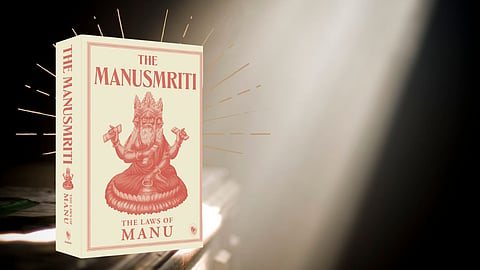

ON February 28, 2025, a Division Bench of Justices Vivek Kumar Birla and Anish Kumar Gupta of the Allahabad High Court rejected an application for quashing of an FIR filed by Priyanka Bharti, a spokesperson for the Rashtriya Janata Dal and a PhD scholar, had termed the book Manusmiriti as ‘holy’. During a heated television debate on India Today and TV9 Bharatvarsh, Bharti allegedly tore pages of the Manusmriti. On December 29, 2024, an FIR was filed in the Roravar Police Station in Aligarh against Bharti under Section 299 of the Bharatiya Nyaya Sanhita, which lays down the punishment for “deliberate and malicious intention of outraging the religious feelings of any class of citizens of India, by words, either spoken or written, or by signs or by visible representations or through electronic means or otherwise, insults or attempts to insult the religion or the religious beliefs of that class.”
The Court ruled that public acts of religious desecration had the potential to incite unrest and disturb public order.
But can the characterisation of being a “holy” textbook be, at all, attributed to the Manusmriti, particularly given its contents?
A little bit about the Laws of Manu
Manusmriti or The Laws of Manu is stated to have 2685 verses. The entire text is divided into twelve chapters. The translators of the text, American Indologist Wendy Doniger and academician Brain K. Smith, state in their Introduction to the 1991 text that, “Though it is certain that the text is the culmination of the work of several authors and a considerable amount of popular wisdom, it is attributed to someone named Manu and calling it Manu’s law distinguishes it from, for instance Gautama’s law or Yajnavalkya’s law.”
The date of this text is not fairly known though many like the Britannica suggest that it dates from circa 100 CE. Despite its ancient lineage, it seems that the text has not lost its force as a guide to life. The growing intolerance in the nation cannot be pinned on this text alone. But we cannot lose sight of the fact that today, a whole eco-chamber is being fed with the so-called insights that one can gather from this ancient text. Such is the allure of this book that even judges, who are otherwise sworn to uphold constitutional morality, cannot help but sing paean to this text which preaches an open form of exclusion, hatred and economic oppression towards the lowest classes.
Manusmriti and Nazism
It was Sir William Jones,the famed Indologist, who first translated the Manusmriti from Sanskrit to English. In 1734 the Royal Asiatic Society, Kolkata published the translated text. Soon this English translation gave way to translation in several European languages. The German translation appeared in 1797, French in 1893, Portuguese in 1859, followed by the Russian in 1913.
One of the European philosophers who openly and unabashedly praised Manu and his laws was none other than the ideologue of the Nazis, Friedrich Nietzsche. For instance in his famous philosophical work The Will to Power, that was edited and published posthumously by his sister Elizabeth Nietzsche, this is what he wrote:
“One draws a breath of relief when coming out of the Christian sick-house and dungeon atmosphere into this healthier, higher, wider world. How paltry the ‘New Testament’ is compared with Manu, how ill it smells.”
And again he writes
“One sees immediately that it has a real philosophy behind it, in it, not merely an ill-smelling Jewish acidity compounded of rabbinism and superstition.”
Manusmiriti is a text that dwells on practically everything – be it propounding the doctrine of metaphysical origin of the four castes that comprise the ‘Chaturvarna’ or the laws relating to marriage, rules relating to Kingship i.e. how should a good king think, live and act, axioms on the nature of women, foods that ought to be consumed, or rules relating to oblations. The text is a nigh encyclopedic compendium of rules related to the ‘government of the self’ and the ‘government of the others’ in a society that is dominated by the upper castes i.e. the priestly class, the warrior class and the merchant class.
Since it is not possible to dwell or comment on each and every aspect of the text, I would like to touch upon a few themes that emerge consistently or structurally, as one might say.
The status of the lower castes or the Shudras in Manu’s city-state
In the very first chapter after giving a metaphysical explanation of the cosmogony, Manu in verse 31 states that, “From his mouth he created the priest, from his arms the ruler, from the thighs the commoner, and from his feet the servants.” And then in verse 91 he prescribes that the servants must serve all other classes without any resentment. In chapter 2 verse 31, he states, “(The name) of a priest should have (a word for) auspiciousness, of a ruler strength, of a commoner property, and (the name) of a servant should breed disgust. Having assigned the lower caste people a lowly origin and a sub-ordinate social and economic status, Manu states in chapter 3, verse 241 that, “The pig destroys (the offering) by sniffing them, the cock with the flapping of his wings, the dogs by letting his gaze fall upon them and a lower-class person by his very touch.” In Chapter 4, verse 108, Manu forbids recitation of the Vedas, “in the vicinity of the servants.”
There are plethora of injunctions against the Shudras, the community assigned the lowest hierarchy in the Varna system, in the text, which if and when practiced can only lead to a wholesale exclusion and outright discrimination and daily violence against people from marginalised and oppressed-caste communities. Chapter 8 of this text in verse 270-284 prescribes the modes of punishment that shall be inflicted upon those who err. In verse 279, Manu states that, “If a man of lowest caste injures a man of higher caste with some particular part of his body, that very part of his body should be cut off. Verse 281 states that, “If a man of inferior caste tries to sit down on the same seat as a man of superior caste, he should be branded on the hip and banished or have his buttocks cut off.”
Similarly in order to ensure that no meaningful relationship develops between the various castes, in verse 366 of the same chapter, Manu prescribes death penalty on any man of a ‘rear’caste who, “makes love with a virgin of the highest caste.” Manu in Chapter 8, verse 414 like Aristotle in his text Politics, (Book-I, chapter V), also believes that slavery in a slave is his innate nature. A slave is fit only for slavery. He warns that a kingdom overrun by atheists, where servants are in the majority and where there are no twice-born (dwija) men, will be destroyed due to famine and disease.
In order to ensure that a servant always lives on the edges of economic uncertainty, he states in Chapter 10, verse 129 that, “A servant should not amass wealth, even if he has the ability, for a servant who has amassed wealth annoys priests.”
The status of women in Manu’s city-state
In his philosophical text Thus Spake Zarathustra (1883), Nietzsche wrote that, “Man shall be trained for war and women for recreation; all else is folly.”
Manu’s world view too relegates women to a secondary place. Woman is an object not a subject with agency. Women are not to be treated on par with men. In the world view of Manu, women are to be treated no better than chattels; prizes of war that should be confiscated when one wins it. He states in chapter 2, verse 213 that it is in the nature of women to corrupt men. In verse 215 he says that no one should sit in a deserted place with his mother, sister, or daughter, for the strong cluster of the sensory powers drags away even a learned man.
In chapter 5, verse 147, he says that a girl, a young woman, or even an old woman should not do anything independently, even in (her) house. In childhood a woman should be under her father’s control, in youth under her husband’s, and when her husband is dead, under her sons’. She should not have independence. In chapter 7, verse 96, he states what should happen when one wins a war. Here he states that, “Horses and chariots, elephants, parasols, money, grain, livestock, women, all sorts of things and non-precious metals belong to the man who wins them.”
Since Manu does not ascribe any degree of subjectivity to women in general, this is what he says when it comes to deposition of evidence before a court of law, “One single man who is not greedy may be a witness, but not several women, even if they are unpolluted, because a woman’s understanding is unreliable, nor even other men who are rife with bad qualities.” In chapter 9, verse 46, he says, “A wife is not freed from her husband by sale or by rejection; we recognise this as the Lord of Creatures long ago.”
A bare reading of the text shows that apart from containing maxims on living a good life for the twice-born men, the Manusmriti is replete with assertions or legal injunctions that if implemented can lead any society back to a state system where no notions of fundamental rights are enjoyed by anyone other than the fortunate ones. The little social progress that India has made as a nation in the last 75 years will be wiped away in a matter of days if Manu is brought back as a legal order. It is Dr. Ambedkar that India needs and his sense of empathy and equity that alone is capable of holding this nation as one.
Any other experiment is bound to cost this nation heavily.