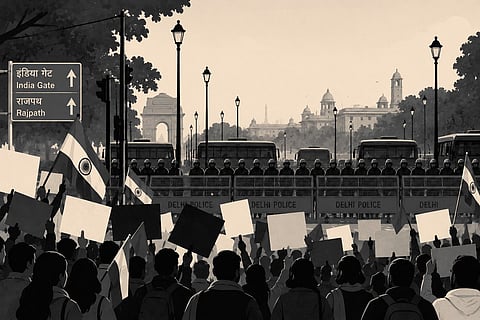

A DEMOCRACY DOES NOT have to formally suspend its Constitution to make dissent difficult. Sometimes, it is enough to close the routes through which citizens reach one another, restrict access to the spaces where they assemble, and make the costs of protest so high that people begin to withdraw before they are stopped. When public infrastructure becomes an instrument for controlling political participation, the suppression of dissent extends beyond the policing of a crowd. The events reported in New Delhi on 10 October 2026 raise precisely this concern.
The Cockroach Janta Party (CJP), which was founded as an online platform following observation of Chief Justice of India Surya Kant’s that unemployed youth are like cockroaches, called for a peaceful demonstration at Jantar Mantar demanding resignation of Chief Election Commissioner Gyanesh Kumar, who has allegedly manipulated the electoral rolls and voter registration forms following the implementation of Special Intensive Revision (SIR) of voter list across the country. .
Those coercive measures adopted by police to shut down capital city of Delhi, detain almost seven thousand people and block internet on October 10, 2026 cannot be understood merely as a disruption of activities of protesters to organise a political rally. They raise deeper concerns about the erosion of constitutional freedoms and the conditions under which citizens can exercise their right to dissent. Reports indicate that approximately 50,000 security personnel were deployed, nearly 57 metro stations were shut down and fairly big iron nails were fixed on city roads. The reported overnight detentions of around including prominent political figures such as Mamata Banerjee and Arvind Kejriwal, and YouTuber Dhruv Rathee, further intensified concerns about the scale of the State’s muscular measures to muzzle people’s freedom. The CJP leaders Abhijeet Dipke, Saurav Das, and Ashutosh Ranka were detained the moment their commercial flight landed in Delhi. Their legal head, Ratna Singh, has also been detained without even informing her of the grounds of arrest. These reported repressive measures raise a fundamental constitutional question. When the regulation of public order extends beyond the protest site to restrict mobility, detain organisers and impede peaceful assembly, does the state’ s response cross the line of legitimate crowd management to get manifested in the sinister methods for suppression of dissent? The constitutional infirmities will become clearer when examined in the light of the following considerations.
The status of Article 19: the right to assemble
The core of a functional democracy lies in the citizen’s right to question the State and hold the Government accountable. The Constitution safeguards this democratic imperative through Article 19(1)(a), which guarantees the freedom of speech and expression, and Article 19(1)(b), which guarantees the right to assemble peaceably and without arms. These are not privileges bestowed at the Government’s discretion, but fundamental rights that enable citizens to express dissent, organise collectively, and peacefully challenge the exercise of State power, when the State exceeds its constitutional authority or acts in ways that undermine democratic accountability. Although Article 19(3) permits reasonable restrictions on the right to assemble in the interests of the sovereignty and integrity of India and public order, such restrictions cannot be treated as an unrestricted licence to suppress peaceful dissent. The constitutional question, therefore, is not merely whether an assembly may be regulated, but whether such regulation remains within the bounds of constitutional reasonableness. Therefore, a blanket denial of permission to protest and barricade the city, shut down internet fails the test of proportionality and so contravenes the fundamental right enshrined in Article 19 of the Constitution.
The State, through Delhi Police, refused permission to the CJP to protest, on the ground that it never submitted application seeking permission to that effect. It was also stated by the authorities that there could be a massive disruption of law and order in case CJP went ahead in organizing protests. However, in the landmark case of Mazdoor Kisan Shakti Sangathan v. Union of India (2018), the Supreme Court of India ruled that the government cannot completely ban peaceful demonstrations in central areas of Delhi like the Jantar Mantar. Therefore, by denying permission and arresting the organisers, the state blatantly acted against the mandate of the Hon’ble Supreme Court.
Weaponizing Section 163 BNSS as a Political Tool
To make the mass detentions legally executable, the State relied on Section 163 of the Bharatiya Nyaya Suraksha Sanhita (BNSS); the equivalent provision of the colonial-era Section 144 of the Code of Criminal Procedure (CrPC). According to this provision, Executive Magistrates are allowed to issue prohibitory orders (banning gatherings of four or more people) in urgent cases of nuisance or apprehended danger. It was designed to prevent riots and immediate threats to human life and not to insulate the Chief Election Commissioner from being accountable to the public.
The Supreme Court has repeatedly warned against the misuse of prohibitory orders in cases such as Babulal Parate v. State of Maharashtra and Anuradha Bhasin v. Union of India. The court ruled that the power bestowed by this provision cannot be used as a tool to suppress legitimate grievances or to curtail the lawful exercise of fundamental rights. The apprehension of danger must be real and imminent. Detaining hundreds of peaceful protestors is inconsistent with law and it only prevents protesters from exercising their fundamental right to peacefully assemble and express their dissent.
Infrastructural Suppression: The Foucauldian Panopticon in Practice
To understand the chilling nature of the October 10th clampdown better, it would be salutary to examine Michael Foucault’s concept of the panopticon. which is an architectural model of a prison where the inmates are constantly visible from a central watchtower. Since the inmates never know exactly when they are being watched and monitored, they internalize the fear of surveillance and begin to regulate their own behaviour driven by panic and scare.
On October 10th, Delhi was turned into a modern-day panopticon. By shutting down 45 metro stations and coordinating with ride aggregators like Ola and Uber to restrict movement to central Delhi, the State converted civic infrastructure into a weapon against the citizens. The fact that the Delhi Police could track the exact flight carrying the CJP leaders and arrest them immediately in the flight itself sends a terrifying message to every average citizen: “You are always being watched. Your travel itinerary, your location, and all your communications”.
The panopticon aims to induce docility, and by making the physical act of reaching the protest site logistically impossible, the State creates a chilling effect whereby the citizens self-censor and stay home, not because they agree with the government but because the cost of dissent has been made unbearable by the State.
Detention After Dark: Gendered Violations of Legal Safeguards
One of the most disturbing incidents of the October clampdowns was the preemptive midnight raids leading to detention of 1000 people in the dark hours. Among those were female students, activists, and leaders of various organisations. Reports of male police officers aggressively handling female protestors have also been seen on videos which highlight a severe breakdown of statutory protections.
Under Section 43 of the BNSS, it provides strict safeguards that no woman shall be arrested after sunset and before sunrise, and in exceptional circumstances, the arrest must be made by a woman police officer only after obtaining prior written permission from a Judicial Magistrate. The Bombay High Court in the case of Christian Community Welfare Council of India v. Government of Maharashtra, established that women are highly vulnerable to abuse during arrests made at night. This principle was later adopted by the Supreme Court and the Legislature. But the sweeping late-night arrests, without prior magistrate approval, clearly violate this mandate, thereby suspending the rule of law.
The Constitutional Cost of Detention: Article 21 and Personal Liberty
The Constitution of India guarantees that no person shall be deprived of their life or personal liberty except in accordance with a procedure established by law through Article 21. The overnight crackdowns clearly violated this mandate as well when the accommodations of CJP volunteers and youth activists were raided in the middle of the night before they had even committed an allged offence or reached the protest site.
In the infamous midnight crackdown on sleeping protestors led by Baba Ramdev, the Supreme Court in the Ramlila Maidan Incident v. Home Secretary, Union of India, made a historic ruling and held that a peaceful protest is a fundamental right. The police cannot forcefully evict or detain demonstrators in the middle of the night without valid, reasonable, and proportionate justification. The Court had established that the “right to sleep” is a fundamental component and extension of Article 21, and disrupting it with state action is unconstitutional.
How Democracies Die: Warning Signs in State Action
The transformation of a democracy into an authoritarian regime rarely occurs now overnight through a military coup. More often, it unfolds gradually, through the systematic erosion of democratic norms, institutions, and civil liberties. In their seminal work, How Democracies Die, Steven Levitsky and Daniel Ziblatt explain how democracies can be hollowed out from within when elected leaders increasingly exhibit authoritarian tendencies and weaken the institutional and normative safeguards that sustain democratic governance.
These concerns resonate with ideas of Partha Chatterjee outlined in his Ruth Benedict Lectures, delivered at Columbia University in April 2018. and subsequently published as I Am the People: Reflections on Popular Sovereignty Today. Chatterjee’s engagement with popular sovereignty offers a useful framework for reflecting on a contemporary political landscape in which populist movements are gaining ground, authoritarian leaders are emerging, democratic institutions appear increasingly vulnerable, and traditional political parties are struggling to sustain public trust and political solidarity. When political leaders claim to embody the will of “the people,” those who question or oppose them can increasingly be portrayed as enemies of the people themselves. The language of popular sovereignty then risks becoming a means of exclusion rather than an expression of democratic participation. In such circumstances, the cynical maxim, “Show me the person and I shall show you the law,” captures the danger of a political order in which the application of law appears to depend less on constitutional principle than on a person’s identity, political position, or perceived loyalty to those in power.
Tragically the October 10th incident in Delhi captures those maladies. The denial of legitimacy to protests launched by youth and opposition parties stifled their fundamental right. The State no longer treats the opposition as legitimate political rivals with valid grievances but as criminal threats to the State. The CJP that emerged out of sheer youth frustration over unemployment is not treated as a citizen collective but as an insurgent threat that needed to be stopped by deploying 50,000 police officers and cancelling all trains to Delhi. . The readiness of the State to curtail the civil liberties of the opponents by detaining journalists, lawyers, and political leaders is a textbook execution of this indicator. When the State uses the police force to detain lawyers-the very people meant to defend the Constitution- it signals terminal decline of civil liberties.
Conclusion: The Undeclared Emergency
As a citizen witnessing the barricaded streets of New Delhi, the closure of metro stations, internet shutdowns, cancelled trains, and viral footage of protesters being harassed at the protest site, one cannot escape the unsettling sense that the social contract between the citizen and the State, as theorised by Thomas Hobbes, is under strain. Michel Foucault’s insight that power does not eliminate resistance but often drives it beneath the surface becomes pertinent here. Therefore, the suppression of dissent may silence its visible expression, but it does not extinguish the underlying conflict; it merely pushes it underground, where it continues to persist.
The Constitution guarantees citizens the freedoms of speech and expression, peaceful assembly, and the protections of liberty and dignity. Yet, the clampdown reveals how those operating the Indian State can employ the infrastructure of modern life as an instrument of suppression. By restricting access to air travel, metro services, and digital communication, the State risks creating a Panopticon of infrastructural control, in which the ordinary conveniences of citizenship become means of constraining dissent and undermining fundamental freedoms.
When the referee of our democracy- the Election Commission cannot be questioned by the public without being arrested, the electoral process itself loses its sanctity. This cannot be termed as a law-and-order operation; it is a demonstration of brute force. The most profound danger, therefore, is not simply that streets are barricaded or public spaces restricted, but that citizens may gradually be reduced from participants in a constitutional democracy to subjects of surveillance and control. An emergency need not always announce itself through a formal proclamation. Democratic freedoms can also be diminished through the cumulative normalisation of exceptional measures. But history offers lessons that repression fails to suprees people who always rise and successfully fight for constitutionally mandated freedom.
Mahatma Gandhi while addressing the Congress session in Ahmedabad on December 28, 1921, described freedom of opinion and freedom of association as “the two lungs that are absolutely necessary for a man to breathe the oxygen of liberty”.
He then very boldly stated, “If there is any authority in this country that wants to curb the freedom of speech and freedom of association, I want to be able to say in your name, from this platform, that that authority will perish, unless it repents, before an India that is steeled with high courage, noble purpose and determination, even if everyone of the men and women who choose to call themselves Indians is blotted out of the earth.”
“We the People” are now steeled with courage to save the Constitution which guarantees their freedom and so powers that be must act in accordance with the Constitution and constitutional morality so that liberty is upheld in face of all odds.
