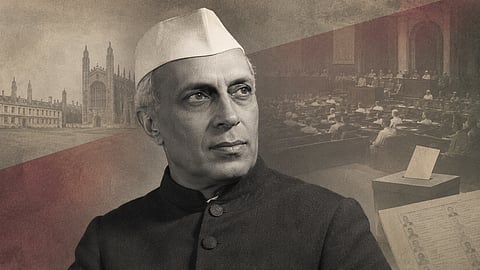

ON this day in 1889, in an age when the sun never set on the British Empire, a boy was born in Allahabad, then the capital of North-Western Provinces in British India. The boy was Jawaharlal Nehru- who would go on to become the architect of modern India, its first Prime Minister and one of the most towering leaders of India’s freedom struggle. His father, Pandit Motilal Nehru, was one of the foremost lawyers of the Province and a leading member of the Indian National Congress. Jawaharlal Nehru attained his education and grew up in Edwardian England (period of King Edward VII’s reign), wherein he was exposed to liberal rationalism, a faith in science and an early curiosity about socialism, which became the intellectual furniture of his political thought that he carried back to India as the vocabulary of his nationalism.
Nehru as a student in Edwardian England
In May 1905, Nehru, accompanied by his parents and sister, reached London. Soon thereafter, Nehru was admitted to Harrow, one of the two most prestigious English schools (the other being Eton). Here, he showed an early interest in politics and aviation.
In October 1907, Nehru got admitted to Trinity College, Cambridge, where he spent three years studying Natural Sciences Tripos (chemistry, geology and botany). By 1907-08, Nehru’s interest in Indian politics had become quite serious, and he ‘wanted to play a brave part in them, and this was not likely to lead a soft life’. He recounts spending long winter evenings in Cambridge sitting by the fireside and engaged in deep discussion with his friends, in the pre-World War I era. Nehru was also a part of ‘Cambridge Majlis’, a debating society of Indians, although he hardly spoke there. Ironically, as per Nehru, in Majlis and elsewhere in private conversations, young Indian students ‘often used the most extreme language when discussing Indian politics’, sometimes even admiring the early acts of anti-imperial violence in Bengal; and the same persons would, later on, join the Indian Civil Service, or become High Court judges, seldom taking any effective part in freedom struggle. Around the same time, back at home in India, Motilal Nehru was increasingly drawn into active politics, being a strong member of the Moderates group of the Congress; something with which young Jawaharlal did not agree back then.
During his stay in Cambridge, his future career was being considered. Initially, Indian Civil Service was contemplated, but neither him nor his father were keen on it, primarily because he was still underage (age limit for ICS exam back then was 22-24) and that he would be posted at distant places. Then, as the hand of providence had willed for good, it was decided that he would join the paternal profession, i.e., the Bar, and was admitted to the Inner Temple on 11th January 1909. After graduating from Cambridge in 1910, Nehru hovered about London for the next two years. He lived at 60, Elgin Crescent, Notting Hill, in the vicinity of Kensington Palace.
While in London, Nehru was interested in Fabian socialist ideas, Irish Home Rule movement and woman suffrage struggle. His close observation of these struggles during his years in the Inner Temple made him sensitive to the question of political representation. In particular, the suffrage movement highlighted the irony of a parliamentary system that claimed democratic legitimacy while denying a substantial portion of its population the right to vote on account of gender, property or subjecthood. Eventually, on 19th June 1912, Jawaharlal Nehru was Called to the Bar (became a Barrister), and a few months later, he returned to India after spending over seven years in England. However, this early realisation, that political freedom is meaningless without an inclusive franchise, stayed with him as he moved from being a student of English law to a leader of India’s anti-colonial movement.
Constitutionalism, Democracy and the Fight for Adult Suffrage
Nehru's contact with the British parliamentary system and his legal training at the Inner Temple were the bedrock of his lifelong adherence to constitutional government and political equality. In India, he faced a colonial system that rationed democratic participation. Although the Government of India Act, 1935 had significantly expanded the electorate from its 1919 predecessor, but the franchise still remained restricted by property, tax and educational qualifications. It was a far cry from universal adult suffrage, which Nehru considered the bedrock of a free nation.
Nehru’s conviction found its most profound expression he moved the historic Objectives Resolution in the Constituent Assembly on 13 December 1946. He described the resolution not just as a legal draft, but as “a declaration…a firm resolve…a pledge and an undertaking and it is for all of us I hope a dedication”. Nehru laid down the philosophical foundations of the Constitution. Most importantly, by proclaiming in the Objectives Resolution that India as an “Independent Sovereign Republic” and that “all power and authority of the Sovereign Independent India, its constituent parts and organs of government, are derived from the people”, Nehru firmly established the democratic legitimacy of the new state. Nehru’s resolution ensured that the ultimate sovereignty of the future Republic was to be vested in the masses, not in a privileged few.
The promise translated into constitutional machinery needed a radical break from the colonial past. In spite of the widespread poverty and illiteracy at the dawn of independence, Nehru and the framers of constitution rejected gradualism. Thus, ensuring that universal adult franchise became an intrinsic part of independent India from day one was viewed as an act of monumental faith in the common citizen. This vision culminated with the adoption of Article 326 of the Constitution which guaranteed to every adult the equal right to vote. For Nehru, political democracy could not be rationed; if the Republic was to survive and thrive, it had to belong entirely to its people right from its inception.
Political thought: The making of Nehru
Nehru’s political thought took a decisive socialist turn after he participated in the 1927 Brussels Congress of Oppressed Nationalities and his subsequent visit to the Soviet Union. In his Presidential Address at the Faizpur session of the Indian National Congress (1936), Nehru endorsed the view that imperialism was an inherent outgrowth of capitalism, which is a central tenet of Marxist thought that Lenin further developed. The editors of Nehru’s Selected Works describe him in this period as never a rigid Marxist, yet deeply influenced by the theory and impressed by what he saw in the Soviet Union.
He valued Marxism for its absence of dogmatism and its stress on outlook and action and resisted treating communism as holy doctrine. When asked in 1950 whether he was a Marxist, he said he had a horror of dogma, whether in religion or economics, while still crediting much truth in the Marxist analysis of history.
Moreover, under Mahatma Gandhi’s influence, he could not subscribe to the violence implicit in the Marxist resolution of conflict. His position was not simple pacifism, though. In his 1936 review of Nehru's An Autobiography, published in The Labour Monthly, R. Palme Dutt, a British politician, acknowledged Nehru's growing acceptance of the Marxist worldview, particularly his recognition of the need to unite national liberation with social emancipation. However, Dutt criticised Nehru for accepting Marxism at the global level while resisting its class-based analysis of Indian politics. Nehru exposes Gandhi’s defence of landlord interests but still regards him as the representative of the peasantry. He fails to see that the Congress right wing’s vacillation towards imperialism is not a personal aberration but an expression of its bourgeois class character. This failure obscures the limits of bourgeois nationalism and its capacity to contain, rather than advance, the mass struggle.
Partha Chatterjee (political scientist), in his book chapter “Nehru and the Passive Revolution”, draws on Gramsci to argue that India’s transition to independence took the form of a passive revolution. By this, he means that social change was directed by the nationalist elite and the postcolonial state, rather than driven by a popular revolution from below. Workers and peasants were mobilised in the anti-colonial struggle, but they did not determine the course of the transformation. Thus, power passed from colonial rulers to an Indian ruling elite, while much of the institutional structure and existing class relations remained intact.
Despite his differences with orthodox Marxism, Nehru consistently identified as a socialist. In his 1929 Presidential Address at Lahore, he declared, “I must frankly confess that I am a socialist and a republican.” He translated this commitment into policy through the Planning Commission and Five-Year Plans, drawing on Soviet experience in state-led economic development, particularly industrial planning. Yet he adapted this model to Indian conditions, retaining private enterprise within a mixed economy.
Nehru’s tryst with London post-independence and influence on early independent India
Nehru’s pragmatic ideological outlook also shaped his approach to India’s relations with the United Kingdom post-independence. Although Britain had emerged victorious out of World War II, it had been significantly weakened, and in 1947, when India became independent, it marked the beginning of the end of the British Empire, triggering an era of decolonisation over the coming decades. However, during the 1940s and 50s, Britain still had considerable influence over international affairs, especially concerning its former colonies. Upon independence, India, which was now a British Dominion[1] instead of a colony, became a part of the British Commonwealth of Nations under the Statute of Westminster 1931. However, an impending question was regarding India’s future in the British Commonwealth upon becoming a republic. It was in this background that Nehru pushed for India’s full membership of the Commonwealth. This culminated in the historic London Declaration of 1949, jointly drafted by V.K. Krishna Menon and Sir Norman Brooks, which allowed India to remain in the Commonwealth without accepting the King as its Head of State who was now to be the ‘Head of the Commonwealth’- a symbol of free association of its member nations, whilst also dropping the word “British” from the Commonwealth’s name. This gave birth to the modern Commonwealth of Nations and allowed independent Republics to be part of it. According to Nehru, India had joined the Commonwealth “obviously because we think it is beneficial to us and to certain causes in the world that we wish to advance”, and entering into an alliance with a nation (or group of nations) doesn’t mean accepting or commitment to every policy of the other nation.
When India finally became a sovereign Republic in 1950, Nehru, despite his monumental strategic push towards Non-Alignment, fostered diplomatic ties with Britain. Throughout his premiership, he continued to regularly attend the Commonwealth Prime Ministers’ Conferences which were held annually in London. He also attended Queen Elizabeth II’s coronation in June 1953; and, in 1956, he was honoured with ‘Freedom of the City of London’, a ceremonial award bestowed upon people of high international standing.
Conclusion
More than a century after he lived in London, the city still commemorates Jawaharlal Nehru’s memory. The house on 60, Elgin Crescent, where he once lived during his days as a student Barrister, bears a ‘Blue Plaque’ commemorating him. At India Place, beside India House (High Commission of India in the U.K.), stands a bronze statue of Nehru, which was unveiled by the then Prime Minister Sir John Major in 1991. The Nehru Centre in Mayfair functions as the cultural wing of the Indian High Commission.
The most interesting irony is, perhaps, the fact that Jawaharlal Nehru, who lived and studied in Edwardian England in the heyday of the British Empire, rose to become one of the most towering leaders of anti-colonial resistance during the 20th century.
At the same time, Nehru’s enduring relevance lies not only in how he reshaped post-colonial ties with Britain based on sovereign equality, but also in the democratic foundations he helped build at home. The constitutional leap of faith he championed, i.e., anchoring the Republic in universal adult suffrage, remains a defining pillar of Indian democracy. Yet, nearly eight decades after the Objectives Resolution affirmed that all authority flows from the people, that foundational guarantee faces renewed strain. The Election Commission of India’s Special Intensive Revision (SIR) of electoral rolls has raised serious concerns over onerous documentation demands, procedural opacity, and the large-scale deletion and disenfranchisement of voters. To revisit Nehru’s journey from Edwardian England to the Constituent Assembly today, is therefore, more than an exercise in historical memory. It is a reminder that a constitutional democracy endures only so long as the equal right of every citizen to remain on the electoral roll is protected against administrative exclusion.
Student Barrister, University of London, UK
Advocate, Supreme Court of India
Member, Lincoln's Inn
Maimuna Siddiqui
Maimuna Siddiqui is currently pursuing law at Aligarh Muslim University. Her areas
of interest include corporate law and gender justice. She enjoys reading Urdu
literature, history and philosophy.
