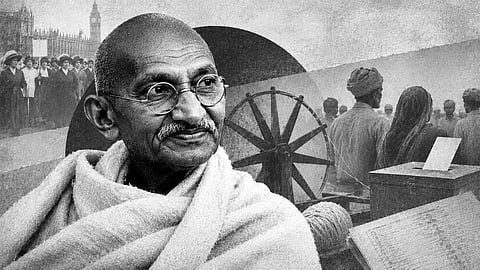

MOHANDAS KARAMCHAND GANDHI visited London in 1906 and 1908 to gain support for the diaspora’s rights in South Africa. During these visits, he encountered protests by “suffragettes”. In Indian Opinion in November 1906, he wrote: “Today the whole country is laughing at them, and they have only a few people on their side. But undaunted, these women work steadfastly in their cause. They are bound to succeed and gain the franchise, for the simple reason that deeds are better than words”. Gandhi took keen interest in the suffragette campaign, met their leaders and learned from their work. Although he admired “the value and methods of passive resistance” of these suffragists, he expressed regret over the militant section of the movement. He wrote, “They have their own weapon. Why should they copy the evil ways of men?” Despite his disagreements over methods, Gandhi supported the cause, which later led him to advocate for universal adult franchise.
Voting as Direct Action
Years later, on June 9, 1931, the Congress Working Committee (CWC) met in Bombay to chart its plan for the second Round Table Conference in London. The CWC passed its resolution that Gandhi alone would represent the Congress at the conference. On June 18, 1931, Gandhi wrote in Young India that he was opposed to attending the conference to achieve a “Swaraj constitution” and wanted to “wait till all the communities were satisfied to adopt a purely national solution”. However, he did not advocate abandoning the freedom struggle, and argued that the Congress should consolidate its position among all communities to achieve Swaraj. Prescribing the methods to achieve that goal, he wrote:
“This does not mean giving up the struggle for freedom. It all depends upon what we mean by and want through Purna Swaraj. If we mean an awakening among the masses, a knowledge among the masses of their true interest and ability to serve that interest against the whole world, and if through Purna Swaraj we want harmony, freedom from aggression from within or without, and a progressive improvement in the economic condition of the masses, we can gain our end without political power and by directly acting upon the powers that be. One form of direct action is adult suffrage. The second and more potent form is Satyagraha”
This makes adult franchise a crucial weapon in Gandhi’s quiver of non-violent resistance. Through Satyagraha and the ballot, the powerless resist authority without violence. However, Gandhi’s grading is important and nuanced, as he considered Satyagraha the “more potent” form. Without overstating that, the vote remained Gandhi’s chief weapon; one can admit that he accepted its non-violent attributes and considered it a way of “direct action”.
Congress as Laboratory
Gandhi tested the franchise as a method to achieve Swaraj on the Congress itself as he sought to change the franchise qualifications in the 1920s. On June 19, 1924, Gandhi unfolded his plan to replace the four-anna franchise with a spinning franchise within Congress in Young India. He wrote:
“I believe in khaddar, I believe in the spinning wheel. It has two aspects, terrible and benign. In its terrible aspect, it is calculated to bring about the only boycott we need for independent national existence, viz., that of the foreign cloth. It alone can kill the demoralising British self-interest. In its benign aspect, it gives a new life and hope to the villager…It is the very best popular education that is needed for the millions…To be truly national, the Congress must devote itself exclusively to that which will bring the nation most quickly within the reach of Swaraj”.
Thus, Gandhi tied the seemingly mundane act of spinning with the national question, which could eventually legitimise Congress’ credentials as a national organisation. On June 27, the All India Congress Committee (AICC) met in Ahmedabad and passed Gandhi’s resolution despite AICC’s not all that willing to introduce such a drastic change. In protest against this violation of the letter of the Congress’ constitution, the Swarajists walked out of the session, with Motilal Nehru characterising Gandhi’s action as “autocratic”. Despite this criticism, Gandhi propagated spinning as a franchise within the Congress religiously to strengthen the cause of Swaraj. In a meeting in Comilla on January 5, 1927, Gandhi asked, “Are the millions of the villagers enfranchised? Is India living in her ten or twenty cities, or is she living in her 700,000 villages?...The one and unequivocal answer is the spinning wheel and khaddar. The message of khaddar can penetrate to the remotest villages if we only will that it shall be so. The spinning wheel can be turned by millions of the villagers of India who have been reduced to pauperism, who have been ground down to dust, not merely under the foreigners' heels but under your heels, under my heels”.
Gandhi’s constant appeals drew enthusiastic pledges. For instance, in 1925, Maulana Zafar Ali Khan promised that he would get five thousand Muslim spinners as members. Moreover, the Congress Resolution on Fundamental Rights and Economic Changes at its Karachi Session in March 1931 listed “adult suffrage” as a key promise in the future constitution of Swaraj. Over the years, for Gandhi, the question of franchise became increasingly synonymous with the spinning wheel. In 1934, announcing his potential retirement from the Congress, Gandhi declared that “my conviction is growing that if India is to win complete independence in terms of the toiling millions and through unadulterated non-violence, the spinning-wheel and khadi have to be as natural to the educated few as to the partially unemployed and semi-starved millions”. For him, the spinning-wheel was the nation’s “second lung” while agriculture acted as the first lung. Moreover, he argued that “hand-spinning” remained the “nearest approach to adult franchise”. This shows that Gandhi’s experiment to link adult franchise with spinning within Congress reflected his intent to make the vote a bond between the masses and the educated few. In this sense, Gandhi treated the Congress as his laboratory to strengthen the latter’s grip over the masses to achieve Swaraj. One key tension was that Gandhi’s spinning qualifications, which made yarn the price of membership, sat awkwardly with the key tenets of universal adult franchise. However, he himself noted in Young India on January 1, 1925, that the “honestest unwilling spinner” would get a member of his family to spin for her. While this remained his position for the Congress only, he developed his understanding of adult franchise as a political thinker in parallel.
Round Table Conference
In his speech at the Federal Structure Committee at the Round Table Conference on September 17, 1931, Gandhi declared, “I am wedded to adult suffrage. Somehow, or other, Congressmen swear by it”. For Gandhi, adult suffrage was necessary for many reasons. First, Gandhi saw it as a weapon in the hands of the marginalised sections. Referring to the property and educational qualifications required for voting rights back then, Gandhi underlined that he could not “bear the idea that a man who has got wealth should have the vote, but that a man who got character, but no wealth or literacy, should have no vote; or that a man who works honestly by the sweat of his brow day in and day out should not have the vote for the crime of being a man”. For him, such a construct was an “unbearable thing” as it violated the principle of political equality. Though he valued mass literacy, he refused to make political participation conditional upon literacy.
At the same time, Gandhi did not consider direct election an indispensable feature of democracy. He said, “The words ‘indirect election’ do not frighten me”, as he weighed practical considerations. According to Gandhi, direct election would produce enormously large constituencies, making it hard for representatives to maintain a “personal touch” with people regularly. Therefore, he recommended a decentralised system of indirect representation rooted in the village. He envisioned village committees electing taluka committees, which would later elect district and provincial councils, with the latter sending representatives to the union legislature. But he In this sense, indirect said that such ideas were advanced by one Lord Peel. In that sense elections would create a chain through which the concerns of the masses could travel from the village to the centre. The Congress itself served as proof that such a system could function properly. Gandhi claimed:
“Even so we would have millions, and something is needed to link the village with the Central Legislature. We have something analogous to the Central Legislature in the Indian Congress Committee. We have also provincial bodies analogous to the Provincial Legislatures, and we have also our own tin-pot legislation, and we have also our administration. We have got our own executive. It is perfectly true we have no bayonets to back it, but we have something infinitely superior to back our decisions and to get our people to conform to those decisions, and we have hitherto not found insurmountable difficulties.”
According to Gandhi, this machinery worked “smoothly” and “expeditiously” to sustain a genuine political contact between the people and representatives. He claimed that this system had connected the “representative with the humblest villager”. A decade after independence, this system was introduced as the Panchayati Raj System, becoming a fundamental part of our representative framework.
Adult Franchise as Political Counter to Separate Electorates
As Indian political unity became increasingly difficult in the last two decades of the Raj, Gandhi used the adult franchise to counter the demand for the protection of the special interests, such as Muslims and the Untouchables. Although Muslims were granted separate electorates in 1909, they sought to retain the separate electorates in the upcoming constitutional arrangements. On March 21, 1931, as the British Government discussed whether a special inquiry into the franchise should happen after communal settlement or not, Gandhi contended that he would dedicate his total energy to settling the communal question. Moreover, he claimed that an adult franchise would be “an indispensable condition of any solution”. Further, he added, “In the peculiar conditions of India adult franchise may appear a hard task, but it would be harder still not to have an adequate solution to our communal problems. Muslims and Sikhs feel the same. Muslims may not be unanimous, but there is a large body of Muslim opinion which feels that adult suffrage is the real solution”.
This shows that Gandhi proposed adult franchise as a better alternative than separate electorates. In his statement to The Hindu on April 6, 1931, Gandhi resisted the Muslim League’s demand for the retention of separate electorates by invoking “nationalist Muslims”. He said, “For one thing, I had the warning of nationalist Muslims not to accept anything that did not proceed on the principle of joint electorates based on adult suffrage”. This combination of joint electorates with adult suffrage was presented as the Congress’ alternative to the separate electorates with limited franchise. As the spokesman of the Congress at the Federal Structure Committee meeting on September 17, 1931, Gandhi declared without mincing words that “in any scheme that the Congress can be party to, there is no room for the protection of special interests”. He contended that the “special interests are automatically protected when you have got adult suffrage”.
Gandhi’s view that the adult franchise could genuinely substitute separate electorates appears in his non-official public meetings and correspondence. For instance, in his speech at the Indian Majlis, Oxford, on October 24, 1931, Gandhi held, “Look at the history of Europe. Have you got separate electorates for the working classes or women? With adult franchise, you give the untouchables complete security. Even the orthodox Hindus would have to approach them for votes”. As much as Gandhi believed in the adult franchise, he equally used it as a tool to counter the non-Brahminical contentions for power and representation. Moreover, he feared that the separate electorates would weaken Hindu unity and Hinduism fundamentally. For instance, in a letter to Samuel Hoare, British Conservative politician and Secretary of State for India, Gandhi wrote on March 11, 1932:
“I need hardly reiterate all the objections to the separate electorates for the Depressed Classes… I am not against their representation in the legislatures. I should favour every one of their adults registered as voters, irrespective of education or property qualifications, even though the franchise test may be stricter for others. But I hold that separate electorates are harmful for them and for Hinduism, whatever it may be from a purely political standpoint”.
This anxiety that separate electorates would “vivisect” and “disrupt” Hinduism defined his advocacy of the universal adult franchise in the early 1930s.
Election of Constituent Assembly on Adult Franchise
By the beginning of the Second World War, the Congress began pushing for a constituent assembly elected on the adult franchise to draft the constitution of independent India. Gandhi extended his full support to the Congress’s demand for the constituent assembly. He wrote in Harijan on November 25, 1939, that the Constituent Assembly would be the “surest index to the popular feeling”. Further, he added, “Illiteracy does not worry me. I would plump for an unadulterated adult franchise both for men and women, that is, I would put them all on the register of voters”. As the Raj cited the crisis of Indian unity to justify the delay in granting independence to India, Gandhi retorted through The News Chronicle:
“I fail to see why I fail to see why Great Britain's intentions about India should be dependent upon the Muslim, Hindu or any other opinion. The only opinion that counts is India's opinion, not even the Congress opinion. India's opinion can only be ascertained by the free vote of her people. The only true and democratic method is to ascertain their will through adult suffrage, or any agreed equivalent”.
Thus, Gandhi supported the creation of a constituent assembly based on adult franchise to draft India’s potential constitution. He reiterated that “neither the size of the country nor the illiteracy of the masses” should be reason against adult suffrage.
To conclude, Gandhi’s advocacy for adult franchise was never a static position. It evolved from his admiration of the discipline of suffragettes, was tested in the Congress through the spinning franchise and was presented before the British both as a moral position and a political alternative to non-nationalist demands for representation. In his vision of Swaraj, legitimate authority must be accountable to the poorest villager. Over the years, his instruments changed, but the ballot, for Gandhi, remained a non-violent link between power and the masses.
