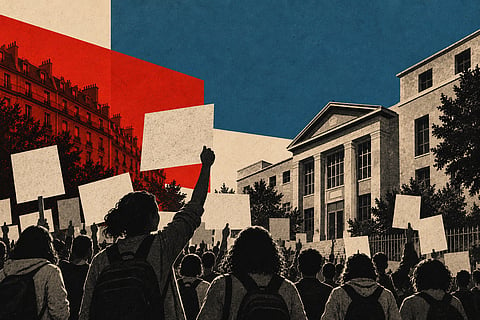

WHEN PROTESTS ACROSS the world erupt regarding inequality within schools and neglected educational priorities, led primarily by students, there is hope that they are asking democracies to honour two connected promises: quality education for all and the freedom to demand it. Whether the questions revolve around missing teachers or broken infrastructure, the demand reflects the distance between equality promised within a democracy and the actual opportunity it provides or fails to provide. The school protests in France have been indicative of simple demands surrounding adequate staff, usable facilities, and fairer learning conditions. Reverberating these demands across multiple countries in Europe – Spain, Portugal, even Germany - and in India, the Cockroach Janta Party’s (CJP) “School Thik Karo” (Set Right the Schools) campaign makes a comparable demand by publicly scrutinising government schools. These demands fall within the scope of international defence of public education and democratic participation with a shared claim to equality, rather than evidence of a single, centrally organised worldwide movement.
European Protests: What they Reveal, International Law, and Collective Rights
In France, pupils in disadvantaged Paris suburbs have turned deplorable school conditions ranging from consistent teacher shortages, overcrowding, inadequate facilities, and inequality across neighbourhoods into a national political issue – highlighting that one’s address should not be the sole determinant of their future. Enrolment in public schools alone cannot ensure access to quality education. So the question is not merely about education budget or even policy, per se – but rather who are the direct beneficiaries of an enhanced budget (if any)? Whether a mere national average is concealing the unequal burdens borne by particular communities, and even the unequal burdens of apparent neutral allocation may actually leave the children facing the greatest obstacles with the least institutional support. A placard in France read, “Four riot police for one student/ One professor for thirty five.” It underlined the pitiable conditions caused by shortage of teachers in French schools and heavy deployment of police forces to deal with protesters.
Even though France seems to be leading the charge on the scale of protests, there seems to be a wider European concern regarding the state of schools – ranging from Romanian teachers demonstrating against austerity measures, Greek students recurringly demanding better teachers, decent facilities, and meaningful investment in public education.
Here, international law can be indicative, providing a framework for understanding these protests – Article 21 of the International Covenant on Civil and Political Rights (ICCPR) protects peaceful assembly, and Article 19 protects freedom of expression. More often than not, in a democratic society, when read together, they safeguard essential means through which people question public decisions and organise demands for change. While this right is qualified by the touchstones of national security, public order, public safety, public health, morals, and the protection of others’ rights, these restrictions demand justification. Mere inconvenience or governmental embarrassment cannot be a substitute for showing why a particular restriction is necessary or proportionate. Even the mere disruption of traffic or everyday activity does not, by itself, constitute violence, and such a right to protest needs to be protected and enabled by the State. Peaceful disobedience, even with isolated violent acts, should not be automatically attributed to other participants or even to the entire assembly, which is largely peaceful. These distinctions matter when images of burning objects or clashes overwhelm discussion of a movement’s demands, where authorities have responded to violence and protect people from harm. However, the authorities have to assess individual conduct and the circumstances of the gathering and peaceful participants do not lose their rights – individually or collectively simply because someone nearby commits an offence.
Equally, a legitimate and overall peaceful educational demand does not make every protest tactic lawful, such as blocking access to a school, which can affect other children’s education; prolonged obstruction can raise serious competing interests. The legal task is to assess the actual conduct, harm, and available alternatives, as automatically organising every blockade is as inadequate as treating every disruptive gathering as a security threat. In this case, the European Convention on Human Rights (ECHR) serves as an indicator of the scope and legal application of the right to peaceful assembly, particularly under Article 11. The European Court of Human Rights guidance recognises that authorities must tolerate a degree of disruption, while the extent and duration of the disturbance remain relevant, and identifies duties to take reasonable measures to enable lawful demonstrations to proceed peacefully. Recently, there has been an international recognition of collective action from the International Court of Justice’s Advisory Opinion (ICJ AO) on the right to strike under ILO Convention No. 87. The Court confirmed that the Convention protects workers’ right to strike, while leaving the precise content, scope and conditions of its exercise unresolved by not expressly mentioning that right.
Highlighting these different international legal instruments is important, as a teachers’ strike involves the withdrawal of labour, whereas a student demonstration or parents’ rally engages the separate protections of expression and peaceful assembly. These actions may converge around the same demand for functioning public schools, but their legal foundations remain distinct. While the ICJ AO did not establish a general right to protest or automatically legitimise every school blockade, its relevance to the wider argument is that international law recognises collective action as a protected means of defending interests. This recognition challenges the expectation that those affected by institutional failures should confine themselves to deferential requests. The Hungarian Protests showcase this collective action, as Teachers and students opposed changes to educators’ working conditions and restrictions affecting their collective action. In 2023, the European Trade Union Committee for Education criticised legislation adopted despite sustained protests and urged meaningful consultation; the ability of teachers to defend their profession belongs within the debate over the quality of education children receive.
While these international legal instruments reflect the rights to peaceful assembly, freedom of expression, and collective rights in the European context, these rights have been contextualised in the context of India’s protests. The ICCPR binds its contracting states, including France and India; the ECHR and ILO bind France and other European nations but not India. Its jurisprudence nevertheless offers a useful comparative perspective alongside the separate obligations India bears under the ICCPR. Hence, the legal case for protecting peaceful school protests rests on India’s own constitutional guarantees and its applicable international human rights obligations. Even with these restraints, European protests offer an uncomplicated model for India to emulate, as its own schools and governments face similar concerns regarding the quality of education and, therefore, equality of opportunity. The value of the comparison lies in recognising that material prosperity and an enhanced education budget (8.27% increase) or a new educational policy do not automatically secure a fair public education system. Political choices still determine which children receive reliable public provision and which are expected to tolerate its deterioration.
India’s Parallel Demand
In India, protests stemming from the NEET paper leak scandal (following irregularities in the medical entrance test) have now snowballed into the recent controversy over Special Intensive Revision (SIR) and questionable functioning of the Chief Election Commissioner. However, between the two distinct protests, there was a call for a campaign often described as a movement to save schools, reported under the name “School Thik Karo”. Announced by CJP founder Abhijeet Dipke, the leader behind the NEET Protests and the SIR Protests, the initiative invites parents and village representatives to inspect government schools to ascertain if electricity, safe drinking water, toilet facilities, and mid-day meals are provided to children or not. It also calls them to document deficiencies through forms and videos. The method matters, as CJP asked for a social audit and turns a broad allegation of neglect into questions that an administration should answer. Is the water available? Do the toilets work? Who must authorise repairs?
When will the deficiency be corrected? Such questions connect everyday experience with public responsibility. The campaign has also announced an “Adivasi School Thik Karo” initiative to document conditions in tribal areas across several states. Its announced focus on teachers and basic facilities makes the distributional question explicit: whose schools receive sustained public attention?
There are important differences between a French suburban lycée and an Indian village school. Caste, tribal marginalisation, geography, language and household resources require attention on their own terms. Nevertheless, both settings invite the same democratic test: does the public system offer children a credible opportunity to learn, irrespective of the social position into which they were born? Community participation must also have limits, and the right to access equitable education should not be a mere burden on the parents. Parents should not have to finance essential repairs or repeatedly publicise deprivation before officials act to address it. Citizen audits can expose failures; responsibility for remedying them remains with public authorities.
The substantive basis for the right to education also exists in international and national law. For instance Article 13 of the International Covenant on Economic, Social and Cultural Rights (CESCR), provides that education must be . At the national context in India Article 21A of the Constitution of India mandates that “The State shall provide free and compulsory education to all children of the age of six to fourteen years in such manner as the State may, by law, determine.” Article 2 of the ICESCR requires states to take steps towards realising Covenant rights using the maximum of their available resources, while guaranteeing non-discrimination. The requirements enshrined in Articles 2 and 13 of the ICESCR emphasise that there should be functioning institutions providing access without discrimination. These also underline the necessity for ensuring quality education, responsive to learners’ needs. While financial constraints are real and Governments must choose between competing demands, international law does not erase those choices. An appeal to limited resources should prompt scrutiny of spending decisions, rather than close discussion of neglected schools, especially with yearly increases in education allocations.
As stated earlier India already has a constitutional foundation for this scrutiny through Article 21A, which guarantees free and compulsory education for children aged six to fourteen, and Article 19, which protects citizens’ freedom of expression and peaceful, unarmed assembly, subject to constitutional restrictions. Demands for better schools and the freedom to voice them therefore belong within India’s own constitutional commitments. These constitutional safeguards are also backed by legislative action under the Right to Education Act, which requires school norms to include access to drinking water and toilet facilities. Asking whether these exist is a request for compliance with and enforcement of an established legal framework, not merely an unnecessary demand. These protests or public audits are emboldened by the fact that children, and even future generations, have concrete rights, such as the right to express views on matters affecting them under Article 12 and the freedoms of association and peaceful assembly under Article 15 of the Convention on the Rights of the Child (CRC). These rights have been invoked by youth globally for climate change and affirmed by the Supreme Court of India for the rights of future generations, as well as by the ICJ’s Advisory Opinion on Climate Change.
Democracy Must Answer
Hence, peaceful protest is a hallmark of democracy because elections cannot communicate every grievance or correct every administrative failure. Between elections, collective action enables people with little individual influence to make neglected conditions visible. Its democratic value is especially clear when those people cannot vote at all. This wider international mobilisation around education contains different histories, organisations and demands, and India’s campaigns need no European endorsement. Their resonance with European struggles demonstrates how widely citizens are questioning the unequal provision of institutions that governments describe as universal.
While European students can be admired as politically aware, Indian children making comparable demands are dismissed as manipulated or disruptive. The standard should remain consistent across borders. Ask whether participation is peaceful, whether the grievance deserves investigation and whether the state’s response respects rights. From France to India, those demanding decent schools are asking which lesson their governments intend to deliver. A well-functioning democracy teaches its children something through every response to protest: that public promises are open to challenge and that institutions must explain their failures, or it can teach them that equality belongs in textbooks while obedience governs everyday life.
