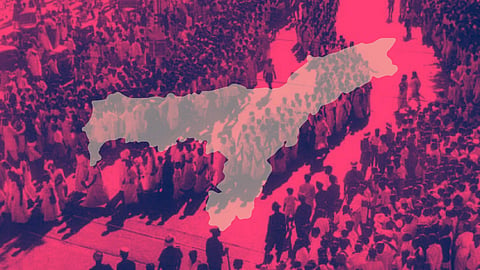

EXACTLY forty two years ago, on the morning of February 18, 1983, Sirajjudin was on his way back from the market, having stepped out to get a few essentials. As he drew closer to his village, he saw people running towards him, away from their homes and the village. Panic stricken, Sirajjuddin looked for his family, finally spotting his two sons cowering in a pond nearby. He hoisted the younger son upon his back, held his elder son by the hand and began running. On either side, he could hear shots being fired. As he pushed his way through the exodus, his elder son’s fingers somehow slipped out of his grip. He lost him to the stampede.
Soon after, Sirajjudin saw an Assamese man running after him with a sickle. Tired from carrying the child, and unable to keep up speed, soon the man had caught up with him. The man raised his sickle high into the air, and with one motion, cracked open his younger son’s skull. Letting the lifeless body drop, Sirajjudin somehow made it to the river, and escaped his pursuers. Around him, corpses dotted the land as far as he could see. He would revisit these harrowing memories to filmmaker Subasri Krishnan for her 2015 film What the Fields Remember. The Nellie massacre had begun, and would, over the course of six hours on February 18, 1983, take over 2000 lives. All of the victims were Bengali Muslims.
The Nellie Massacre is among the bloodiest pogroms in independent India, a cataclysmic ethnic cleansing exercise that was perpetrated by the hegemonic Assamese and minority Tiwa communities in the backdrop of the intense, anti-foreigner Assam Movement (1979-1985). The death toll is comparable to, if not higher than, the 2002 Gujarat riots. Yet, it occupies little space in Assamese and Indian public imagination today. Even as Nellie is seared into the memories of Assam's Bengali/Muslim population, it lies without acknowledgement, restitution, and reparation from the Assamese community.
