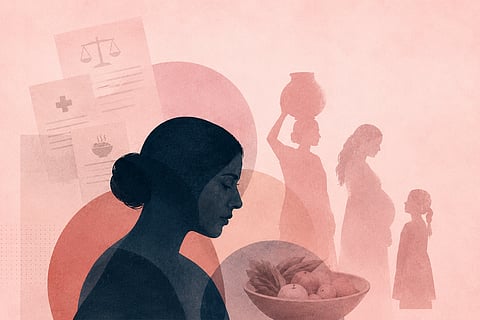

A NEW MONTHLY SERIES in The Leaflet, under the Asia Collective on Women’s Nutrition (‘ACTION’), explores women’s nutrition through a socio-legal lens, drawing relevant examples and lessons from South Asia countries. It asks a question we have too long avoided: not whether law promises nutrition to women, but whether those promises reach them.
Sethi and Murira (2025) helped us recall that South Asia still hosts 114 million underweight girls and women (50 percent of the global burden), while a rise in overweight and obesity now also affects 20 percent of this group in the region. They emphasized the fundamentals, poor maternal nutrition perpetuates multigenerational cycles of malnutrition and is caused by interrelated drivers rooted in social injustice—poverty, harmful social and gender norms, low status of women, and low women's self-efficacy are at play alongside the harsh realities of gender segregation in labor markets, wage gaps and time poverty. To compound these difficulties, as many as 28 per cent of young women are married as children in South Asia and three in four child brides give birth while they are still adolescents, with these girls experiencing compromised agency and increased risks to birth outcomes and for their own nutrition.
In May 2025, we published a set of papers in The Lancet Regional Health – Southeast Asia about a stretch of women’s lives that nutrition programmes tend to forget: the weeks and months before pregnancy begins. The papers laid out the evidence, the interventions that work, and a practical algorithm that a health or nutrition provider could use to care for women before, between and beyond pregnancies. A technical brief followed, turning the science into steps a frontline worker could use. But the longer we worked, the more one question stayed with us. The hard part was never about deciding what to deliver but whether the legal and programmatic systems that promise such care would reach the woman they were written for.
From a legal standpoint, there is no comprehensive provision that gives a woman a full package of nutrition care across her life course. At any real scale, very little reaches the underweight woman or the overweight woman with the kind of attention she needs from the public system. And the schemes that do exist tend to falter in exactly the places and circumstances where women need them most. A right you cannot actually reach is not yet a right but a promise still waiting on delivery.
