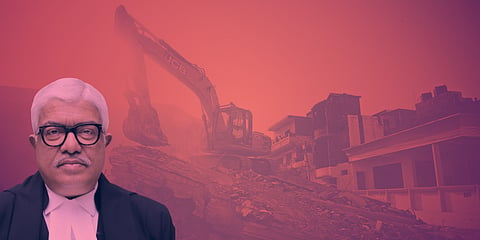

IN NOVEMBER 2024, the Supreme Court did something seemingly extraordinary. A bench of Justices B.R. Gavai and K.V. Viswanathan noted that punitive bulldozer demolitions “undermine[d] the rule of law”. “Can it be said that a person who is only accused of committing some crime or even convicted can be inflicted the punishment of demolition…?,” Justice Gavai asked, and answered himself, “The answer is an emphatic no.”
The judgment had seemed, at that time, as a rare moment of justice on a politically significant issue. By later that day, however, in conversation with a litigator friend who routinely did urgent filings on ‘demolition cases’, the anticipation dawned on us that punitive demolitions would likely continue, adapting around the judgment’s framework, especially due to its exclusion of public encroachments.
We were not far off. On March 17, 2025, for instance, after communal violence in Nagpur, a local Muslim activist was handed a demolition notice alleging that a portion of his house was an unauthorised structure. As months passed, the patterns of criminalisation, followed by demolitions, became more egregious – more and more cases emerged of those incriminated under ‘love jihad’ laws facing bulldozer action on their homes, their properties. This is also what happened to Aafan Khan, in UP’s Hamirpur recently. After being charged under UP’s new anti-conversion law, among other offences, Khan and his uncles were served a demolition notice for their home, and their saw mill and a commercial property were sealed – ‘destruction by mechanical means’, as court submissions would later describe.
Uttar Pradesh, incidentally, had recorded the highest number of incidents in which bulldozers had been deployed for punitive demolition, between 2019 and 2024, according to a Polis Project study. In the months following the Supreme Court’s judgment, those trends likely continued.
When Khan’s matter would have reached his court, Justice Atul Sreedharan would have likely not been ignorant of this. In October 2025, well along the kind of strange fate that followed Justice Sreedharan, he was inexplicably transferred from the Madhya Pradesh HC, where he was the senior most judge, to the Allahabad HC, at serial no. 7. Even as critics made links between his unceremonious transfer and his direction to file an FIR against a BJP minister for his hateful comments against a Muslim woman military officer earlier, the Collegium simply explained that it was on ‘reconsideration sought by the government’, explaining little as to how it was for the ‘better administration of justice’, the basis for transferring judges under Article 222.
Reading Justice Sreedharan’s order in Khan’s case from January 21, 2026, where he wrote that the Court was “a witness to several such cases where notice for demolition is issued ... .immediately after commission of an offence”, it seemed, ironically enough, that justice was indeed being administered better. The questions framed by the High Court – like whether the State’s authority to demolish justify its act of demolishing, whether the State was duty-bound not to demolish a dwelling without a public purpose, or whether demolitions following crimes was a ‘colourable exercise of executive discretion’ – could truly deepen the jurisprudence on India’s punitive demolitions. By reframing the questions as ones that centralise whether the State exercises an authority to demolish people’s home, Justice Sreedharan has possibly opened up a very innovative pathway to curb many of the circumlocutory ‘non-technical’ violations of the Supreme Court’s November judgment. Even more so, it could also possibly patch some of that judgment’s glaring omissions. Yesterday, the High Court part-heard the matter, with the next hearing listed for February 25. “No demolition of the properties without the further orders of this Court, shall take place”, the order notes. For now it certainly seems that as long as Justice Sreedharan holds court, it will stand witness.
At The Leaflet we write because we care. Please write back to us with your thoughts to editorial@theleaflet.in.
This newsletter was first sent to our subscribers. Get the Constitution First newsletter and our latest updates in your inbox by subscribing to The Leaflet.
We're bringing The Leaflet closer to you! Join thousands of readers on our new WhatsApp and Telegram channels. Stay informed, stay connected.
