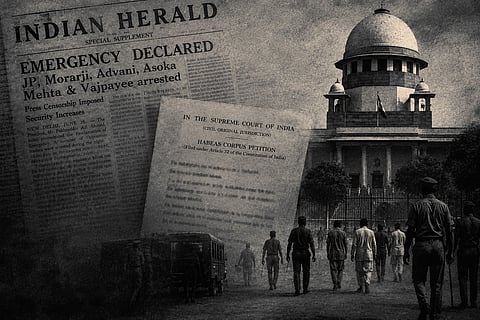

AFTER OBTAINING my law degree in 1973, I started my practice in the Banda district court, where two of my uncles practised: one was a lawyer on the civil and revenue side, and the other on the criminal side. After a year, I shifted to the Kanpur district court to practise with Barrister Narendra Jeet Singh. His wife had inherited property in Kashmir, and he used to visit there every year. At the end of a year, he invited me to spend the summer of 1975 in Srinagar, which I gladly accepted.
On the fateful night intervening 25–26 June, when the Internal Emergency was imposed, I was on a train on my way back to join my father’s chamber at Allahabad. I had flown from Srinagar to Amritsar from where I took a train to Delhi, and then caught an overnight train to Allahabad.
My father was a prominent Rashtriya Swayamsevak Sangh (‘RSS’) man. Our family and the family of Rajju Bhaiya (who later became the fourth Sar Sanghchalak of the RSS) were very close. We had our houses in the same compound. He used to come over to our house every day in the morning to read newspapers and often in the evening after attending the shakha.
After the Emergency was imposed, Rajju Bhaiya went underground to fight against the tyranny. My father was first arrested under the Defence of India Rules, 1962. He was granted bail but before he could come out of jail, he was detained under Maintenance of Internal Security Act, 1971 (‘MISA’), equivalent to the present National Security Act, 1980 (‘NSA’).
We filed a habeas corpus petition for my father’s release. The State raised a preliminary point regarding its maintainability. The matter was referred to a five judge bench. It was decided in our favour by four to one.

However, the State took the matter to the Supreme Court. This is how my involvement started with the habeas corpus case—the case that would make Justice H.R. Khanna, the greatest judge ever to adorn the Bench of the Supreme Court, and for whose honour the New York Times remarked that a statue should be erected in every city in India.
The issue before the Court
On June 27, 1975, two days after Emergency was imposed, the right to move the court to enforce Articles 14, 21, and 22 were suspended completely. This was for the first time, as on earlier occasions, they were suspended only for the people detained or arrested under specific enactments. Article 19 was already unavailable due to Article 358.
The State, in my father’s case as well as in all other habeas corpus petitions filed throughout the country, raised a preliminary objection about their maintainability. According to it, Article 21 was the sole repository of liberty; its enforcement was suspended; and no habeas corpus petition was maintainable.
The answer to the State’s contention lay in the concept of the ‘Rule of Law’.
The ‘rule of law’
The phrase ‘Rule of Law’ is said to be coined by A.V. Dicey in his book ‘An Introduction to the Study of Law of the Constitution’, first published in 1885, but he did not invent it. The idea underlying it has been in vogue since the beginning of civilization. It has many meanings and connotations including:
Power conferred on the executive must be exercised in good faith and for the purpose it is conferred;
Anyone exercising power must not go beyond or outside the limits of the power conferred—it is known by its Latin name, ultra vires or beyond the powers.
Every executive action which acts to prejudice of a person must have the authority of law to support it.
An illegal detention results in not only the violation of Article 21 but is a violation of the rule of statutory law as well.
Suspension of right to move for enforcement of Articles 14, 21 and 22 and non-availability of Article 19 only meant that:
The validity of any law could not be judged on the ground that it was in violation of Articles 14, 21, 22 or of a law made during emergency in violation of Article 19;
No habeas corpus could be filed for violation of Articles 14, 19, 21 & 22; and
No habeas corpus could be filed in the Supreme Court.
But this did not mean that a habeas corpus could not be filed in a High Court for violation of the rule of law. It was a simple proposition, understood by the seven High Courts, namely Allahabad, Andhra Pradesh, Bombay, Delhi, Karnataka, Madhya Pradesh, and Rajasthan. Though, some of them (except one) had dismissed the writ petitions on merits.
Before the battle began
Initially, Justice Khanna was not a part of the bench. The earlier bench consisted of the then Chief Justice of India (‘CJI’) A.N. Ray, Justice M.H. Beg, and three other junior judges. The lawyers for detenus felt that they might lose the case unless senior Judges were on the bench.
A delegation of senior lawyers, led by C.K. Daftary, met CJI Ray in chambers to change the bench to include senior judges to decide such an important and sensitive case. Piqued by the request, CJI Ray asked if it was proper on the part of the lawyers to make such a request. Pat came the reply from Daftary that such a request was entertained by Justice SR Das during his tenure as the Chief Justice.
There have been requests that a judge may recuse due to conflict of interest but one is not sure if the statement was correct or it was Daftary’s spontaneous brilliance. CJI Ray was an admirer of Justice Das. He changed the bench to one including the five senior most judges.
In seniority, Justice K.K. Mathew was next to Justice Khanna but he was not taken on the bench, as he was to retire shortly.
A day before the appeal was to be heard in the Supreme Court, the lawyers for the detenus met at Daftary’s residence to chalk out the strategy. There was some discussion as to who should lead the arguments.VM Tarkunde wanted to lead, as he had successfully argued before Delhi High Court but he had shown his reluctance to meet the CJI to change the bench. (The Delhi High Court in Bharti Nayar’s case had allowed the habeas corpus to release her husband Kuldeep Nayar, a well-known journalist. Though before the delivery of the judgement, his detention was revoked.)
Ram Jethmalani clinched the issue by saying Shanti Bhushan would lead. The meeting ended with Ram Jethmalani relating the latest joke in Bombay. He said, “The Supreme Court of Timbaktoo has decided that a prostitute can be a virgin with retrospective effects.”
“And the Government had submitted, it does not change the basic structure”, quipped Shanti Bhushan. The mood in the conference was buoyant. The question was difficult but there was no way that the Supreme Court could decide against us. Every High Court had decided in our favour as far as the maintainability was concerned.
But who can predict the future? With due apologies to Albert Einstein, ‘God does play dice.’
Recollections from the courtroom
The next day December 15, 1975 was a cold day. Niren De, the then Attorney General, began his arguments in the same fashion as the Government of those days was behaving, by bullying the Court.
I do not mean any disrespect, as now his voice is hushed, but he did create terror. There was so much terror that none of the judges asked any questions on the first day. On the second day, around noon time, Justice Khanna asked the first question. “Life is also mentioned in Article 21. Would the Government’s arguments extend to life as well?”
Without pause Niren De answered, “There is no halfway house. Even if life was taken away illegally, courts are helpless”. It is then that the others, such as Justices Y.V. Chandrachud and P.N. Bhagwati, started asking uncomfortable questions. We heaved a sigh of relief.
By the time the advocates for the Union Government and the State Governments finished their arguments, all effects of the first day had vanished. The mood of the court was cheerful and better.
When S.N. Kackkar stood his ground
At the start of the arguments, Attorney General framed two questions:
First, that Article 21 was the sole repository of the right to personal liberty; right to move to the court for its enforcement was suspended completely; in view of this, the habeas corpus was not maintainable. And second, in case the habeas corpus was maintainable then what was its scope. According to them, there was no scope as MISA was amended and no one was entitled to see the grounds of detention.
The Attorney General also laid down the procedure of the arguments. He would argue the first point followed by the Advocate Generals of the states then V.P. Raman, Additional Solicitor General would argue the second point followed by the Advocate Generals of the State. Niren De argued the first point followed by Advocate General for Madhya Pradesh and later S.N. Kackkar, Advocate General of Uttar Pradesh got up to argue. However, he did not limit his arguments to the first point but touched the second point as well. This was not liked by V.P. Raman.
V.P. Raman made a mention that S.N. Kackkar may not argue the second point as the procedure set by the Attorney General.
Kackkar very coolly, very softly but very firmly informed the Bench, “I am a foreigner to this court and not aware of its traditions but the High Court has decided against my client and I am up against that order. I have to act in the best interest of my clients unless I am told not to do so.”
No court, no authority, no law, no narrative (even by the Attorney General) can override the fundamental duty of an advocate, to represent his client to the best of his ability. CJI Ray appeared helpless, he pondered over for a second and said,“Mr. Advocate General, please proceed in the best interest of your client.”
When Justice Beg went too far
There was another lesson that I learnt. The advocate for the state of Madhya Pradesh cited Shearer v. Shields (1914), a case of Scottish origin for distinction between malice in law and malice in fact.
Justice Beg was born into a distinguished, wealthy family. His father, Mirza Samiullah Beg, was Chief Justice of Hyderabad. He studied at Trinity College, Cambridge, taking Honours in the Archaeological, Anthropological and Historical Triposes, then read law, economics and politics at the London School of Economics, and was called to the Bar by Lincoln’s Inn in 1941. His years in England left him with a taste for looking down upon the Scots.
When a case relating to persons of Scottish origin was cited, he made fun of them. This angered the counsel, who rebuked Justice Beg by saying that only people unaware of history made such statements. After that, Justice Beg. had nothing more to say. It was also a lesson for me: a judge should never belittle anyone and, if he crosses the limits, he may have to be reined in.
The written brief no one noticed
P.K. Tripathi was a member of the Law Commission of India. During the arguments, he moved an application for intervention in favour of the government, which was refused. He was asked to submit his arguments in writing. Lawyers in India are so used to oral advocacy that no one gives any importance to the written briefs. This proved fatal in this case; at least, so far as Justice Bhagawati was concerned.
Justice Bhagwati went on to pay high tributes to the novel submission of PK Tripathi. It is not clear if this novel submission was due to his jurisprudential genius or rather lack of it. But Justice Bhagwati cannot be blamed for this score. We all know that important cases are decided first and reasons are discovered afterwards!
A treasure from Sapru’s library
Shanti Bhushan led the arguments for the detenus. During the hearing, he cited a book. However, there was only one copy of the book available with the judges. This surprised him because the Supreme Court normally purchased five copies of every book for the use of the judges. He mentioned this to the Court.
CJI Ray replied,“It is a rare book. It is not available in the market. This book, and many other rare books, have come from the library of Sir Tej Bahadur Sapru, who donated them to our library.”
It was a moment of pride not only for me but for all the Allahabadis present in the courtroom.
Words no one could explain
Shanti Bhushan also cited some judgements of Justice Krishna Iyer. However, they used some words that were not part of any dictionary. CJI Ray asked him if he could explain their meaning. Shanti Bhushan, with a mischievous smile, said that he was educated in a Hindi medium school and perhaps the convent educated Attorney General could explain.
Niren De was sitting in the court. He got up and with a serious expression vehemently denied knowing their meaning. The result was that the Court refused to consider the rulings. I used to be fascinated by Justice Iyer. But from that day my fascination started waning. Another incident described below convinced me that the best language is simple, plain language rather than the one using difficult words.
Justice, liberty, and deaf ears
During this time, Lord Denning had come to India to deliver the V.V. Chitaley Memorial lectures. He delivered one each at Bombay, Nagpur and Delhi. I attended the one that was held in Delhi and was titled ’Let Justice Be Done’. All judges, including the members of the bench hearing the habeas corpus case, were present. The theme of the talk was, how judges in England, even at the displeasure of the executive, maintained the rule of law.
He did not read his speech; he had no notes; and he used simple words. We were spell bound. It was an inspiring talk and appeared as if he had purposely chosen the topic for the Delhi talk. He seemed to be exhorting the judges to side with rule of law; to side with liberty; to side with people of India. But, alas, it fell on deaf ears.
The Supreme Court reserved the judgement. We expected the appeals to be dismissed by three to two. However, when the judgement was not pronounced for a considerable lapse of time, resulting in the continuance of illegal detentions, an application was filed requesting that the judgement be pronounced or the stay order be vacated. It is only when this application was posted for hearing after a week that the doubts arose.
The judgement was pronounced on April 28, 1976. We lost the case by a four to one majority. The majority heavily relied upon an irrelevant House of Lords’ decision of Liversidge v. Anderson (1941).
An irrelevant precedent
The Liversidge case was decided during the lowest point of allied forces during the Second World War. Here, the point involved was, whether the words used “reason to believe” in Regulation 18-B be given subjective or objective interpretation.
The decision had nothing to do with the maintainability of the habeas corpus during Emergency or Articles 21 and 359. It was specifically overruled in Nakkuda Ali v. Jayaratne (1951) and there is a plethora of criticism about it in leading journals. It was strongly relied on by the State but was distinguished by the High Courts. Unfortunately, the majority view of the Supreme Court relied upon it, ignoring the Nakkuda Ali case as well as criticism of the judgement in the leading journals.
All judges wrote their separate opinion but in the end, wrote conclusions of the majority. Their first conclusion clearly stated that in view of suspension of right to move for enforcement of Article 14, 21, & 22, no habeas corpus or any other writ petition was maintainable. The High Courts dismissed all petitions.
But the judgement did not end the controversy; in many ways, it began a larger one.
ADM Jabalpur’s long shadow
In the normal course, all four puisne judges of the bench would have become Chief Justices of India but the judgement gave the impression that three judges (except Justice Khanna) gave judgements to secure their Chief-Justiceship. And true to this impression, after CJI Ray’s retirement, Justice Beg became the CJI superseding Justice Khanna. This led Justice Khanna to resign.
But then the equation changed. Elections were held and Indira Gandhi lost; Janta party came to power and Morarji Desai became the Prime Minister; and Shanti Bhushan the Union Law Minister.
Justice Beg went on to clarify in Re Shyam Lal (1978) that the common statement of a conclusion at the end of the judgements in the habeas corpus case was misleading; it was loosely and vaguely expressed.
Justice Y.V. Chandrachud J. gave a public apology, and Justice Bhagwati wrote the infamous letter to Indira Gandhi, when she returned to power in 1980.
Justice Beg was to retire on February 21, 1978. Despite strong objections, Moraraji Desai wanted to appoint Justice Chandrachud as the CJI. Jai Prakash Narayan, who was hospitalised in Bombay, was also opposed to his appointment. Shanti Bhushan was sent to Bombay to convince him and later Justice Chandrachud was appointed CJI. Perhaps, it was a wrong step. In my opinion, it damaged the independence of the judiciary more than anything else. It showed ambitious judges the way to climb the ladder of success.
But it has another lesson as well.
Justice Khanna must have known the consequences of his dissent. Personally, it must have been a hard decision. It is said that ‘hard cases make bad law’. Ronald Dworkin, perhaps the greatest jurist of our era, modified it to,’hard cases make great judges.’ The habeas corpus case proved him right. It showed who was a great judge.