
“And these are your motives, my lord?”
“Do you think I have others?” said Lord Vetinari. “My motives, as ever, are entirely transparent.”
Hughnon reflected that “entirely transparent” meant either that you could see right through them or that you couldn’t see them at all.
Terry Pratchett, The Truth (2000)
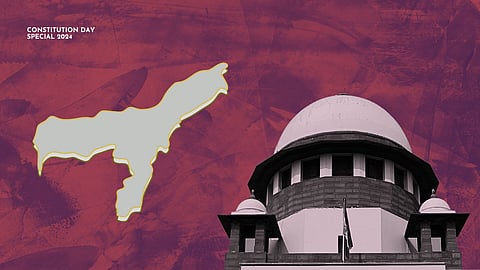
THE Supreme Court’s recent judgment In Re Section 6A of the Citizenship Act of 1955 (Re 6A) demonstrates that the court is only ever as restrained as it wants to be. Sometimes, its motives are blatant. Sometimes, its motives are incomprehensible.
In affirming the constitutionality of Section 6A, the court majority [Justice Surya Kant, writing for himself, and Justices M.M. Sundresh and Manoj Misra (majority); and the Chief Justice of India (CJI) (as he was then) Dr D.Y. Chandrachud (concurring)] asserts its unwillingness or inability to interfere in questions of policy.
Yet, the majority reaffirms and rearticulates its judgment in Sarbananda Sonowal versus Union of India (Sonowal I), and in its Order delves back into questions of policy design and enforcement.
Many of the grounds advanced by the petitioners and correctly rejected by the court could have had dangerous or disastrous consequences. But the court remains unable or unwilling to restrain itself from intervening in complex policy questions, to recognise the limits of its competence, or to understand that its language and interventions may further inflame intolerance and injustice in Assam.
This article explores the court’s approach to these issues in Re 6A.
Section 6A of the Citizenship Act
Section 6A of the Citizenship Act of 1955 was enacted in 1985, in order to give legislative force to the Assam Accord. It provides for two cut-off dates. Residents of Assam who arrived in India after January 1, 1966 and before March 25, 1971 are permitted to retain their citizenship but are not permitted to vote for a 10-year period (after determination of the date of their arrival).
Residents of Assam who arrived in India after March 25, 1971 are stripped of their citizenship and are liable to detention and deportation. Given the intensely virulent anti-Bengali and anti-Muslim sentiments that the political leadership of Assam is propagating today, it is essential to understand the historical and political factors that went into the crystallisation of these dates within the framework of the law.
The colonisation of the northeastern region led to the complete breakdown of the social relations between the diverse communities rooted in the region, including Muslims whose presence in the state can be traced to the early 13th century.
In the early 20th century, the British encouraged, among others, Bengali-Muslim peasants from Eastern Bengal to migrate to India to cultivate what they called “wastelands”— not in any ecological sense, but in the sense of land that had not yet been cultivated.
This flow contributed towards the apprehensions of a rising ethnonationalist movement in the state. It was not long before even official documents were referring to the Bengali Muslims as a scourge: notoriously, a British civil servant referred to them as a “horde of land-hungry Bengali immigrants, mostly Muslims” in 1931.
Following this, two cataclysmic events led to sweeping waves of migration in the regions— first, the Partition of 1947, and second, the war that led to the creation of Bangladesh.
Each tragedy led to the death and displacement of hundreds of thousands of people. Due to Assam’s geographical proximity, there were significant flows of Bengali migrants— Hindu and Muslim— into the state, who then, by most accounts, quickly assimilated into the local population. Quick on the heels of Partition, the state government enacted the Immigrants (Expulsion from Assam) Act, 1950 in response to the scale of migration.
Ethnonationalist insecurities had been fermenting in Assam for decades. In 1979, they erupted into a mass agitation in the form of the Assam Andolan, a student-led movement aimed at the “detection, deletion (from electoral rolls) and deportation” of Bengali Muslims from Bangladesh.
The movement brought economic activity to a standstill as its leaders called for Assam to be declared as being only for the Assamese. This soon took a turn towards ethnic cleansing, with over 3,000 Bengali Muslims being massacred in a period of six hours in a village called Nellie in 1983.
In 1985, the leaders of the agitation and the Union government finally agreed on a cut-off date and embedded it in the terms of the Assam Accord. This is where Section 6A finds its roots.
Amid these insecurities, Assam’s Bengali Muslim community is largely impoverished and acutely low on human development indices. To borrow Judith Butler’s phrase, they live at the edge of precarity, with their lives being rendered ‘ungrievable’.
The Constitutionality of Section 6A
The petitioners in Re 6A challenged the constitutionality of Section 6A on various grounds. That the clause prized ‘global’ fraternity over fraternity among Indians (contrary to the Preamble to the Constitution). That the clause lacked intelligible differentia to justify its ‘unequal’ application solely to Assam. That it was manifestly arbitrary and hence contravened Article 14. And that the clause violated the duty imposed upon the Union government by Article 355 to protect States against ‘external aggression’ by failing to protect (and encouraging) illegal immigration into Assam.
The petitioners relied upon Sonowal I, in which the court struck down the Immigrants (Expulsion from Assam) Act, 1950— both because it applied only to Assam and, in the court’s analysis, because it failed to effectively detect alleged ‘foreigners’ and hence to check what the court characterised as the “external aggression” of illegal immigration into Assam.
In doing so, the court in Sonowal I relied upon exceptionally dubious sources— a report by S.K. Sinha, the former governor of Assam, in which he alleged that Muslim immigration into Assam threatened to sever the Northeast from India (as discussed in more detail below); the US Supreme Court’s judgment in Chae Chan Ping versus United States, in which the court supported a ban on Chinese immigration into the United States; and the xenophobic ranting of the aged Lord Denning, in which he claimed that England had been “invaded … by those who seek England as a haven”.
In Re 6A, the court rejected these contentions— and it was correct to do so. But in reaching that conclusion, the court remained captive to the disastrous legacy of Sonowal I and the court’s history of thoughtless, prejudiced and harmful policy interventions in Assam, including its active role in designing and implementing the National Register of Citizens (NRC) process under the former CJI Ranjan Gogoi.
In Re 6A, the majority explains at length why the court should be slow to intervene in policy formulation by the State, even while acknowledging that legislation is not immune from review simply because it implements policy.
A key factor in the court’s rejection of the petitioners’ challenges under Articles 14 and 355 is that Section 6A is how the Union government has attempted to implement the Assam Accord, and that both the terms of that accord and how it is implemented are ultimately matters for the executive and Parliament to determine.
And yet, the court resists attempts by the respondents to limit Sonowal I to a mere application of Article 14 (not Article 355) and works within the logic of that judgment— including continued reliance on the Sinha report, a reaffirmation that “unabated migration if it poses a threat to the security of the State” can constitute “aggression” under Article 355, and, contrary to the respondents’ submissions, continuing to insist that the court can strike down statutes based on its own interpretation of what Article 355 demands.
CJI Chandrachud identifies the “disastrous consequences” of challenging a legislative enactment for contravention of Article 355— and yet does not grapple with the fact that that is exactly what happened in Sonowal I.
Sonowal I is replete with policy choices and interventions— about what constitutes ‘external aggression’ into India, about the best way to balance competing interests in determining who is a citizen of India, about the appropriateness of a distinct citizenship determination regime operating only in Assam.
As discussed later in this piece, these choices are informed by the court’s fixation on the spectre of infiltration and demographic change. Weaving xenophobic obsessions into Indian jurisprudence, the court wears its motives on its sleeve.
The court cannot at once acknowledge the limits of its role and its competence and continue to reaffirm and bolster Sonowal I; it needs to reckon with the fact that its attempts to decide the ‘right’ way to implement the Assam Accord in Sonowal I, and its attempts to determine the ‘correct’ way to determine who is a citizen and who is not (including through CJI Gogoi’s work in supervising the NRC process), have inflicted extraordinary damage.
But the court has not had that reckoning. Instead, it cannot resist touching the hot stove of policy. The majority continues to maintain that the Union has failed to properly enforce Section 6A or to prevent “persistent immigration in the State of Assam post-March 25, 1971”.
As a result, the court directed that the court’s previous directions in Sonowal I must be implemented in order to deport ‘illegal immigrants’. It also directed that the current statutory machinery and tribunals involved in “the identification and detection of illegal immigrants or foreigners in Assam” are “inadequate and not proportionate to the requirement of giving time-bound effect” to Section 6A.
It further directed that the implementation of immigration and citizenship legislation “necessitat[es] constant monitoring by the court”, under a Bench constituted for that purpose.
In Re 6A, the court takes no clear or comprehensible approach to the limits of its own competence.
Language and the law
The language that courtrooms use is a useful window into the structural issues embedded within the judicial system of Assam, which is itself ingrained in the larger societal rhetoric that vilifies and villainises Bengali Muslims as the ‘other’.
The language that judges use reflects their position in a hegemonic power structure, often rooted in majoritarianism. In Re 6A, the petitioners and the court relied extensively on Sonowal I. It is worth examining some of the discourses underlying this judgment, and how they are replicated in Re 6A.
The idea that Muslims are at the root of the population explosion and that they have caused sharp demographic changes in Assam continues to dominate political discussion.
While such outright Islamophobia has become a part and parcel of the current dispensation’s goals under Hindutva, the judges in Sonowal I (Justices R.C. Lahoti, G.P. Mathur and P.K. Balasubramanyan) rely upon and quote equivalent claims within the S.K. Sinha report:
“The growth of the Muslim population has been emphasised in the previous paragraph to indicate the extent of illegal migration from Bangladesh to Assam because as stated earlier, the illegal migrants coming into India after 1971 have been almost exclusively Muslims.
“Pakistan’s ISI has been active in Bangladesh supporting the militant movement in Assam… Muslim militant organisations have mushroomed in Assam and there are reports of some 50 Assamese Muslim youths having gone for training to Afghanistan and Kashmir.”
This reads less like a comprehensive account of border security emerging from the highest judicial body of the country and more like jingoistic alarmism. The court’s uncritical quotation of these paragraphs from the Sinha report legitimised and replicated these discourses.
In Sonowal I, the court fixated upon the security concerns it saw emerging from the looming spectre of ‘invasion’ by ‘illegal Bangladeshis’. The court used the word ‘Bangladeshi’ as loosely applicable to all those who have Bengali Muslim roots, abundantly clear in the conflation of ‘Muslim’ (the word “Muslim” features 20 times in the judgment) with the body of the ‘illegal’. In particular, Sonowal I uncritically extracted and relied upon assertions from the Sinha report predicting a dire future for the Assamese: